Powerful Cyclone Mekunu leaves at least 1 dead, 40 missing in Oman and Yemen
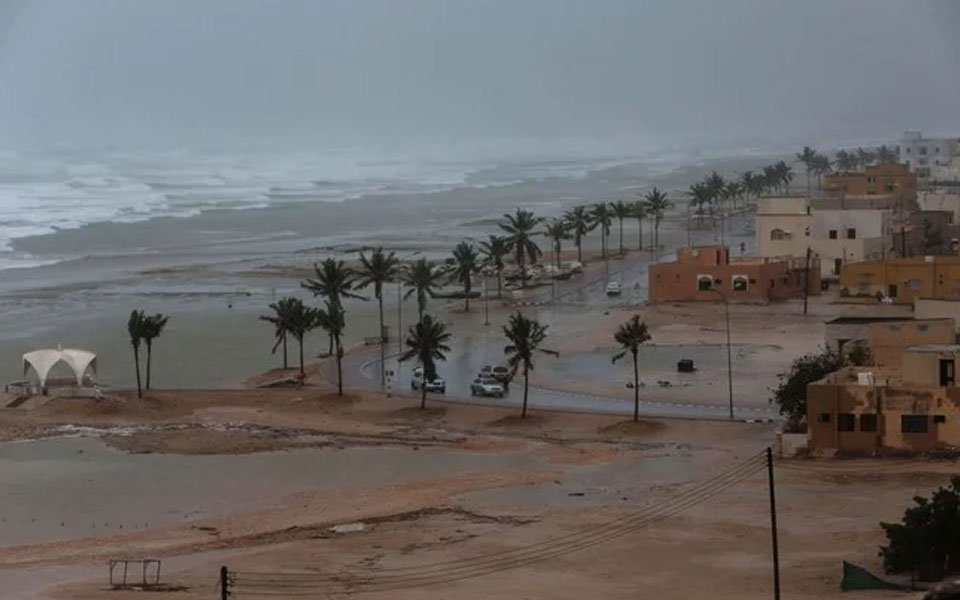
SALALAH, May 26 : Cyclone Mekunu blew into the Arabian Peninsula early Saturday, drenching arid Oman and Yemen with rain, cutting off power lines and leaving at least one dead and 40 missing, officials said.
Portions of Salalah, Oman’s third-largest city, lost electricity as the cyclone made landfall. The Arabian Sea angrily churned Saturday morning, sending mounds of sea foam into the air. The waves ate into one tourist beach, pulling hunks of it away and toppling thatch umbrellas cemented into the sand.
As Mekunu barreled overhead, the eye of the storm provided a moment’s respite. At one luxury hotel, which already had evacuated its guests, workers sat down early for a traditional “suhoor,” a meal Muslims eat before sunrise during the holy fasting month of Ramadan. They laughed and shared plates by flashlight in a darkened ballroom, the cyclone’s wind a dull roar behind their clatter.
At least one person, a 12-year-old girl, died in Oman and 40 others are missing from the Yemeni island of Socotra, which earlier took the storm’s brunt, police said. Yemenis, Indians and Sudanese were among those missing on the Arabian Sea isle and officials feared some may be dead.
Director of Meteorology at the UAE weather center, Mohamad Al-Ebri, told Arab News on Friday that the cyclone is expected to reach the southern coast of Oman within the next 12 hours, however it is possible that by then the cyclone category would have gone down to level one again.
India’s Meteorological Department said the storm packed maximum sustained winds of 170-180 kilometers (105-111 miles) per hour with gusts of up to 200 kph (124 mph). It called the cyclone “extremely severe.”
Many holidaymakers fled the storm Thursday night before Salalah International Airport closed. The Port of Salalah — a key gateway for the country — also closed, its cranes secured against the pounding rain.
James Hewitson, general manager of the five-star hotel Al-Baleed Resort Salalah by Anantara, told Arab News they were expecting the situation to worsen over the coming days.
“The wind has picked up since this morning.”
He said the hotel staff were preparing for the worst outcome, ensuring there was enough fuel to power the generators, should the main electricity supply be cut.
“We have taken all precautions in terms of securing all areas of the building to keep our guests safe,” Hewitson explained.
He said the hotel was well stocked for food and water and that at least one of the restaurants would remain open.
“We have about 50 guests staying with us at the moment,” Hewitson told Arab News. “Some are leaving tonight, some have chosen to leave and we are offering to compensate them with our sister hotels across Oman”
“At the end of today I expect I will have something between 40 to 50 guests staying… We have 250 staff members.”
He explained that representatives from the Ministry of Tourism had visited in the morning.
“We have already taken down our outdoors furniture, and anything that is not bolted down has been put away so that the winds don’t blow them into anyone and hurt people like glass tables or umbrellas.”
And he added that Muscat civil defense had sent a team to support in Salalah. “We have taken all precautions in terms of securing all areas of the building to keep our guests safe.”
Let the Truth be known. If you read VB and like VB, please be a VB Supporter and Help us deliver the Truth to one and all.
Allahabad HC orders probe into 'reinstatement' of teacher in UP's Barabanki
Lucknow (PTI): The Lucknow Bench of the Allahabad High Court on Friday ordered a probe by the special task force (STF) into alleged irregularities in the rejoining of a teacher at City Intermediate College in Barabanki, observing that the reinstatement appeared to be prima facie illegal.
The court also directed the recovery of the salary paid to the teacher during the disputed period.
A bench of Justice Rajeev Singh passed the order on a petition filed by the college management committee. The court expressed doubts over the roles of the District Inspector of Schools (DIOS), Barabanki, the college principal and the teacher concerned and hence, directed a detailed inquiry into the matter.
Taking note of alleged manipulation of records and misleading submissions, the court ordered the immediate transfer of the Barabanki DIOS to ensure a fair probe. It also directed the initiation of disciplinary proceedings against the then joint director of education of the Ayodhya division.
In its order, the court found that the teacher, Abhay Kumar, was initially appointed as an assistant teacher in 2018 but joined an Eklavya Model Residential School in Chhattisgarh as a lecturer in June 2024 without obtaining permission from the management. His subsequent request to retain the lien was rejected.
Despite this, he was allowed to rejoin the Barabanki College in September 2025 on the directions of the joint director of education and the DIOS, and was even paid the salary for October 2025. The court termed the rejoining "wholly illegal" and lacking any legal basis.
The bench also expressed concern over lapses in communication within the education department and directed the Uttar Pradesh chief secretary to ensure that official orders are communicated through email and WhatsApp as well, to prevent disputes.
The matter is next listed for hearing on May 28 when a compliance report is sought.