Quality, global engagement are top strategic priorities of Gulf Medical University
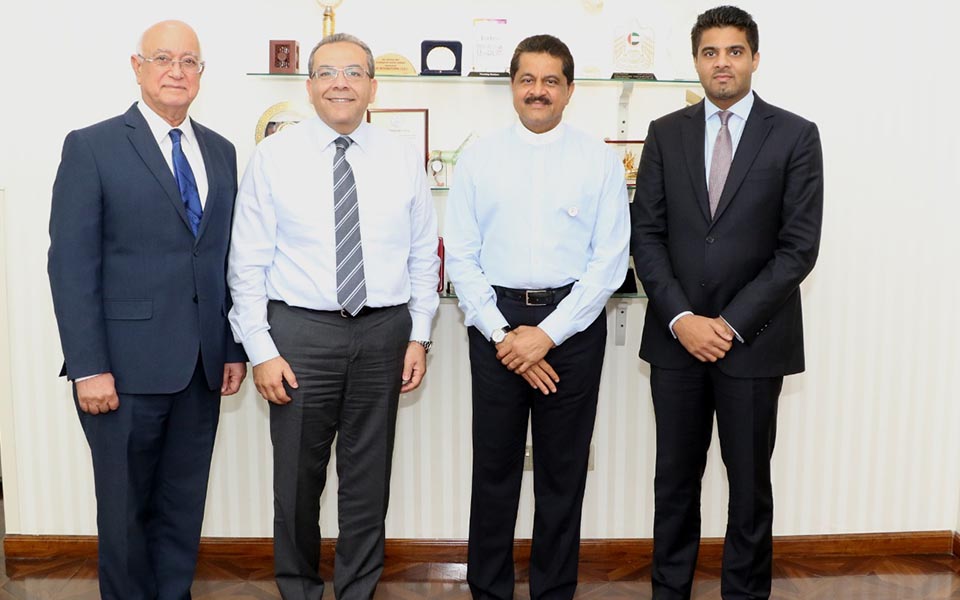
Ajman: Advancing its strategic objectives aimed at producing global medical professionals of the future, the leadership of Gulf Medical University (GMU), Ajman, one of the leading medical universities in the region, has initiated a series of measures to enhance quality and global engagement; two of its top strategic priorities. To this end, the Board of Trustees of GMU headed by Dr. Thumbay Moideen, Founder and President, recently appointed Prof. Sherief Khalifa, the Dean of GMU’s College of Pharmacy as the University’s Vice Chancellor for Quality and Global Engagement.
The new Vice-Chancellor will be instrumental in taking forward the University’s quality and internationalization initiatives, particularly related to the management of improvement projects as well as undertakings and collaborations of strategic importance that support the University’s strategic objectives. “The Board of Trustees is happy to announce the appointment of Prof. Sherief Khalifa as Vice Chancellor for Quality and Global Engagement, in view of Gulf Medical University’s growing strategic partnerships with 60+ universities worldwide, and the increasing numbers of national/international accreditations for various programs. Today, GMU is respected far and wide for our deep commitment to making a difference in the fields of medical education, healthcare and research,” Dr. Thumbay Moideen, Founder, President – Board of Trustees, Gulf Medical University.
Apart from the University’s continued focus on quality enhancement with regard to improving the teaching and training methodologies/technologies and student academic performance, the quality aspect would also seek to analyze and program outcomes and identify/prioritize areas requiring improvement. The global engagement aspect would facilitate the development of strategic partnerships and collaborations with international universities and institutions, facilitating student/faculty exchanges and exchanges and cooperation in academia and research. These are in addition to the University’s efforts to enable the students to get a global experience, and facilitating mobility throughout their student and professional lives.
Congratulating the new vice chancellor, Prof. Hossam Hamdy, Chancellor of GMU said, “Medical education worldwide has transformed significantly in recent years, moving beyond classroom lectures, to technology-intensive training and hands-on learning. GMU not only uses technology, but we also produce technology to actively improve the quality of learning, giving our students a distinctive edge as they step out into the professional world. We have developed partnerships with several international universities and research institutions, which have been crucial to our students acquiring global perspective and employability. With his extensive career as an outstanding academician, I am confident that Prof. Sherief Khalifa is well placed to support GMU’s journey ahead, in our mission to produce healthcare professionals of the future.”
Prof. Sherief Khalifa has many years of experience in higher education in the Middle East region. He had joined the College of Pharmacy at Gulf Medical University in August of 2017 as Professor and Dean. He was appointed as a member of ACPE’s International Services Program for a two-year term (2018 – 2019). ACPE (Accreditation Council for Pharmacy Education) is one of the leading international agencies in quality assurance of pharmacy education.
Let the Truth be known. If you read VB and like VB, please be a VB Supporter and Help us deliver the Truth to one and all.
Two brothers drown while swimming in lake in Kolar district
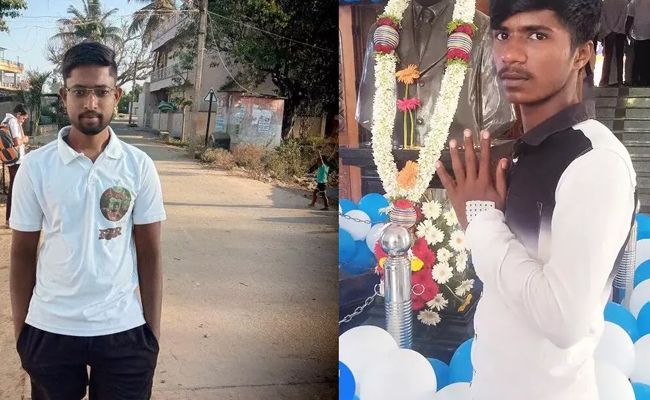
Kolar: Two brothers died after drowning in a village lake near Paccharamakalahalli in Srinivaspur taluk of Kolar district.
The deceased have been identified as Narendra (25) and Chandan (23), residents of Champalli in Ronur hobli.
According to sources, the two had come to Paccharamakalahalli, which falls under the Lakshmipura Gram Panchayat limits, for manual labour work.
They reportedly entered the lake to swim and cool off from the intense afternoon heat but drowned in the water.
The incident occurred within the jurisdiction of the Rayalpad Police Station.