Rex Tillerson stopped Saudi and UAE from 'attacking' Qatar
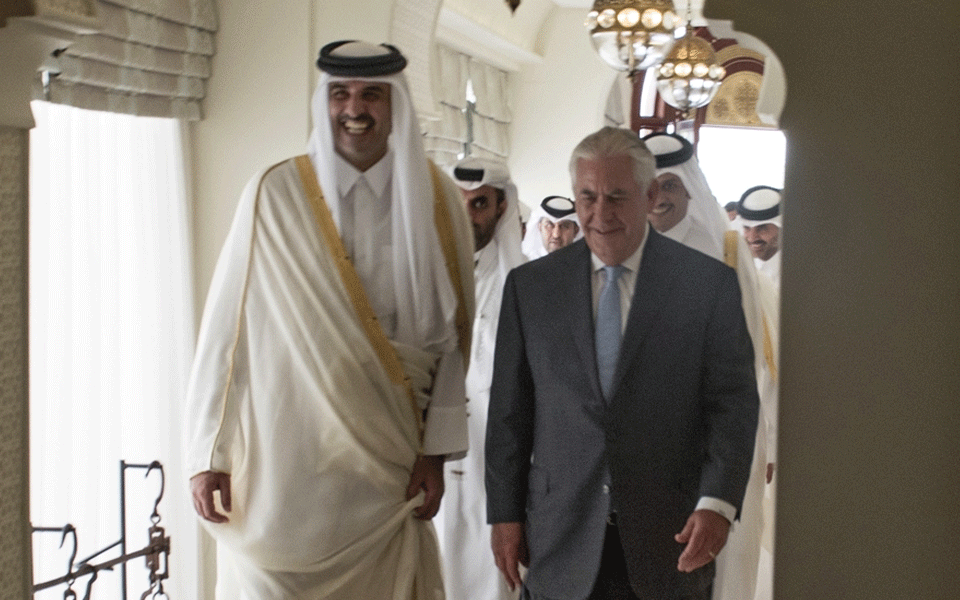
Saudi Arabia and the United Arab Emirates planned to launch a military operation against Qatar at the beginning of a diplomatic crisis that erupted in June last year but were stopped by former US Secretary of State Rex Tillerson in an act that may have played a key role in his dismissal.
According to the investigative news website The Intercept, the plan involved Saudi ground troops crossing the land border into Qatar, and with military support from the UAE, advancing 100km inland and seizing the Qatari capital.
Based on information it said it received from a current member of the US intelligence community and two former Department of State officials, The Intercept said the coup, which was largely devised by Saudi Arabia and the UAE's crown princes, "was likely some weeks away from being implemented".
It said the attack against Qatar's emir, Sheikh Tamim bin Hamad Al Thani, would have involved Saudi forces circumventing the Al Udeid Air Base, which is home of the US Air Force Central Command and some 10,000 American troops, and seizing Doha.
Al Udeid serves as one of the US' most important overseas military bases and carries out operations throughout the Middle East.
However, after Tillerson was notified of the plan by Qatari intelligence officials, he reportedly urged Saudi Arabia's King Salman not to carry out the attack and also encouraged Defense Secretary James Mattis to explain the dangers of such an invasion to his counterparts in the kingdom, it said.
Pressure from Tillerson caused Mohammed bin Salman, also known as MBS, to back down, who was concerned that the invasion would damage Saudi Arabia's long-term relationship with the US.
Long-standing rivalry
However, Tillerson's intervention reportedly enraged Mohammed bin Zayed, also known as MBZ, with the crown prince of Abu Dhabi and de facto ruler of the UAE, subsequently lobbying the White House for Tillerson's removal.
MBZ has had a long-running rivalry with Qatar and supported a failed coup against the Qatari government in 1996 when he served as chief of staff of the UAE armed forces.
The Intercept said none of the current or former officials interviewed by The Intercept had direct insight into why Trump decided to fire Tillerson, but one source said that the timing - a week before the Saudi crown prince arrived in Washington for a much-publicised visit - was significant.
Tillerson, a former executive for the energy company Exxon, had repeatedly criticised the blockading countries for the crisis before his dismissal, and in October last year, accused them of heightening tensions.
"There seems to be a real unwillingness on the part of some of the parties to want to engage," Tillerson said at the time.
"It's up to the leadership of the quartet when they want to engage with Qatar because Qatar has been very clear - they're ready to engage."
Emirati influence over Trump
Tillerson has not given any interviews since he was replaced with Mike Pompeo, but is believed to have disagreed on a number of issues with President Donald Trump, including the blockade of Qatar.
According to one news report, Tillerson was frustrated with Trump for endorsing the blockade, with his aides suspecting that a line in the president's speech where Qatar was accused of funding terrorism at a "very high level" had been written by the UAE's ambassador, Yousef al-Otaiba.
Otaiba is a well-known figure in US national security circles, and according to Politico maintains "almost constant phone and email contact" with Trump's son-in-law Jared Kushner.
The Intercept also reported that four of the sources it interviewed pointed to an ongoing campaign by the UAE to try to provoke Qatar into escalating the crisis.
The UAE has made it illegal for people to express sympathy with Qatar on social media, meanwhile Emirati officials, with close links to its leadership, repeatedly hurl insults against Qatari women.
Saudi Arabia, the UAE, along with Egypt and Bahrain severed diplomatic and trade links with Qatar on June 5, accusing Doha of supporting "extremism and terrorism" and cosying up to Iran.
Qatar has vehemently denied all allegations.
The quartet subsequently ordered Qatari nationals to leave their countries, and also urged their citizens to return to their respective nations, disrupting the lives of thousands in the region and restricting their freedom of movement.
According to several media reports, the four countries want Qatar to join a regional alliance against Iran and normalise relations with Israel.
Qatar's emir has denounced all of the attempts to infringe on the Gulf nation's sovereignty and rejected all of their demands.
Courtesy: www.aljazeera.com
Let the Truth be known. If you read VB and like VB, please be a VB Supporter and Help us deliver the Truth to one and all.
Axar shifts focus to next IPL after KKR all but end DC's campaign

New Delhi (PTI): A beleaguered Axar Patel admitted that both his team's batters and bowlers let the side down after Delhi Capitals suffered a humiliating eight-wicket defeat to Kolkata Knight Riders, virtually ending their IPL 2026 playoff hopes, while indicating the team had already begun looking ahead to the next season.
DC endured a miserable outing at home, managing only 142/8, which Kolkata Knight Riders chased down in just 14.2 overs, powered by a blistering unbeaten 100 from Finn Allen and his destructive stand with Cameron Green (33 not out) as the visitors tore apart the bowling attack.
With just eight points from 11 matches, DC are eighth on the table, while KKR revived their playoff hopes with a resurgent run, moving to seventh with nine points from 10 outings, though their road to the knockouts still remains difficult.
"For now, we'll go back and think about the mistakes we made. After that, obviously there's still a long journey ahead and next year will come too. So we'll think about what plans we can make for next year and what approach we should take," said Axar after the match.
"Based on that, we can also look at the players sitting on the bench and decide who can be given opportunities and what changes we can make," he added, hinting at a possible major overhaul next season.
With 200-plus totals becoming the norm this season, 142 was always going to be inadequate, and Axar admitted the score was well below par while also pointing out at poor judgement shown by the spinners while defending the modest total.
"I think the runs were definitely below par and at the same time the spinners made quite a few mistakes. Looking at the way the pitch behaved, I feel the spinners did make errors.
"At the same time, we lost five wickets in two-three overs, and I think that's where the momentum slipped away from us. That's probably something we need to think about because the same thing happened against CSK...we started well, and then suddenly wickets kept falling," he added.
He admitted the solutions to the issues could be found but players need to show the right mindset and character.
"See, you can't solve it in a complicated way. So, I think it's more about applying the right mindset. Even if you lose one or two wickets, you can still spend time at the crease and play through it. I think that's what needs to be applied, when wickets are falling in clusters, you need to absorb the pressure for an over or two," opined Axar.
KKR skipper Ajinkya Rahane was pleased to see a struggling Finn Allen finally rediscover his touch with the bat.
"I'm really happy for Finn Allen. He was struggling first four or five games, working really hard, but the way he batted tonight was fantastic. But I want to praise our bowlers again.
"We did well because of them. And they've been doing it so well consistently, especially those middle overs and the death overs. Our spinners, Sunil Narine, Varun (Chakravarthy) and Anukul Roy, have been fantastic," he said.
"Fielding-wise, yes, we are working really hard. Our fielding coach has been really strict with us. And that's what has been helping us. The result which you've been seeing about the catches and the ground fielding, credit goes to our fielding coach as well," he added.