Ruler of Ajman Humaid Bin Rashid Al Nuaimi hosts Ajman- based Businessman Dr. Thumbay Moideen
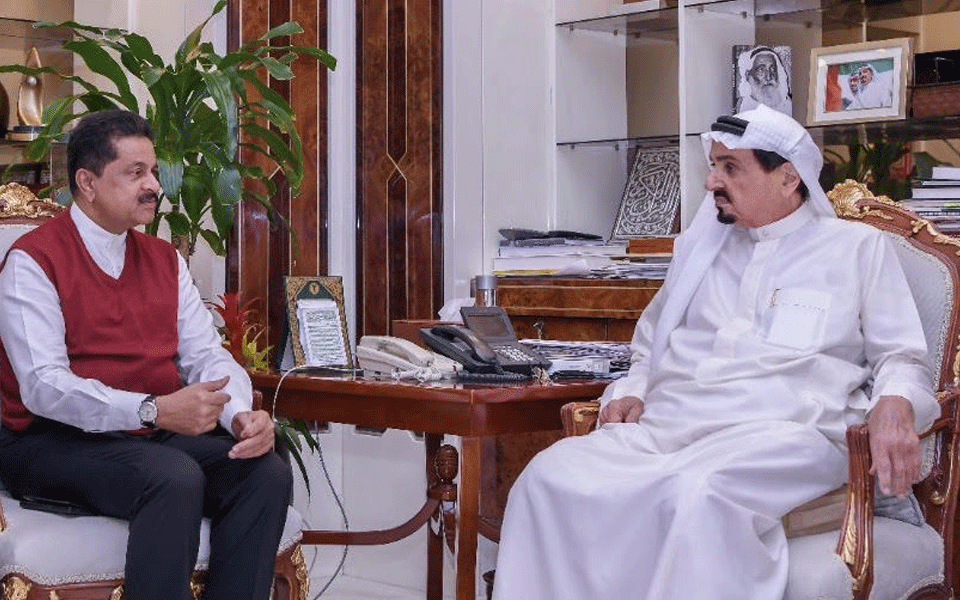
Ajman: His Highness Sheikh Humaid Bin Rashid Al Nuaimi, Member of the Supreme Council, UAE and Ruler of Ajman, received Dr. Thumbay Moideen, the Founder President of Thumbay Group at the Ruler’s Court on 27th January 2020. Dr. Thumbay Moideen briefed His Highness about the latest developments and progress of Thumbay Group, especially in the Group’s three pillars of Education, Healthcare & Research.
Dr. Thumbay Moideen thanked His Highness for all the support given to Thumbay Group and briefed him about the progress of Gulf Medical University, the 9 academic hospitals under the Thumbay Hospital network, 15 Thumbay Clinics, 5 Thumbay Labs and around 60 Thumbay Pharmacy outlets, as well as the group’s strategic plans for 2020 and the developments thereof. He also briefed His Highness about the recently launched Thumbay Medicity – a regional hub of cutting-edge medical education, healthcare and research.
Dr. Thumbay Moideen has been residing in the UAE since 22 years, from the inception of Thumbay Group. The group has grown into a diversified conglomerate with businesses in multiple sectors, serving patients from 175 nationalities, students from 86 nationalities and employing staff from over 50 countries.
Let the Truth be known. If you read VB and like VB, please be a VB Supporter and Help us deliver the Truth to one and all.
Mangaluru: Man sentenced to 20 years rigorous imprisonment in POCSO case

Mangaluru: A court in Mangaluru has sentenced a 44-year-old man to 20 years of rigorous imprisonment in connection with a case under the Protection of Children from Sexual Offences (POCSO) Act.
According to Deccan Herald, the Additional District and Sessions Judge, FTSC-II (POCSO), Maanu K S, delivered the judgment.
The convict has been identified as Dayanand Moolya (44).
According to Special Public Prosecutor Sahana Devi Boloor, the incident occurred on November 16, 2025, when a seven-year-old girl was studying alone at home and the accused illegally entered the house and raped her. He threatened to kill her and throw her into a well if she revealed it to anyone.
The survivor later informed her mother, following which a complaint was registered at Mulki Police Station on November 22. Police Inspector Manjunath B S investigated the case and submitted the charge sheet to the court.
For the rape, under POCSO Section 6, along with Bharatiya Nyaya Sanhita (BNS) Act 65(2) and POCSO 4(2), the man has been sentenced to 20 years of rigorous imprisonment and a fine of Rs 30,000. For illegal entry into the house, under BNS Section 332(B), the convict has been sentenced to three years of simple imprisonment and a fine of Rs 5,000. For issuing death threats, under BNS Section 351(3), he has been sentenced to two years of simple imprisonment and a fine of Rs 5,000.
The court also directed payment of Rs 4 lakh as compensation to the survivor, including Rs 40,000 from the fine amount, and instructed the District Legal Services Authority to provide the remaining Rs 3.60 lakh.