Saudi Arabia bans flights to and from India due to COVID-19 outbreak
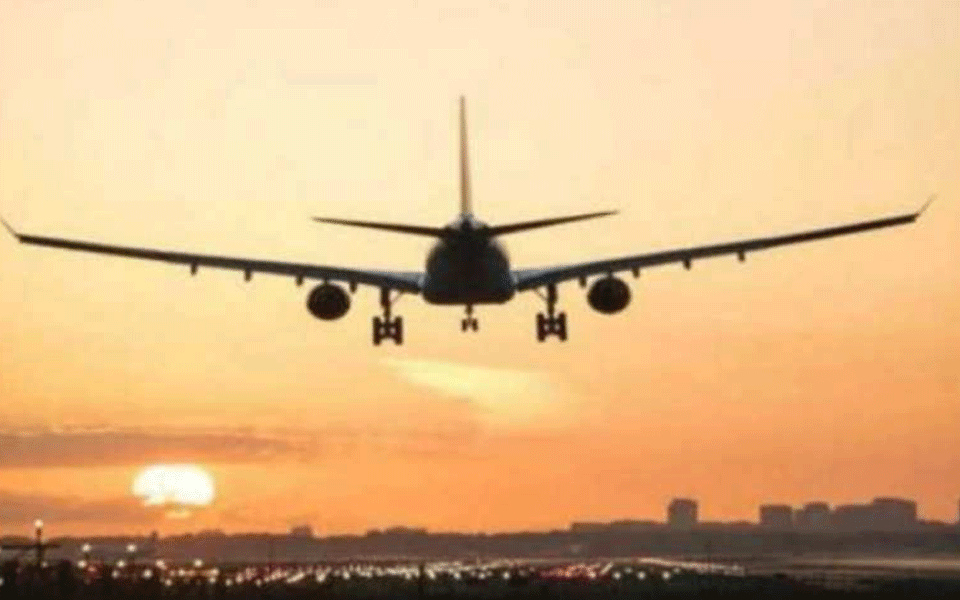
New Delhi: Saudi Arabia has banned flights to and from India from Tuesday amid a surge in coronavirus cases, according to an official document.
In a circular issued on Tuesday, Saudi Arabia's General Authority of Civil Aviation (GACA) said it was "suspending travel to and from the following countries: (India, Brazil and Argentina) including any person who has been in any of the mentioned countries above in the last 14 days prior to their arrival to the Kingdom".
However, it excluded "passengers who have official government invitations .
The GACA circular -- titled: Suspension of travel to countries where the COVID-19 virus has outbreak' -- was marked to all the airlines and chartered flight companies operating at the Saudi Arabia's airports.
Saudi Arabia and the UAE host a significant Indian migrant population.
Five days back, Air India Express had said the Dubai Civil Aviation Authority (DCAA) suspended its flights for 24 hours for bringing two passengers with COVID-positive certificates on August 28 and September 4.
Dubai is the most populous city of the United Arab Emirates (UAE).
Scheduled international passenger flights have been suspended in India since March 23 due to the outbreak. However, special international flights have been operating between India and Saudi Arabia since May 6 under the Vande Bharat mission.
India's COVID-19 caseload has reached 56,46,010, and the death toll has climbed to 90,020 with 1,085 people succumbing to the disease in the past 24 hours, the Health Ministry's data updated at 8 am Wednesday showed.
After one-day suspension for bringing passengers with COVID-positive certificates, Air India Express resumed its Dubai flights on Saturday.
According to rules of the UAE government, every passenger travelling from India is required to bring an original COVID-negative certificate of an RT-PCR test done within 96 hours prior to the journey.
Hong Kong has banned Air India flights from Sunday to October 3 after a few passengers on its flight on Friday tested positive for COVID-19 post arrival, a senior government official said on Sunday.
Air India passenger flights were barred from landing in Hong Kong between August 18 and August 31 after 14 passengers on its Delhi-Hong Kong flight of August 14 tested positive for COVID-19 post arrival.
Passengers from India can arrive in Hong Kong only if they have a COVID-19 negative certificate from a test done within 72 hours prior to the journey, according to rules issued by the Hong Kong government in July.
Let the Truth be known. If you read VB and like VB, please be a VB Supporter and Help us deliver the Truth to one and all.
'Sarke Chunar' row: Sanjay Dutt apologises; to sponsor education of 50 tribal girls
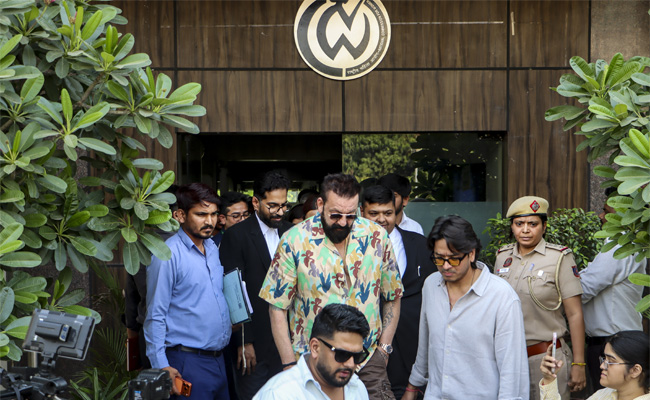
New Delhi (PTI): Actor Sanjay Dutt on Monday appeared before the National Commission for Women (NCW) in connection with the controversy over the song 'Sarke Chunar Teri Sarke' and submitted a written apology, expressing regret for any "unintended" harm caused to society.
During the hearing, held under NCW chairperson Vijaya Rahatkar, the commission raised concerns over alleged vulgarity and indecent representation of women in the song from the movie "KD The Devil" and questioned issues of intent, awareness and accountability.
The chairperson emphasised whether adequate due diligence was undertaken before participating in content that could be perceived as promoting objectification of women, while also underlining the responsibility of senior and influential public figures in ensuring that their work remains within the bounds of legal and societal standards.
As a corrective measure, Dutt committed to sponsoring the education of 50 tribal girl children as part of efforts towards social welfare and women's empowerment, the NCW said in a statement.
He also assured the commission that his future artist agreements would include mandatory legal due diligence provisions to ensure dignified and appropriate representation of women and children in films and related creative projects.
Actor Nora Fatehi, who was also summoned, could not appear as she is currently abroad and has sought a fresh date for the hearing.
On April 6, other individuals associated with the song, including director Kiran Kumar alias Prem, lyricist Raqueeb Alam and representatives of KVN Production Company Gautam K M and Suprith, appeared before the commission and submitted their apologies.
The NCW underscored that while artistic freedom is important, it must be exercised with responsibility and sensitivity, reiterating the need for accountability in content reaching wide public audiences and reaffirming its commitment to safeguarding the dignity and representation of women.
The Hindi version of the song, released on March 15 on YouTube, drew public ire for its sexually explicit lyrics.
After the outrage, the makers deleted the Hindi version of the song from YouTube, although it was widely played and shared across various platforms.
Fatehi, in a video later, distanced herself from the song, saying she shot the video for the Kannada version and her permission was not taken to use it in the Hindi version. The lyricist, singer and the director also apologised.
The issue was brought up in Lok Sabha during Question Hour by Samajwadi Party (SP) MP Anand Bhadoria last month.
Union Information and Broadcasting Minister Ashwini Vaishnaw said the song was already banned and the government was ready to take action against such vulgarity.
"KD The Devil" is a Kannada film, dubbed in four languages, including Hindi. It will release on April 30. The film features Dhruva Sarja, V Ravichandran, Ramesh Aravind, Shilpa Shetty, and Dutt.