Saudis say they don't want war, but will defend themselves
Dubai, May 19: Saudi Arabia does not want war but will not hesitate to defend itself against Iran, a top Saudi diplomat said Sunday amid heightened tensions in the Persian Gulf after attacks on the kingdom's energy sector.
Adel al-Jubeir, the minister of state for foreign affairs, spoke a week after four oil tankers two of them Saudi were targeted in an alleged act of sabotage off the coast of the United Arab Emirates and days after Iran-allied Yemeni rebels claimed a drone attack on a Saudi oil pipeline.
"The kingdom of Saudi Arabia does not want war in the region and does not strive for that... but at the same time, if the other side chooses war, the kingdom will fight this with all force and determination and it will defend itself, its citizens and its interests," al-Jubeir told reporters.
A senior Iranian military commander was similarly quoted as saying his country is not looking for war, in comments published in Iranian media on Sunday.
Fears of armed conflict were already running high after the White House ordered warships and bombers to the region earlier this month to counter an alleged, unexplained threat from Iran.
The US also has ordered nonessential staff out of its diplomatic posts in Iraq.
But President Donald Trump appears to have softened his tone in recent days, saying he expects Iran to seek negotiations with his administration. Asked on Thursday if the US might be on a path to war with Iran, the president answered, "I hope not."
The current tensions are rooted in Trump's decision last year to withdraw the US from the 2015 nuclear accord between Iran and world powers and impose wide-reaching sanctions, including on Iranian oil exports that are crucial to its economy.
Iran has said it would resume enriching uranium at higher levels if a new nuclear deal is not reached by July 7.
That would potentially bring it closer to being able to develop a nuclear weapon, something Iran insists it has never sought.
Energy ministers from OPEC and its allies, including major producers Saudi Arabia and Russia, are meeting in Saudi Arabia on Sunday to discuss energy prices and production cuts.
Iran's oil exports are expected to shrink further in the coming months after the US stopped renewing waivers that allowed it to continue selling to some countries.
OPEC and non-OPEC oil producers have production cuts in place, but the group of exporters is not expected to make its decision on output until late June, when they meet again in Vienna.
Saudi Arabia's King Salman, meanwhile, has called for a meeting of Arab heads of state on May 30 in Mecca to discuss the latest developments, including the oil pipeline attack.
The kingdom has blamed the pipeline attack on Iran, accusing Tehran of arming the rebel Houthis, which a Saudi-led coalition has been at war with in Yemen since 2015. Iran denies arming or training the rebels, who control much of northern Yemen, including the capital, Sanaa.
"We want peace and stability in the region, but we won't stand with our hands bound as the Iranians continuously attack. Iran has to understand that," al-Jubeir said. "The ball is in Iran's court."
Al-Jubeir also noted that an investigation, led by the UAE, into the tanker incident is underway.
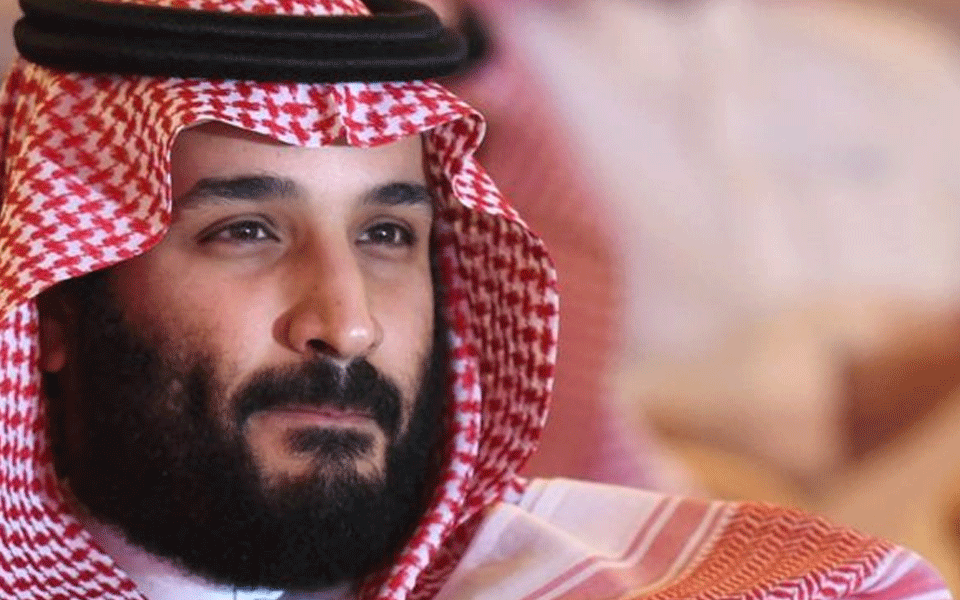
The state-run Saudi news agency reported Sunday that US Secretary of State Mike Pompeo called Saudi Crown Prince Mohammed bin Salman to discuss regional developments. There was no immediate statement by the State Department about the call.
An English-language Saudi newspaper close to the palace recently published an editorial calling for surgical US airstrikes in retaliation for Iran's alleged involvement in targeting Saudi Arabia's oil infrastructure.
The head of Iran's Revolutionary Guard, Gen. Hossein Salami, was quoted Sunday as saying Iran is not looking for war, But he said the US is going to fail in the near future "because they are frustrated and hopeless" and are looking for a way out of the current escalation.
His comments, given to other Guard commanders, were carried by Iran's semi-official Fars news agency.
Let the Truth be known. If you read VB and like VB, please be a VB Supporter and Help us deliver the Truth to one and all.
Over 17,000 people went missing in Delhi in 2024: NCRB

New Delhi (PTI): A total of 23,058 people, comprising 9,482 men and 13,576 women, were reported missing in Delhi in 2024, according to the latest National Crime Records Bureau (NCRB).
Of the total, 5,491 were children below the age of 18 — 1,571 boys, 3,920 girls.
The city recorded 17,567 fresh adult missing persons cases in 2024, comprising 7,911 men and 9,656 women.
According to the NCRB data, released on Wednesday, 14,637 men, 18,238 women and six transgender persons were still missing from previous years.
At the latest count, in 2024, Delhi had a total of 55,939 missing persons cases — 24,119 men, 31,814 women and six transgender persons.
In 2024, police traced or collected 28,392 missing persons, including 12,182 men, 16,208 women and two transgender persons.
Only half of the men and half of the women who went missing could be traced.
A total of 27,547 missing persons – 11,937 men, 15,606 women, four transgender persons — were yet to be untraced by the end of the year, the data showed.
The data also revealed that 5,352 children from previous years remained untraced at the beginning of 2024.
The number of still missing boys was 1,621, and the number of missing girls was 3,729. Two transgender children were yet to be found.
After adding the pending cases from previous years, the total number of missing children cases handled in 2024 rose to 10,843.
The police traced or recovered 6,762 missing children — 2,030 boys, 4,732 girls.
The recovery rate stood at 63.6 per cent for boys and 61.9 per cent for girls, while no transgender child was traced.
By the end of 2024, a total of 4,081 children remained untraced, 1,162 of them boys, 2,917 girls, and two transgender children.