Thumbay University Hospital performs its first advanced heart bypass surgery
Landmark off-pump CABG marks major milestone in cardiac care services
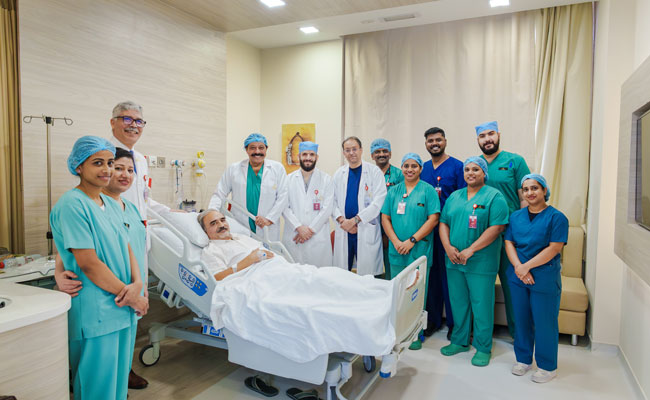
Ajman, UAE: Thumbay University Hospital has reached a significant clinical milestone with the successful completion of its first Coronary Artery Bypass Grafting (CABG) surgery, marking the launch of advanced cardiac surgical services at the academic medical centre.
The landmark procedure was performed on a 51-year-old patient, Syed Omer, who was diagnosed with severe ischemic coronary artery disease, including critical left main coronary artery stenosis, a high-risk condition that significantly restricts blood flow to the heart.
The patient also had diabetes mellitus, requiring precise peri-operative management and advanced cardiac care.
The surgery involved a double-vessel bypass using the off-pump (beating heart) technique, where the heart continues to beat during the operation without the use of a heart-lung machine. This approach reduces surgical stress on the body and is associated with faster initial recovery, fewer complications, and improved outcomes in selected patients.
The highly specialized cardiac surgery team under Dr. Khaled Farrag, Consultant of cardio thoracic surgery, successfully placed two grafts to bypass the blocked coronary arteries, restoring healthy blood flow to the heart muscle. The patient is back with his family and enjoying normal life with remote supervision.
A defining moment for academic healthcare
Speaking on the achievement, Akbar Moideen Thumbay, Vice President, Healthcare Division, Thumbay Group, said,“This first successful bypass surgery at Thumbay University Hospital is not just a medical achievement. It is the beginning of a new era of advanced cardiac care within our academic healthcare ecosystem. Every major hospital remembers its first open-heart case. For us, this moment reflects the depth of our clinical expertise, the strength of our infrastructure, and our long-term commitment to bringing complex, life-saving care closer to the community. It reinforces our belief that a university hospital must lead not only in education, but also in clinical excellence.”
Raising the standard of heart care
The successful CABG procedure confirms Thumbay University Hospital’s readiness to manage complex and high-risk cardiac conditions. The hospital’s cardiac programme is supported by advanced operating theatres, intensive care facilities, comprehensive cardiac diagnostics and an integrated emergency and rehabilitation framework.
For patients, this development ensures access to advanced heart surgery within a university hospital environment, supported by evidence-based practices, continuous academic oversight and multidisciplinary expertise.
Looking ahead
With this milestone, Thumbay University Hospital formally enters the field of advanced cardiac surgery, strengthening its position as an emerging academic medical centre delivering specialised, high-end clinical services aligned with international standards.
The hospital is expected to introduce additional cardiac procedures and specialised programmes as it continues to expand its clinical capabilities and subspecialty services.
For more information, visit thumbayuniversityhospital.com.
Let the Truth be known. If you read VB and like VB, please be a VB Supporter and Help us deliver the Truth to one and all.
AIITA welcomes Karnataka’s ban on obscene songs in school events
Bhatkal: The Karnataka unit of the All India Ideal Teachers Association (AIITA) has welcomed the Karnataka government’s decision to strictly ban school children from dancing to obscene songs during educational and cultural programmes in government, aided, and private schools across the state.
AIITA Karnataka State President M. R. Manvi congratulated the government for taking what he termed an important step to preserve the sanctity of education.
“Such decisions to safeguard the dignity of school children and uphold the values of education are the need of the hour. This rule should not be limited to government schools alone but must be strictly implemented in all private educational institutions as well,” he said.
He further urged the government to address other concerns within school programmes.
“The government should not only prohibit obscene dances in the name of school anniversaries, but also ensure that plays and dialogues that incite religious hatred are avoided. Schools should be centres of harmony, not platforms for spreading hatred,” he added.
According to a recent circular issued by the Department of School Education and Literacy, obscene dances are adversely affecting the mental health and moral values of students.
In this regard, schools have been advised to use songs that promote nationalism, positive thinking, the greatness of Kannada culture, and value-based traditions instead of inappropriate content during programmes.
The circular also emphasises that students should be dressed in decent attire.
AIITA also backed the department’s warning that disciplinary action would be taken against head teachers if such guidelines are violated. The association has further demanded that district Deputy Directors of Public Instruction strictly monitor the implementation of these rules.