UAE announces complete withdrawal of forces from Yemen amid rift with Saudi Arabia

Abu Dhabi: The United Arab Emirates on Tuesday declared that it would withdraw its remaining forces from Yemen, bringing an end to what it described as its “counterterrorism” mission, amid escalating tensions with Saudi Arabia over developments in the country’s south.
The announcement followed a demand by Yemen’s internationally recognised government, led by the Saudi-backed Presidential Leadership Council, that Emirati forces leave Yemeni territory within 24 hours. Riyadh publicly supported the call, deepening a rare public rift within the Saudi Arabia-led coalition that has been fighting Houthi rebels since 2015.
In a statement, the UAE Ministry of Defence said it had conducted a “comprehensive assessment” of its role in Yemen and decided to terminate the mission due to recent developments and their implications for the safety and effectiveness of its personnel. It said the withdrawal would be carried out in a manner ensuring the security of its forces.
Al Jazeera reported that the decision came hours after Saudi-led coalition aircraft struck the southern port city of Mukalla, targeting what Riyadh claimed was a weapons shipment linked to the UAE and intended for the separatist Southern Transitional Council (STC). Saudi Arabia said it viewed recent STC advances in the Hadramout and Mahara provinces as a threat to its national security, accusing Abu Dhabi of exerting pressure on the group to carry out military operations.
The STC, which had earlier fought alongside the internationally recognised government against the Houthis, launched a major offensive this month, seizing control of large areas of southern Yemen, including provinces bordering Saudi Arabia. The advances ended years of relative stalemate and triggered sharp warnings from Riyadh.
Saudi Arabia said any threat to its security was a “red line” and that it would take all necessary measures to counter such risks. Its concerns were echoed by Rashad al-Alimi, head of Yemen’s Presidential Leadership Council, who accused the UAE of directing and supporting the STC’s actions. Following the Mukalla strike, al-Alimi announced the dissolution of a defence pact with the UAE and ordered Emirati forces to leave within a day.
The UAE rejected the accusation, saying it was surprised by the Saudi air strike and maintaining that the shipment targeted in Mukalla did not contain weapons and was meant for Emirati forces, not the STC. It reiterated its commitment to Saudi Arabia’s security and said it was seeking a solution to prevent further escalation.
The Mukalla strike, which caused damage but no casualties, exposed widening fractures within the coalition formed nearly a decade ago to counter the Houthis. Emirati troops first deployed in Yemen in 2015, but the UAE had already drawn down most of its forces in 2019, retaining only a limited presence in government-held areas.
Saying both Saudi Arabia and the UAE reflected a commitment to regional stability and the principles of the Gulf Cooperation Council, Qatar welcomed their statements. Saudi Foreign Minister Prince Faisal bin Farhan also held calls with US Secretary of State Marco Rubio and Pakistan’s Deputy Prime Minister Ishaq Dar to discuss regional developments.
The STC spokesperson, Anwar al-Tamimi, said there was “no thinking about withdrawal” from areas it had seized, warning that any move against its forces would be met with a response. Meanwhile, Yemeni authorities imposed temporary air, sea and ground restrictions following the escalation, as uncertainty continued to surround the future balance of power in southern Yemen.
Let the Truth be known. If you read VB and like VB, please be a VB Supporter and Help us deliver the Truth to one and all.
Two injuries, one DNF, a DQ as India end messy World Relays campaign
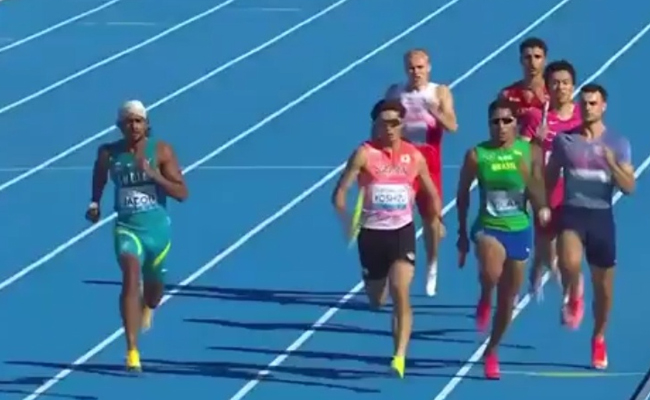
Gaborone (Botswana) (PTI): Amoj Jacob and Ragul Kumar got injured during the men's 4x400m and 4x100 races respectively as India ended their World Athletics Relays campaign in disappointment on the second day of competitions here on Sunday.
The Indian camp had high hopes of making the 2027 World Championships in the men's 4x400m relay but the team did not finish (DNF) the race as Jacob suffered cramps and pulled out of the race after taking the baton from the first leg runner Dharamveer Choudhary. Rajesh Ramesh and Vishal TK were to run in the third and fourth legs.
Those teams which could not qualify for the 2027 Beijing World Championships by reaching the final round of each of the six relay events on Saturday were given another chance in the second qualification round on Sunday.
The top two teams in each of the two heats (in all six relay events) booked the Beijing ticket on Sunday.
India will now have to try and qualify for the World Championships through the Top Lists of the World Athletics, which is a long and tedious process.
In the men's 4x100m race, third leg runner Ragul Kumar fell down the track after failing to hand over the baton inside the exchange zone to fourth leg runner Gurindervir Singh, which clearly showed the lack of coordination among the runners.
Harsh Santosh Raut and Animesh Kujur ran the first two legs.
The Indian quartet was disqualified and Kumar was seen being taken away from the Field of Play with the help of the volunteers.
It was a comedy of errors in the case of the women's 4x100m race, which saw the baton being dropped during an exchange between first leg runner Tamanna and second runner Nithya Gandhe, though the Indians finished the race in 53.09 seconds.
Gandhe started running quite a distance, but after realising that the baton was not in her hand, she turned and ran back to pick it up.
The only silver-lining for the Indian contingent was the national record time in the mixed 4x100m relay race, though the quartet of Ragul Kumar, Nithya Gandhe, Animesh Kujur and Sneha SS finished sixth in heat number two with a time of 41.35 seconds, bettering the previous national mark of 42.30 seconds set in March in Chandigarh.
The mixed 4x400m relay quartet of Theerthesh P Shetty, Kumari Saloni, Nihal William and Rashdeep Kaur ended at fifth in heat number one with a time of 3 minutes and 19.40 seconds.
On Saturday, all the five Indian relay teams had failed to make it to the respective final rounds and thus missed out on the 2027 World Championships berths.