UAE, India ink 10 pacts for collaboration during PM Modi's visit: Foreign Secretary Vinay Kwatra
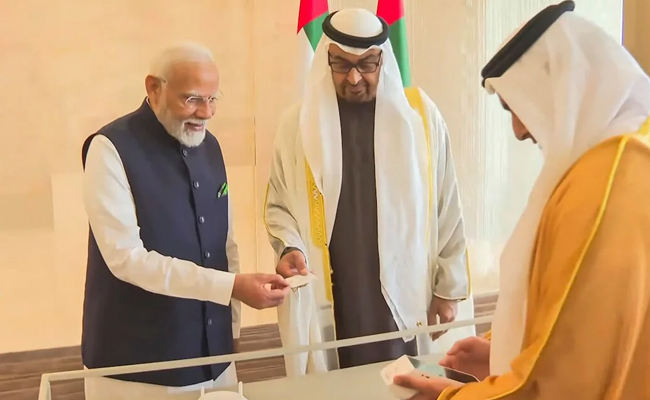
Abu Dhabi (PTI): In a bid to further strengthen their bilateral relationship, India and the UAE have inked 10 pacts for collaboration in key sectors like energy, infrastructure, investments, and management of archives, Foreign Secretary Vinay Kwatra said here on Wednesday.
The 10 memoranda of understanding and agreements were signed during the meeting Prime Minister Narendra Modi had with UAE President Sheikh Mohamed bin Zayed Al Nahyan on Tuesday.
He said the MoU in the field of electricity interconnection and trade will focus on green hydrogen and energy storage, besides cooperation on ensuring energy security and trade.
Kwatra said the Inter-governmental Framework Agreement concerning Cooperation for the Empowerment and Operation of the India-Middle East-Europe Economic Corridor (IMEC) will further regional connectivity.
"The main areas under this agreement include cooperation on logistics platforms which is a crucial element of furthering the objectives of these particular corridors and provision of supply chain services to cover all types of general cargo, bulk containers, and liquid," he said.
"One of the aims is to see how quickly the IMEC gets operated and benefits the core objective of stronger, deeper, more extensive regional connectivity between the parties involved," Kwatra said.
The corridor was announced in New Delhi during the G20 summit in September.
The IMEC is being seen as an alternative to China's Belt and Road Initiative (BRI).
The IMEC will connect India, the United Arab Emirates (UAE), Saudi Arabia, Jordan, Israel and Europe.
Kwatra said the MoU on Cooperation in Digital Infrastructure Projects will create a framework for wide-ranging cooperation, including investment cooperation, in the digital infrastructure sector and also facilitate the sharing of technical knowledge, skills and expertise.
"Government agencies as well as regulatory authorities will seek to forge partnerships under this MoU. This would focus on key areas of digital space that includes high power computing, digital innovation, and platforms relating to management of data," the foreign secretary said.
He said the Bilateral Investment Treaty will set the basis for a stronger, wide-ranging investment partnership because it focuses, not just on protecting the existing investments, but also advances the objective of further capital flows between the two economies.
The MoU on the Development of the National Maritime Heritage Complex (NMHC) would foster engagement between the two countries aimed at supporting the Maritime Heritage Complex at Lothal, Gujarat.
"The two sides will work closely to develop this project in a comprehensive fashion," the foreign secretary said.
He said the Cooperation Protocol between the National Library and Archives of the UAE and the National Archives of India will shape extensive bilateral cooperation in this field including restoration and preservation of archival material.
The protocol will promote cooperation in archives management through the exchange of expertise, historical information, research, and studies.
The agreement on interlinking of the instant payment platforms - UPI (India) and AANI (UAE) will facilitate seamless cross-border transactions between the two countries.
Kwatra said the agreement on inter-linking domestic debit/credit cards - RuPay (India) with JAYWAN (UAE) was an important step in building financial sector cooperation and will enhance the universal acceptance of RuPay across the UAE.
Let the Truth be known. If you read VB and like VB, please be a VB Supporter and Help us deliver the Truth to one and all.
Steel mirrors deployed in Mysuru to discourage public urination
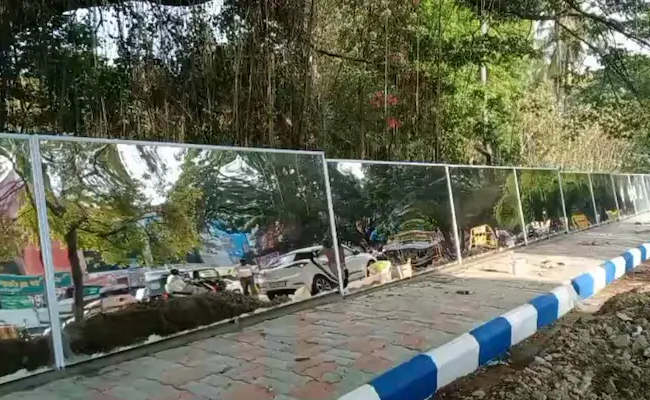
Mysuru (PTI): Fed up with people relieving themselves along roadsides, the Mysuru City Corporation has adopted a unique strategy to curb the practice and promote civic sense by installing reflective steel mirrors along pavements, officials said on Friday.
In what officials described as a first-of-its-kind initiative, the Corporation installed stainless steel sheets with a mirror finish along an 80-metre stretch opposite the Mysuru Suburban Bus Stand.
Officials said the reflective sheets are intended to confront anyone attempting to urinate in public with their own reflection, thereby discouraging the act psychologically.
“The idea is to maintain cleanliness and hygiene, prevent public nuisance, and promote civic sense. It is a simple yet psychological approach that encourages self-awareness through reflection,” officials added.
Soon after the mirrors were installed, videos of the initiative went viral on social media, with many people appreciating the administration’s innovative attempt to address public urination. At the same time, some users pointed out the lack of basic civic sense among people.
Several social media users also suggested that more public toilets, maintained in a hygienic condition, were needed to further discourage open urination.
Explaining how the idea originated, Nitesh Patil, Administrator and Regional Commissioner of the Mysuru City Corporation, told PTI that despite a public toilet being located next to the bus stand, many people continued to urinate in the open.
Even fines and warnings failed to deter them from relieving themselves against vacant compound walls, leaving behind a foul smell.
“One of our engineers came up with this idea, and we decided to implement it. The initiative has received a very positive response from the public, social media, and the press. We are now planning to identify more such locations in the city and install similar reflectors,” he said.
According to him, to ensure that the installation is both effective and visually appealing, LED lighting that switches on along with the streetlights has also been added, causing the stretch to glow at night and enhancing the city’s appearance.
Patil said the initiative had helped create civic awareness while also beautifying the city.
“We want our city to be clean and hygienic. We aspire to become the cleanest city in the country,” he added, recalling that Mysuru secured third place nationally in the Swachh Survekshan Awards 2024–25 last year.