US Embassy in Saudi Arabia hit with Iranian drones as American and Israeli attacks on Iran escalate
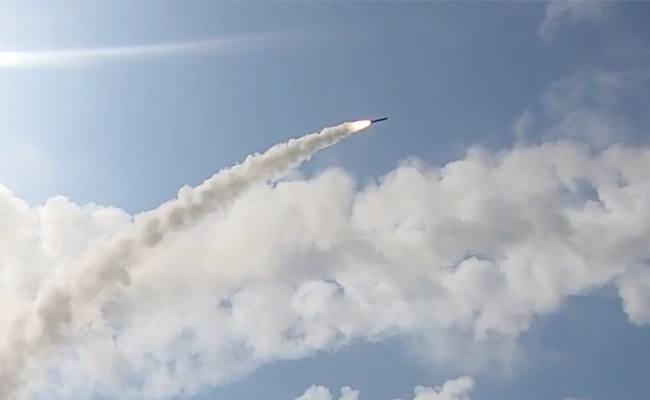
Dubai (AP): Iran hit the US Embassy in Saudi Arabia's capital with a drone strike early Tuesday as it kept striking targets around the region, while the United States and Israel pounded Iran with airstrikes in what US President Donald Trump suggested was just the start of a relentless campaign that could last more than a month.
The attack from two drones on the US Embassy in Riyadh caused a “limited fire” and minor damage, according to Saudi Arabia's Defence Ministry, which did not release further details. It follows an attack the day before on the US Embassy in Kuwait.
The expansion of Iranian retaliation across the Gulf and the intensity of the Israeli and American attacks, the killing of Iranian Supreme Leader Ayatollah Ali Khamenei and the lack of any apparent exit plan portend a possible prolonged conflict with far-reaching consequences.
Many countries deemed safe havens in the Mideast have been hit by Iran in retaliation for the US and Israeli strikes, with recent targets including two Amazon data centers in the United Arab Emirates and a drone impact near another in Bahrain that caused damage, the company said Tuesday.
Iran has also hit energy facilities in Qatar and Saudi Arabia, and attacked several ships Strait of Hormuz, the narrow mouth of the Persian Gulf through which a fifth of all oil traded passes, sending global oil and natural gas prices soaring.
The US State Department urged US citizens to leave more than a dozen Middle Eastern countries due to safety risks, as have many other countries, though with much of the airspace closed many remain stranded.
Trump said operations are likely to last four to five weeks but that he was prepared “to go far longer than that.”
“The hardest hits are yet to come from the U.S. military,” Secretary of State Marco Rubio told reporters before briefing members of Congress about the Iran operation.
Hundreds dead in Iran and dozens in Lebanon along with 11 in Israel
--------------------------------------------------------------------------
The Iranian Red Crescent Society said the U.S.-Israeli operation has killed at least 555 people. In Israel, where several locations were hit by Iranian missiles, 11 people were killed. Israel's retaliatory strikes against Hezbollah killed dozens of people in Lebanon.
“Military escalation would force more families from their homes and hit civilians hard,” said Amy Pope, director general of the International Organization on Migration as she called Tuesday for the international community to press for de-escalation.
“Millions are already displaced in the region,” she said.
The U.S. military has confirmed six deaths of American service members. All six were Army soldiers and part of the same logistics unit in Kuwait, according to a U.S. official who was not authorized to comment publicly and spoke on condition of anonymity.
Three people were reported killed in the United Arab Emirates, and one each in Kuwait and Bahrain.
Iran's top diplomat on Monday shared a photo showing graves he said were for more than 160 girls killed during a US-Israeli strike on a school in Minab. “Their bodies were torn to shreds,” Abbas Araghchi, the country's foreign minister, said on X.
In Israel, three young siblings killed by an Iranian strike were being laid to rest at the Mount of Olives in Jerusalem on Monday night.
The chaos of the conflict became apparent when the US military said Kuwait had “mistakenly shot down” three American fighter jets while Iran was attacking it with aircraft, ballistic missiles and drones. US Central Command said all six pilots ejected safely.
Israel and US target nuclear facilities and missile infrastructure
------------------------------------------------------------------
Iranian state TV said strikes caused two explosions early Tuesday at a broadcasting facility in Tehran, but said no one was injured.
Reza Najafi, Iran's ambassador to the International Atomic Energy Agency, told reporters that airstrikes targeted the Natanz nuclear enrichment site on Sunday.
“Their justification that Iran wants to develop nuclear weapons is simply a big lie,” he said.
Israel and the US have not acknowledged strikes at the site, which the U.S. bombed in the 12-day war between Iran and Israel in June. Israel has said it is targeting the “leadership and nuclear infrastructure.”
Trump said the military campaign's objectives are to destroy Iran's missile capabilities, wipe out its navy, prevent it from obtaining a nuclear weapon and ensure that it cannot continue to support allied groups like Lebanon's Hezbollah, which fired missiles at Israel on Monday.
Iran has said it has not enriched uranium since June, though it has maintained its right to do so and says its nuclear program is peaceful.
Israeli Prime Minister Benjamin Netanyahu maintained, however, that Iran was rebuilding “new sites, new places” underground for making atomic bombs in an interview broadcast late Monday on Fox News Channel's Hannity.
“We had to take the action now and we did,” said Netanyahu, who offered no evidence to support his claim.
Satellite photos analyzed by The Associated Press showed limited activity at two nuclear sites in Iran before the war. Analysts said Tehran was likely assessing damage from the 2025 US strikes and possibly salvaging what remained.
Attacks on Iran have drawn in proxy forces from around region
--------------------------------------------------------------------
The conflict has also spread to Lebanon, where the Iranian-supported militant group Hezbollah fired missiles at Israel on Monday, though there were no reports of injuries or damage.
Israel retaliated with strikes on Lebanon. The country's Health Ministry reported at least 52 people were killed and 154 wounded in overnight strikes in the Beirut suburbs and southern Lebanon.
An Israeli military spokesman, Brig. Gen. Effie Defrin, said Israel is keeping “all options on the table,” including a potential ground invasion of Lebanon.
Israel hit Beirut with more airstrikes early Tuesday morning, saying it was targeting “Hezbollah command centers and weapons storage facilities.”
Hezbollah also said it launched drones targeting an Israeli air base. The Israeli military said it downed two drones.
An Iranian-linked militant in Iraq has also claimed strikes on US military facilities.
Let the Truth be known. If you read VB and like VB, please be a VB Supporter and Help us deliver the Truth to one and all.
Putin meets Iran's FM Araghchi, says Russia ready to do its best to help bring peace to West Asia
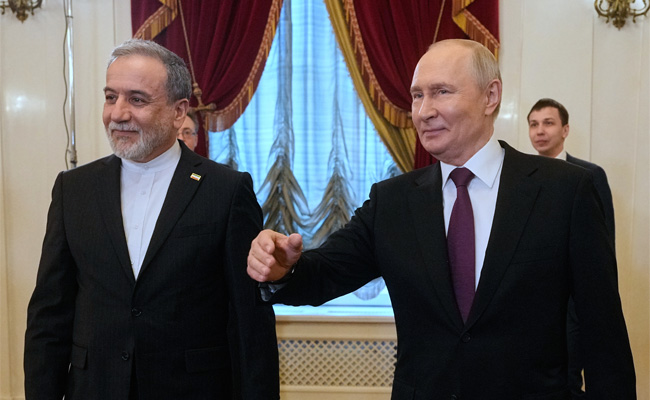
Moscow (PTI): Iran's Foreign Minister Abbas Araghchi on Monday met Russian President Vladimir Putin, who hailed the Iranian people for fighting bravely and heroically for their sovereignty and said Moscow is ready to do its best to help bring peace to West Asia as soon as possible.
Araghchi, who held talks with Omani and Pakistani leadership before arriving in Russia, met Putin in St. Petersburg and thanked him for supporting Iran, state-owned TASS news agency reported.
"Russia is ready to do everything in its power to ensure that peace in the Middle East is achieved as soon as possible," Putin said during his meeting with Araghchi, which was also attended by Russian Foreign Minister Sergey Lavrov.
Revealing that he received a message from Iranian Supreme Leader Mojtaba Khamenei last week, Putin asked Araghchi to convey his "gratitude for this message and best wishes for his health and well-being."
He praised the Iranian people for fighting "bravely and heroically" for their sovereignty, Iran's state-run PRESS TV reported.
"We really hope that, based on the courage and desire for independence, the Iranian people, under the guidance of the new leader, will weather this difficult period of trials and peace will come,” Putin said.
He also stressed that Russia “intends to maintain” its strategic relations with Iran.
Araghchi said that the world witnessed Iran’s strength in countering the US during the recent war, and that the Islamic Republic is a "stable and powerful establishment."
"With their courage, the Iranian people succeeded in resisting the US aggression and will be able to endure it,” he said.
He said that it became clear that Iran has “great friends and allies” like Russia, and conveyed “warmest greetings” from Supreme Leader Mojtaba Khamenei and President Masoud Pezeshkian to the Russian leader.
Araghchi said relations between Moscow and Tehran represent a “strategic partnership at the highest level” and will continue to develop "regardless of circumstances."
"We are grateful to you for the solid and strong positions in support of the Islamic Republic of Iran," he said.
Foreign Minister Lavrov said that the talks between President Putin and the Iranian Foreign Minister were "useful and constructive."
Kremlin Spokesman Dmitry Peskov later said that Russia is "ready to provide any good offices, any mediation services that are acceptable to the parties."
"We will be ready to do everything so that ultimately peace ensues, guaranteed peace, and that there is no return to hostilities," Peskov was quoted as saying by TASS.
He was asked how Moscow can assist in future negotiations on the Iranian settlement.
Araghchi arrived in Russia after his whirlwind trip to Islamabad, which, according to him, was “very productive” and involved “good consultations" with Pakistan's Army Chief Field Marshal Asim Munir, amid uncertainty over the second round of peace talks to resolve the war in West Asia.
"We held good consultations with our friends in Pakistan. The trip was successful. We assessed the outcome of our recent (meetings) and discussed in what direction and under what conditions talks can move on,” Araghchi said in a video posted on his Telegram channel upon his arrival in St Petersburg.
Referring to the second round of talks between the US and Iran to resolve the conflict in West Asia, Araghchi said: "Developments have taken place in the negotiations."
"Despite some progress in earlier rounds, the talks failed to reach their objectives due to the Americans' approach, the excessive demands they made, and the wrong approaches they adopted. Therefore, it was necessary to consult with our friends in Pakistan to review the latest situation,” Iran's official news agency IRNA quoted him as saying.
He said that the trip to Pakistan was a good opportunity to review developments related to the US-Israeli war against Iran, expressing confidence that “these consultations and coordination between the two countries will be highly significant.”
Araghchi arrived at St. Petersburg's Pulkovo Airport early Monday, where he was welcomed by Russian officials and Iran’s ambassador to Russia, Kazem Jalali, the report said.
The first round of peace talks between Iran and the US, held on April 11 and 12, failed to bring the desired result for the parties to the conflict.
The Iranian minister arrived in Islamabad for the second time on Sunday after a short visit to Oman, where he held talks with Sultan Haitham bin Tariq al-Said on security in the Strait of Hormuz and diplomatic efforts to end the Iran-US conflict.
After Araghchi left Pakistan for Oman on Saturday, President Donald Trump announced that US negotiators Steve Witkoff and Jared Kushner would no longer be going to Islamabad for talks with Iran, contending that Washington held all the cards on the matter.
Trump on Sunday reiterated that the US and Iranian officials can talk by phone for a peace solution to the conflict.
On Tuesday, Trump extended the two-week ceasefire with Iran indefinitely to give Tehran more time to prepare a unified proposal to end the war, just hours before the truce was set to expire.
The war began when the US and Israel jointly attacked Iran on February 28, killing Iranian Supreme Leader Ayatollah Ali Khamenei and several top commanders. The retaliation by the Islamic Republic extended the war to the entire Gulf region.