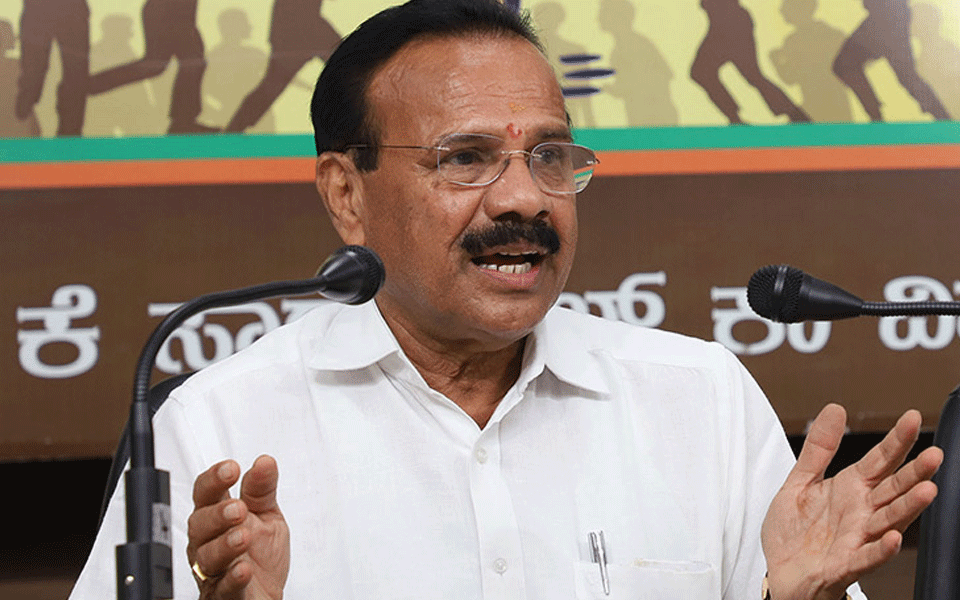
Mangaluru: "There should be at least two to three flights from Saudi Arabia to Karnataka (Bengaluru Airport or Mangaluru Airport) every week. That is my intention,” said Union Minister of Chemicals and Fertilizers and former chief minister of Karnataka D V Sadananda Gowda.

He was speaking in a video conference organised by coastaldigest.com with Kannadiga delegates in Saudi Arabia.

“Today itself I will contact the external affairs ministry and Director General of Civil Aviation (DGCA) to convince them the need to add operate flights to bring back stranded Kannaidgas from the Kingdom," Gowda added. 

Responding positively to the advices, requests and concerns of Kannadiga delegates who participated in the video conference, Gowda said: “Two things need to be done. First thing is number of flights from Saudi Arabia to Karnataka should be increased. Second thing is to ensure that most of these flights land in the Mangaluru Airport as most of the Kannadiga expats in Saudi Arabia are from the coastal region.


Let the Truth be known. If you read VB and like VB, please be a VB Supporter and Help us deliver the Truth to one and all.


New Delhi (PTI): Harish Rana, the first person in India to be allowed passive euthanasia, passed away on Tuesday at AIIMS-Delhi after more than 13 years in a coma, sources said.

The 31-year-old, who has been in a coma since 2013, was shifted from his Ghaziabad home to the palliative care unit at Dr BR Ambedkar Institute Rotary Cancer Hospital at the All India Institute of Medical Sciences (AIIMS) on March 14.

Three days before that, the Supreme Court, in a landmark judgment on March 11, allowed passive euthanasia for Harish, who was a BTech student at Panjab University who fell from a fourth-floor balcony in 2013 and suffered severe head injuries.

He had been in a coma since, with artificial nutrition support and occasional oxygen support.

Passive euthanasia is the intentional act of letting a patient die by withholding or withdrawing life support or the treatment necessary to keep him alive.

Harish's nutritional support was gradually withdrawn after he was admitted to the hospital, the sources said on Tuesday.

Harish's family had said after the apex court judgment that the withdrawal of artificial life support would not bring any personal benefit to the family, but in the larger public interest, the decision could help others facing similar situations.

His father, Ashok Rana, had said passive euthanasia would restore Harish's dignity after years of irreversible suffering.

Pinki Virani, a journalist and activist who filed a petition for euthanasia to Aruna Shanbaug in 2011, thanked the doctors and nurses at AIIMS for “compassionately applying passive euthanasia”, and urged that one should let their family members know “if they would want to exercise this right for themselves”.

“May Harish Rana rest in peace. May his parents and his brother find a quiet peace of their own amid what has been a very long loss for them... I continue to be grateful to the Supreme Court for allowing the right to die with dignity in 2011... It's a choice, and if they so choose, they can help the process by making their wishes – pertaining legally to passive euthanasia – known so that their final exit is free from guilt and trauma,” Virani told PTI.

The top court had rejected Virani's plea on behalf of Shanbaug, who remained bedridden in a vegetative state in a Mumbai hospital since a brutal sexual assault in November 1973.

The Mumbai nurse finally died of pneumonia in 2015.

In its March 11 judgement, the apex court had directed AIIMS-Delhi to ensure that life support is withdrawn with a tailored plan so that dignity is maintained.

A specialised medical team headed by Dr Seema Mishra, professor and head of the department of anaesthesia and palliative medicine, was constituted to implement the process, the first in India.

The team comprised doctors from departments of neurosurgery, onco-anaesthesia and palliative medicine, and psychiatry.

The Supreme Court, in its March 11 judgment, allowed passive euthanasia for a person for the first time in the country.

Ruling on the long-discussed emotive issue, a bench of Justices J B Pardiwala and K V Viswanathan asked the Union government to consider bringing a comprehensive legislation on passive euthanasia.

The top court noted that Rana survived only through clinically administered nutrition via 'percutaneous endoscopic gastrostomy' tubes, and medical boards had unanimously concluded that continuation of treatment would merely prolong biological existence without any possibility of recovery.

When primary and secondary boards have certified withdrawal of life support, there is no need for judicial intervention, the apex court said.

It also asked the Centre to ensure that the chief medical officers in all districts maintain a panel of registered medical practitioners for nomination to secondary medical boards.

The court made a special mention of Rana's parents, Ashok and Nirmala Rana, expressing its appreciation to them for showing immense love and care for their son.

“His family never left his side,” the court said.

The order allowing passive euthanasia is in line with the court's 2018 Common Cause judgment, which was modified in 2023 and recognised the fundamental right to die with dignity.

In the 2018 judgement, a constitution bench recognised passive euthanasia and the right to die with dignity as a fundamental right under Article 21 of the Constitution.

The court had held that passive euthanasia could be carried out using “advance medical directives”.

On January 24, 2023, a five-judge Constitution bench modified the 2018 guidelines to ease the process of granting passive euthanasia to terminally ill patients.

A primary and a secondary medical board will have to be formed for an expert opinion on the withdrawal of artificial life support for a patient in a vegetative state, the guidelines said.