Women need not wear abaya: Saudi crown prince
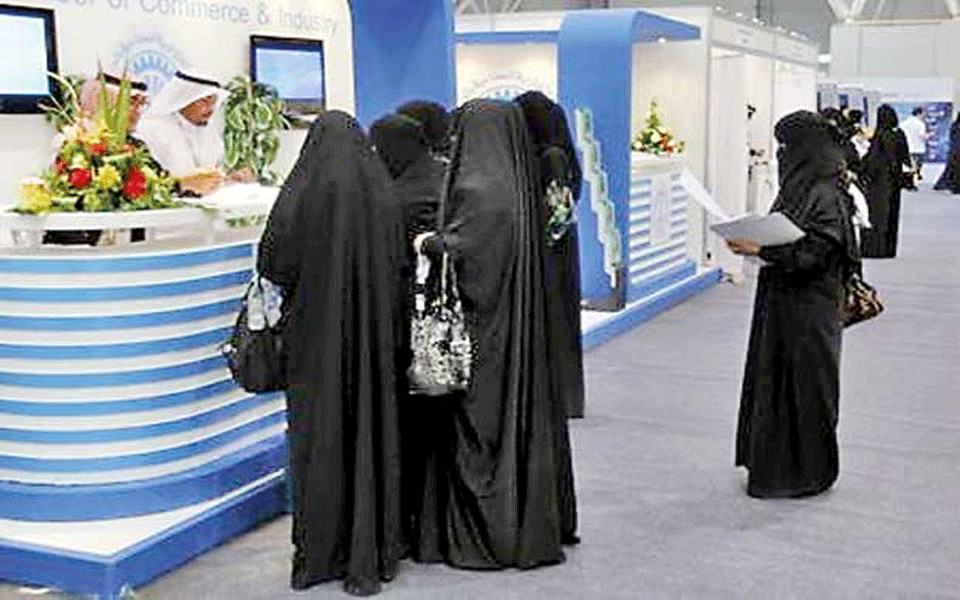
Riyadh: Women in Saudi Arabia need not wear headcover or the black abaya — the loose-fitting, full-length robes symbolic of Islamic piety — as long as their attire is “decent and respectful”, the kingdom’s reform-minded crown prince said.
With the ascent to power of young Prince Mohammad Bin Salman, the country has seen an expansion in women’s rights including a decision to allow women to attend mixed public sporting events and the right to drive cars from this summer.
The changes have been hailed as proof of a new progressive trend towards modernisation in the traditionally conservative country.
The laws are very clear and stipulated in the laws of sharia (Islamic law): that women wear decent, respectful clothing, like men...”
- Saudi Crown Prince Mohammad Bin Salman
“The laws are very clear and stipulated in the laws of sharia (Islamic law): that women wear decent, respectful clothing, like men,” Mohammad said in an interview with CBS television aired late on Sunday.
“This, however, does not particularly specify a black abaya or a black head cover. The decision is entirely left for women to decide what type of decent and respectful attire she chooses to wear.”
A senior cleric said last month that women should dress modestly, but this did not necessitate wearing the abaya.
“This, however, does not particularly specify a black abaya or a black head cover. The decision is entirely left for women to decide what type of decent and respectful attire she chooses to wear.”
- Saudi Crown Prince Mohammad Bin Salman
It remains unclear if these statements signal a change in the enforcement of women’s dress code in the country.
Saudi Arabia has no written legal code to go with the texts making up sharia, and police and judiciary have long enforced a strict dress code requiring Saudi women to wear abayas and in many cases to cover their hair and faces.
But the country has witnessed a bold new climate of social freedoms with the rise of the 32-year-old crown prince to power after decades of elderly rulers.
Saudi women have started wearing more colorful abayas in recent years, the light blues and pinks in stark contrast with the traditional black.
Open abayas over long skirts or jeans are also becoming more common in some parts of the country.
On March 8, a group of women in the Saudi city of Jeddah marked International Women’s Day by exercising one of their newly acquired freedoms: the right to go for a jog, paying no heed to bemused onlookers.
Let the Truth be known. If you read VB and like VB, please be a VB Supporter and Help us deliver the Truth to one and all.
England sticking with Key, McCullum and Stokes despite Ashes humbling

London (AP): England is not sacking anybody following the 4-1 Ashes loss in Australia.
A review of the tour by the England and Wales Cricket Board, announced within hours of the final match in January, was concluded on Monday. Firing people would “be the easy thing to do,” ECB chief executive Richard Gould said but he insisted, "This is not the time to throw everything out."
Managing director Rob Key, coach Brendon McCullum and captain Ben Stokes kept their jobs after the best England side to go to Australia in 14 years lost the Ashes in 11 days with two games to spare.
“Moving people on can sometimes be the easy thing to do. That's not the route that we're going to take,” Gould said. “I've seen the driving ambition and determination that we're lucky enough to have within our leadership group to take the lessons from the Ashes and move forward.”
Gould previously was the chief executive of Bristol City soccer club and said the ECB would not follow the same route as soccer's hire-and-fire culture.
“Cricket is a very unique sport in that it takes a team of leadership ... it's not like football where there's a single point of failure or success with a manager," he said. He added the ECB would not “select or deselect management based on a popularity campaign.”
The main criticisms of England's tour were poor preparation, player misbehavior, and selection mistakes.
At a press conference at Lord's, Gould and Key said McCullum and Stokes have not had a “bust up,” they did not want McCullum to “completely change” but “to evolve,” the behavior of some players was “unprofessional,” there will be more consequences for underperforming, and a commitment to “better long-term planning” ahead of major test series.
Some changes were already implemented for the Twenty20 World Cup, where England reached the semifinals. Gould implied that performance saved McCullum.
Key acknowledged that England supporters would be disappointed to see the management team go unpunished.
“I know people want punishment and that people then should be sacked for that,” Key said. “That doesn't mean we don't feel like we've gone through some serious pain: Brendon, myself, Ben. It's been as tough a time as I think I've had.”