Yemen's Houthi rebels release ex-president Saleh's sons: Report
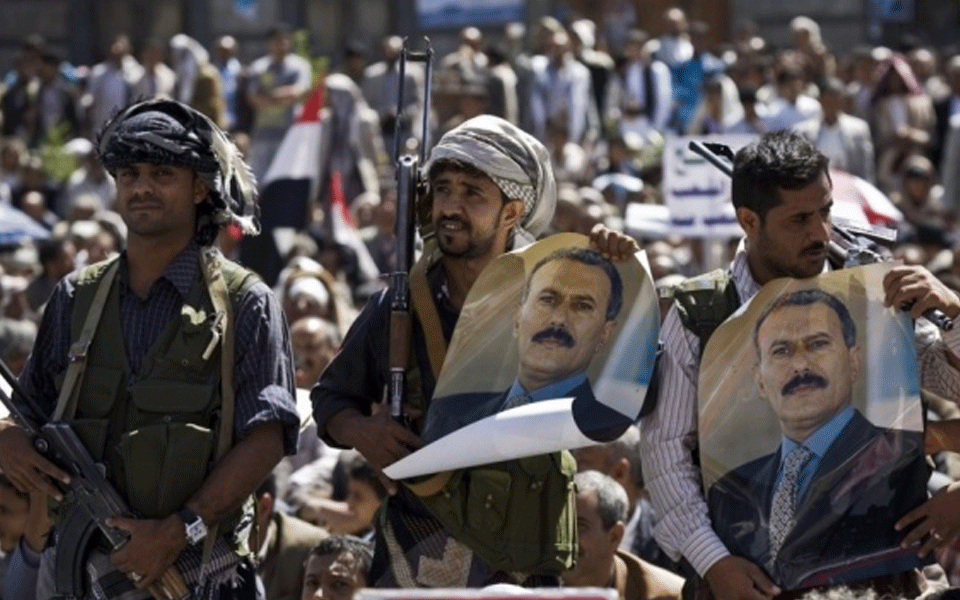
Sanaa, Oct 3 : Yemen's Shia Houthi rebels on Wednesday released two sons of slain former President Ali Abdullah Saleh, the media reported.
"The sons of Ali Abdullah Saleh, Salaah and Madyan, were released upon an amnesty from the (so-called) President of the Supreme Political Council Mahdi al-Mashat (top Houthi official)," the Houthis rebels said in a statement cited by state news agency Saba.
The release came nearly 10 months after the rebels arrested them along with dozens of the former President's relatives following deadly clashes in the capital that killed Saleh at the hands of Houthis.
On December 4, 2017, the Houthis said they killed Saleh, their once partner, after he sought peace with Saudi Arabia, the Sunni Gulf country that led an Arab military coalition against Iranian-allied Shia Houthi rebels.
A senior Houthi militia member told Xinhua news agency that the release came following a "mediation from Oman" and that the sons of Saleh would be transported by an "Omani plane to United Arab Emirates (UAE), where they would join their exiled older brother Ahmed Ali Abdullah Saleh in Abu Dhabi".
Saleh's family allied with the government of Saudi-backed exiled President Abd-Rabbu Mansour Hadi after the former broke out from alliance with Houthis in late 2017. There were no comments from the government on the Houthi statement.
Last week, the Saudi-backed internationally recognized government said that the "Houthis prevented a UN plane from landing in Sanaa on September 28 to transport sons of Saleh, according to an agreement to release them signed by the Houthis".
Saleh's family members, most of whom were military commanders and ran the country's elite Republican Guards and Counter-terrorism Special Forces during his 33 years of rule, are reportedly backed by the US, Saudi Arabia and the UAE.
In September 2014, the Houthis advanced from their stronghold Saada province, storming the capital and controlled it and other northern cities by force, including the Red Sea port city of Hodeidah.
The move triggered Saudi Arabia to lead an Arab military coalition and launched an Air Force campaign on Yemen in March 2015 to reinstate the government of exiled President Abd-Rabbu Mansour Hadi.
The war has killed more than 10,000 Yemenis, mostly civilians, and displaced 3 million others, according to UN aid agencies.
Let the Truth be known. If you read VB and like VB, please be a VB Supporter and Help us deliver the Truth to one and all.
Primary accused in 96.6 pc POCSO cases were close acquaintances: NCRB

New Delhi (PTI): In 96.6 per cent of 44,126 cases of sexual abuse of minors, close acquaintances have emerged as the primary offenders, according to the latest data released by the NCRB.
In its report 'Crime in India 2024' released by the National Crime Records Bureau (NCRB), 44,126 total cases have been registered under the Prevention of Children from Sexual Offences (POCSO) Act under Sections 4 and 6 which pertain to penetrative sexual assault on minors during the year across the country.
The figures present a grim picture as close acquaintances emerged as primary accused in 42,634 (around 96.6 per cent) of the 44,126 total cases falling in that category, according to the latest NCRB data.
The data shows that family members were involved in 3,658 cases, while family friends, neighbours, employers or other known persons were named in 16,668 cases.
The largest share came from friends, online friends or live-in partners acting on the pretext of marriage, with 22,308 cases.
Cases where the offender was unknown or not identified stood at mere 1,492, or 3.4 per cent of the total.
Among states, Tamil Nadu reported the highest number of POCSO cases at 5,320, followed by Maharashtra at 4,829 and Madhya Pradesh at 3,721. Uttar Pradesh was next with 3,671 cases.
In Union territories, Delhi accounted for the highest number of cases at 1,038, followed by Jammu and Kashmir at 228 and Puducherry at 82. The Andaman and Nicobar Islands reported 77 cases.
The data also shows that Andhra Pradesh, Arunachal Pradesh, Himachal Pradesh, Nagaland, Sikkim, Uttarakhand, Tripura and several Union territories, including Chandigarh, Andaman and Nicobar Islands, Dadra and Nagar Haveli and Daman and Diu, Lakshadweep, Ladakh and Puducherry, reported 100 per cent of cases involving known offenders.