Novel regenerative bandage may heal diabetics' wounds faster
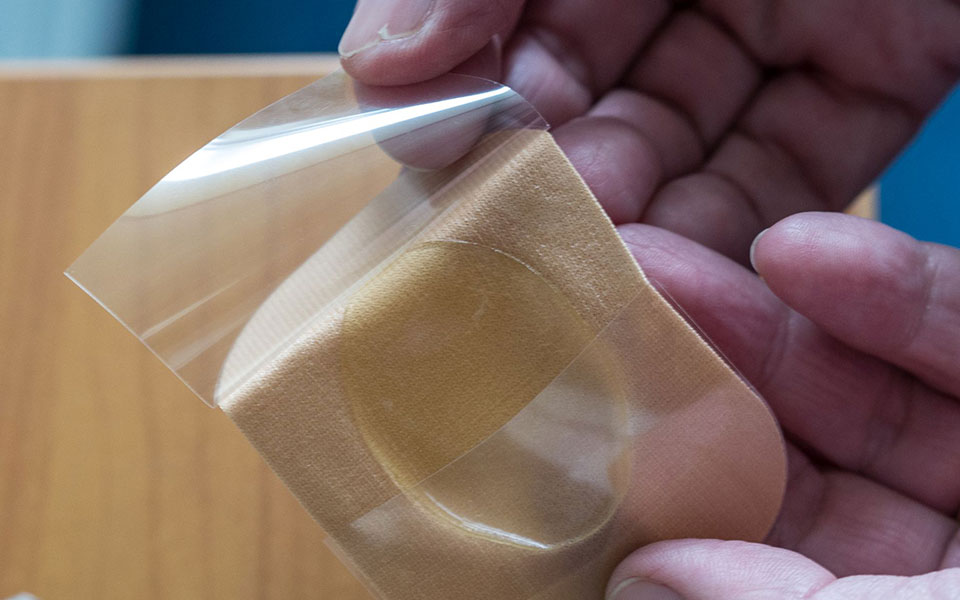
New York, June 12: Your painful, hard-to-treat sores may soon be a thing of the past as scientists have developed a regenerative bandage that may quickly heal them without using drugs, an advance which may help make healing of wounds in diabetics faster.
The study, published in the journal Proceedings of the National Academy of Sciences, showed that the bandage healed diabetic wounds 33 per cent faster than one of the most popular bandages currently on the market.
"The novelty is that we identified a segment of a protein in skin that is important to wound healing, made the segment and incorporated it into an antioxidant molecule that self-aggregates at body temperature to create a scaffold that facilitates the body's ability to regenerate tissue at the wound site," said lead author Guillermo Ameer from the Northwestern University in Illinois, US.
The logic behind the regenerative bandage is laminin -- a protein found in most of the body's tissues including the skin.
Laminin sends signals to cells, encouraging them to differentiate, migrate and adhere to one another. The team identified a segment of laminin -- 12 amino acids in length -- called A5G81 that is critical for the wound-healing process.
They incorporated A5G81 into an antioxidant hydrogel bandage that it previously developed in the laboratory. The antioxidant nature also helps counters inflammation.
Hydrogel liquid can form the exact shape of the wound which makes this bandage better than others.
"Wounds have irregular shapes and depths. Our liquid can fill any shape and then stay in place. Other bandages are mostly based on collagen films or sponges that can move around and shift away from the wound site," Ameer said.
The team also used animal models to test the effectiveness and found no adverse effects of the bandage on the animals.
Ameer also added that their bandage can be rinsed off with cool saline, so the regenerating tissue remains undisturbed.
Let the Truth be known. If you read VB and like VB, please be a VB Supporter and Help us deliver the Truth to one and all.
Iran war 'close to over,' says Trump
_vb_23.jpeg)
Washington (PTI): US President Donald Trump has said that the war with Iran is “close to over,” asserting that if he pulled up stakes right now, it would take Tehran 20 years to rebuild the country.
The president's comments come hours after the US Central Command said it has successfully blocked all traffic to and from Iranian ports and coastal areas in the first 24 hours of Trump's blockade, saying the US was supporting freedom of navigation for vessels transiting the Strait of Hormuz.
“I think it’s close to over, yeah. I view it as very close to being over,” Trump told Fox News in an interview that will be telecast later Wednesday.
The interview for the programme “Mornings with Maria” was recorded on Tuesday.
“I think it’s — I had to divert because if I didn’t do that, right now you’d have Iran with a nuclear weapon. And if they had a nuclear weapon, you’d be calling everyone over there ‘sir,’ and you don’t want to do that,” Trump said.
The US and Iran failed to reach an agreement following historic marathon talks in Islamabad over the weekend to find a peaceful resolution to the conflict that started on February 28.
A US media report said on Tuesday that Trump said that a second round of talks with Iran could be held in Islamabad “over the next two days.”
“You should stay there, really, because something could be happening over the next two days, and we're more inclined to go there,” Trump told The New York Post.
Trump attributed the possibility of a second round of talks to the “great job” done by Pakistan Army chief Field Marshal Asim Munir.
“It's more likely, you know why? Because the field marshal is doing a great job,” the US President said.
He did not say whether Vice President J D Vance would continue to lead the negotiating team, which included White House Special Envoy Steve Witkoff and Jared Kushner.
“I’ve been saying they can’t have nuclear weapons. So I don’t like the 20 years,” Trump said when asked about suggestions that a moratorium might encourage Iran to make an agreement.
“I don’t want them (Iran) to feel like they have a win,” the US President said.
_vb_48.jpeg)