Omicron has higher risk of reinfection than Delta and Beta variants: Singapore's health ministry
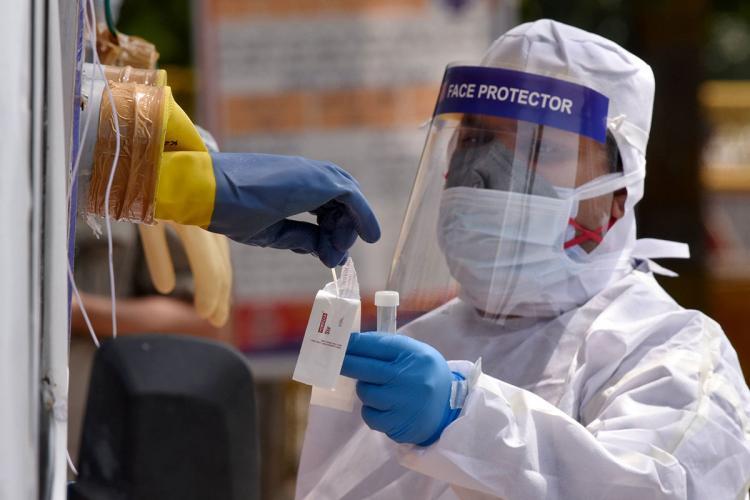
Singapore, Dec 6: Singapore's Ministry of Health has said that early clinical observations globally suggest that the Omicron variant of COVID-19 may be more transmissible and have a higher risk of reinfection compared to the Delta and Beta variants of the virus.
"This means that there is a higher likelihood of individuals who have recovered from COVID-19 to be reinfected with the Omicron variant," Channel News Asia quoted the ministry as saying on Sunday in an update on the Omicron variant.
Meanwhile, the city-state reported one more "preliminarily positive" Omicron case on Sunday. The 37-year old vaccinated permanent resident was on the same flight as two other "preliminary positive" cases that landed here from South Africa on December 1.
On Sunday, Singapore also reported 552 new COVID-19 cases and 13 deaths linked to the coronavirus.
The ministry said it has, over the past several days, reviewed reports from South Africa and other countries, and actively engaged experts in affected countries to obtain first-hand information.
"This press release updates our understanding of the Omicron variant, even while many questions remain with no clear answers," the Channel quoted MOH.
With the new variant spreading globally, Singapore "must expect to detect more cases at our borders and, in time to come, also within our community", MOH cautioned.
Studies on whether existing COVID-19 vaccines are effective against the new variant are ongoing, but "there is an emerging view amongst scientists around the world that existing COVID-19 vaccines will still work on the Omicron variant, especially in protecting people against severe illness," the MOH said.
The ministry urged those eligible to get themselves vaccinated or go for their booster jabs, saying there is strong scientific consensus that doing so will protect against any existing and future variants of COVID-19.
Addressing concerns regarding the severity of the strain of the virus, the MOH said Omicron cases have "mostly displayed mild symptoms, and no Omicron-related deaths have been reported so far".
Common symptoms reported include sore throat, tiredness and cough, the ministry added.
As for reports that there were more Omicron-related hospitalisations among younger people in South Africa, the ministry said this could be due to an overall high infection rate among the population.
Another factor could be that existing patients hospitalised for non-COVID-19 related reasons could have tested positive for the variant while in hospital. "Having said that, it is early days to conclude on the severity of the disease," the MOH said.
The Omicron outbreak was first detected in a university town with a younger demographic.
According to the South African health experts, any hospitalisation stays for this demographic thus far have been short, of about one to two days.
MOH said it would need to collect more information on older individuals infected with the Omicron variant to assess if it is more severe than the Delta variant.
The ministry said studies so far show antigen rapid tests, in addition to the polymerase chain reaction (PCR) tests, are effective in detecting COVID-19 infection, including Omicron cases.
"Testing, therefore, remains key to our early detection and initial containment of transmission," the MOH added.
The ministry also said it would "continue to coordinate with health authorities globally to study and understand the Omicron variant, so as to develop the best possible response".
The MOH's update comes after two imported cases in Singapore tested "preliminarily positive" for the Omicron COVID-19 variant on Thursday.
The passengers were isolated after arriving from South Africa on a Singapore Airlines flight on December 1, and did not have any community interaction, the ministry said last week.
Both of them were fully vaccinated and had mild symptoms of cough and scratchy throat. Their confirmatory test results are still pending, the MOH said.
The third case's pre-departure test in Johannesburg on November 29 was negative for COVID-19, said the MOH.
He was taken to a stay-home notice dedicated facility upon arrival in Singapore, and his PCR tests on December 1 and 3 came back negative, the ministry said.
He developed fever and sore throat on December 4 and was taken to the National Centre for Infectious Diseases (NCID), where he tested "preliminarily positive" for the Omicron variant, the Health Ministry said.
The man is fully vaccinated and has mild symptoms. He is currently recovering in an isolation ward at NCID, said the MOH, adding that "he had not interacted in the community, and there is currently no evidence of any community transmission from the case".
The National Public Health Laboratory is conducting whole genome sequencing to confirm the variant.
As of Sunday, Singapore has reported 2,69,211 COVID-19 cases and 759-coronavirus linked deaths since the pandemic began last year.
Let the Truth be known. If you read VB and like VB, please be a VB Supporter and Help us deliver the Truth to one and all.
Man arrested with Rs 2.54-crore heroin in Mumbai

Mumbai (PTI): Police have arrested a man and seized over 500 grams of heroin worth Rs 2.54 crore in the illicit market from him in Mumbai, officials said on Friday.
The police's Anti-Narcotics Cell (ANC) made the drug seizure in Santacruz in the western suburbs. The operation was conducted by the Kandivali unit of the ANC on Thursday as part of a special crackdown against drug trafficking in the area, they said.
Acting on specific inputs, an ANC team conducted a raid in Santacruz (East) and intercepted a man. During a search, the team recovered 508 grams of high-grade heroin from his possession, an official said.
The seized contraband, a highly addictive, opioid drug derived from morphine, is estimated to be worth Rs 2.54 crore in the international market, he informed.
Following the seizure, a case was registered against the man under relevant sections of the Narcotic Drugs and Psychotropic Substances (NDPS) Act, 1985, and he was formally placed under arrest in the early hours of Friday.
The police are currently investigating the source of the drug and trying to identify the intended recipients of the consignment, he said.