
Stock markets close flat in volatile trade; Eternal jumps nearly 11 pc

Mumbai, Jul 22 (PTI): Benchmark stock indices Sensex and Nifty closed almost unchanged in a volatile trade on Tuesday as gains in quick commerce and private banking shares were offset by losses in oil & gas and IT shares.
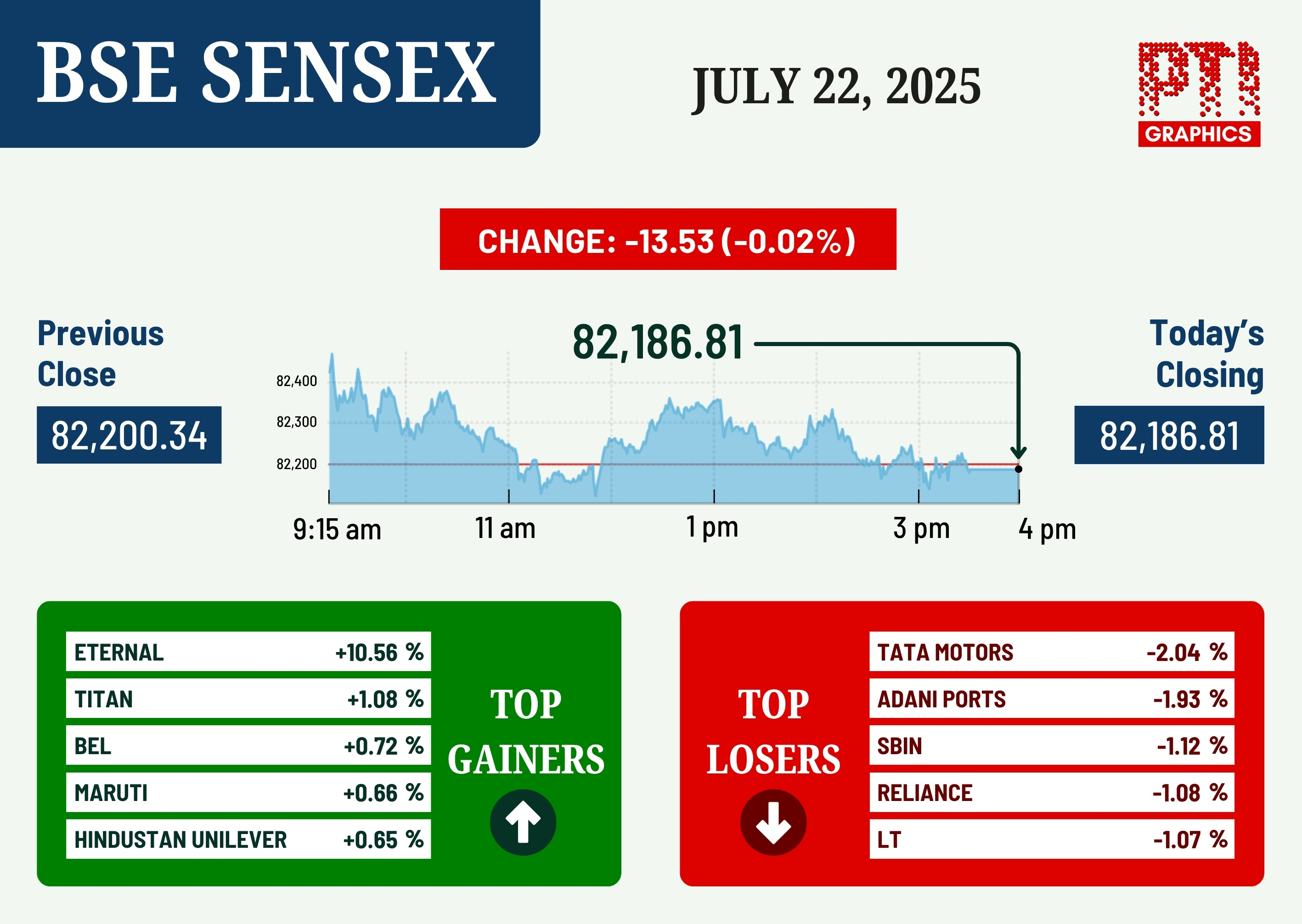
The 30-share BSE Sensex ended 13.53 points or 0.02 per cent down at 82,186.81. During the morning trade, it climbed 337.83 points or 0.41 per cent to 82,538.17 but lost momentum later.
The 50-share NSE Nifty dipped 29.80 points or 0.12 per cent to settle at 25,060.90.
Lack of clarity over the US-India trade deal ahead of the August 1 deadline and profit booking by FIIs hit the market sentiment, experts said.
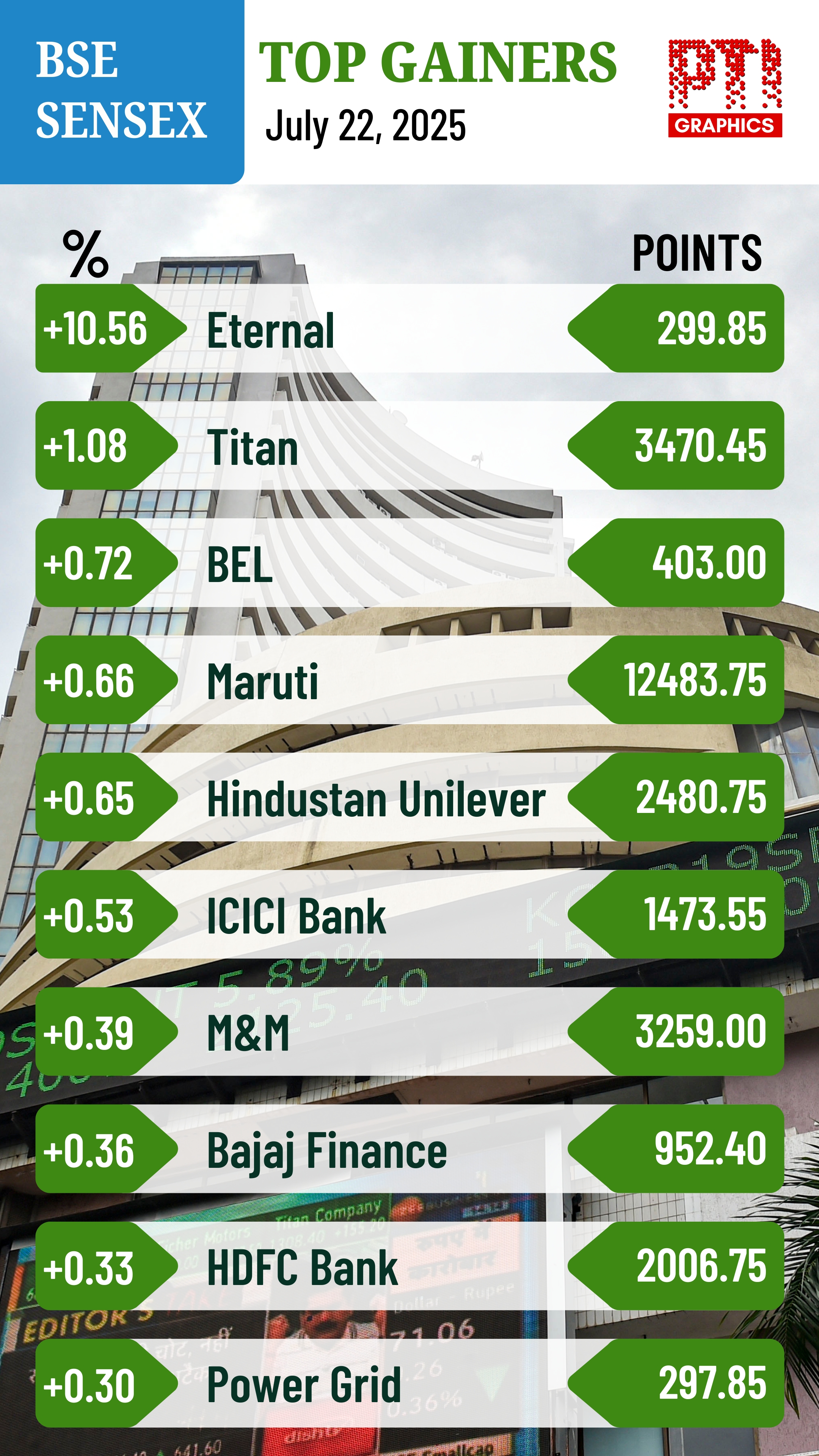
Among Sensex firms, Eternal jumped the most by 10.56 per cent in a post-result rally. Food delivery and quick commerce firm Eternal, which owns the Zomato and Blinkit brands, on Monday reported a consolidated net profit of Rs 25 crore for the June quarter, as continuing investments in quick commerce and going-out businesses weighed on its bottom line.
Titan rose by over 1 per cent while HDFC Bank and ICICI Bank extended gains after their quarterly results.
Hindustan Unilever, Bharat Electronics, Maruti, ICICI Bank and Mahindra & Mahindra were also among the gainers.
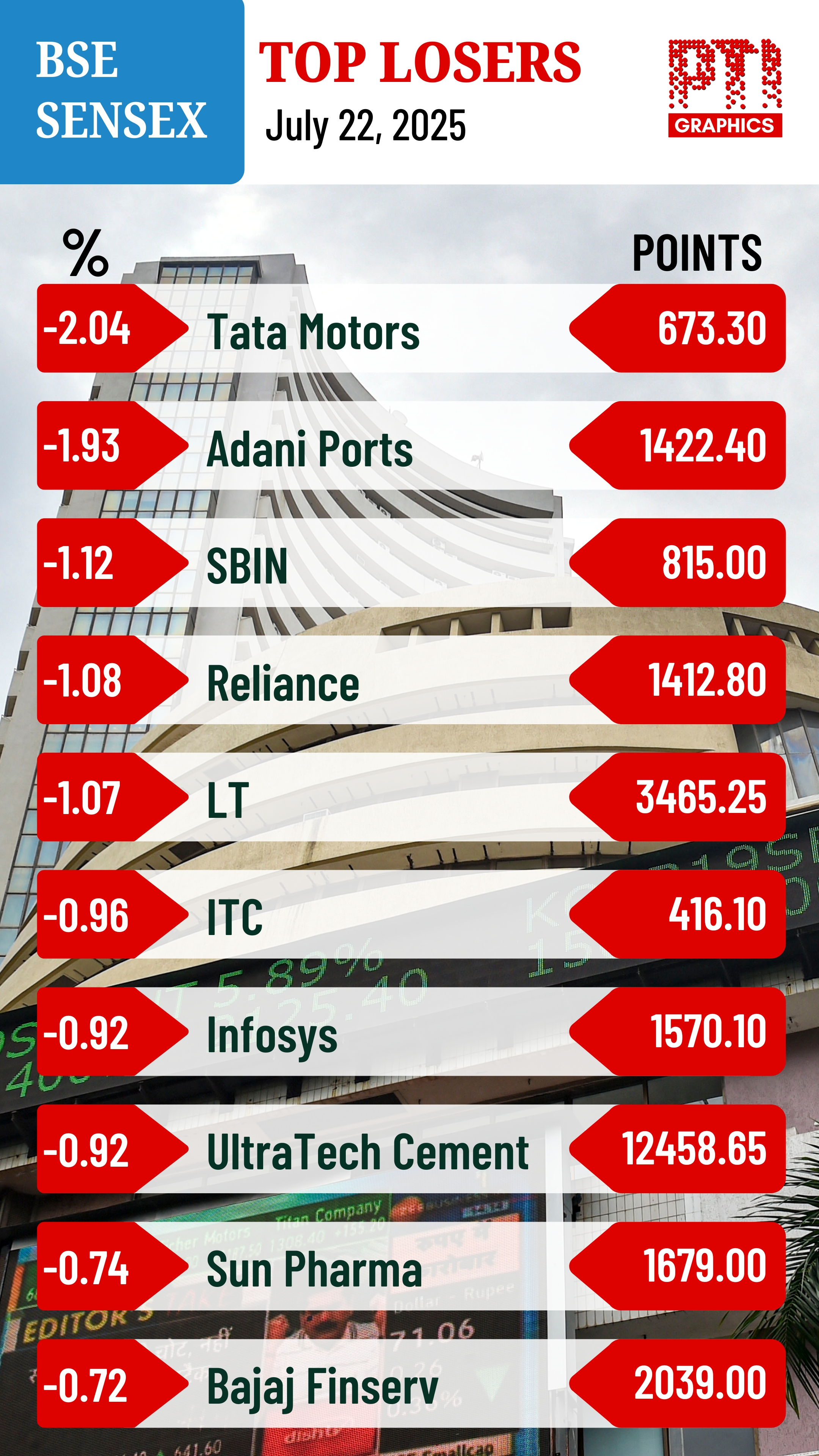
However, Tata Motors, Adani Ports, State Bank of India and Reliance Industries were among the laggards.
"The market’s attention is on quarterly earnings, which slowed lately after some traction from banking stocks. Positivity noticed on Friday and Monday tapered ahead of the critical August 1st deadline of US trade agreement.
"Upside in Q1 earnings will be the critical point to sustain the current premium valuations. Continued profit-booking by FIIs exerts downward pressure, while steady inflows from DIIs could support for a range-bound movement with a positive bias towards Q1 results and trade deal," Vinod Nair, Head of Research, Geojit Investments Limited, said.
The BSE midcap gauge declined 0.62 per cent and smallcap index dipped 0.17 per cent.
Among BSE sectoral indices, realty dropped 1.01 per cent, followed by telecommunication (0.87 per cent), auto (0.78 per cent), IT (0.53 per cent) and teck (0.53 per cent).
Consumer discretionary emerged as the only gainer.
“Markets remained range-bound and ended almost flat, indicating a pause amid mixed signals. The market continues to lack clear direction amid mixed earnings announcements and muted global cues,” Ajit Mishra – SVP, Research, Religare Broking Ltd, said.
In Asian markets, Shanghai's SSE Composite index and Hong Kong's Hang Seng settled in positive territory while South Korea's Kospi and Japan's Nikkei 225 index ended lower.
European markets were trading mostly lower. The US markets ended mostly higher on Monday.
Foreign Institutional Investors (FIIs) offloaded equities worth Rs 1,681.23 crore on Monday, while Domestic Institutional Investors (DIIs) bought stocks worth Rs 3,578.43 crore, according to exchange data.
Global oil benchmark Brent crude dropped 0.97 per cent to USD 68.54 a barrel.
On Monday, the Sensex climbed 442.61 points or 0.54 per cent to settle at 82,200.34. The Nifty jumped 122.30 points or 0.49 per cent to 25,090.70.
Let the Truth be known. If you read VB and like VB, please be a VB Supporter and Help us deliver the Truth to one and all.
Inappropriate for MLAs seeking free IPL tickets, says D.K. Suresh

Bengaluru: Bengaluru Milk Union Ltd President D.K. Suresh on Monday said it is inappropriate for MLAs to seek free IPL tickets, adding that those interested in watching matches should pay for them personally.
Speaking to reporters near his residence in Sadashivanagar, he said, “IPL is a commercial tournament and does not represent the country. It is not right for public representatives to focus too much on such matters.”
Referring to the recent controversy during the RCB celebrations, he said, “let us find out who benefited the most from the statements made during the incident.” He also pointed out that BJP MLAs had received IPL tickets as well.
Responding to discussions about relocating the Chinnaswamy Stadium, Suresh said the government has already approved the construction of a new stadium at a location he had proposed.
“I had suggested building a stadium in Surya City and submitted a proposal for it. Bengaluru needs four stadiums in four directions to cater to its growing population and encourage youth participation in sports,” he said.
He noted that apart from Kanteerava Stadium, KSCA, and the Football Stadium, there are limited facilities in the city.
“When I was a Lok Sabha member, I had proposed allocating 100 acres in my constituency at Surya City. The land was later earmarked and the plan approved,” he added.
Suresh said he has discussed the project with Minister Zameer Ahmed Khan, Rajiv Gandhi Housing Corporation Chairman Shivalingegowda, and Anekal MLA Shivanna.
“The Cabinet has now approved the project, and a stadium will be developed on around 50–60 acres,” he said.
He further added that he has requested the Deputy Chief Minister to build another stadium at Shivarama Karanth Layout through the BDA, where 40 acres have been allocated. Plans are also being discussed to develop a well-equipped stadium in Bidadi.
Commending state government's recent bilingual policy move, Suresh said forcing children to learn three languages could affect their comprehension.
“It is a good decision to make two languages compulsory. Learning a third language should be left to the choice of students and parents,” he said.
Responding to criticism from BJP leaders, he said their tendency is to oppose every decision of the government.
“To please their central leadership, they take a pro-Hindi stance. Instead, they should advocate for the adoption of Kannada in all states,” he said.
When asked about the earlier three-language policy under Congress, he said, “the situation is different now. Today, the focus should be on quality learning. Kannada should remain the primary language, while students and parents can choose an additional language.”


