
Don’t opt for medical profession to make money, do it with an aim to serve people: Dr. Safwan Ahmed
An interview with the recepient of Best Post-Graduate Resident in Neurology - 2019 award at NIMHANS

Managaluru's Dr. Safwan Ahmed was on Monday, September 16, awarded with Dr. Anisya Vasanth Memorial Award for the Best Post-Graduate Resident in Neurology -2019.
The event was attended by Karnataka Chief Minister BS Yediyurappa, Union Health Minister Dr. Harshvardhan, MP PC Mohan, Rajya Sabha MP Dr. Rajiv Gowda, Institute's Director Dr. B N Gangadhar and other dignitaries.
Son of Late Ahmed Hussain and Tasleem of Kaikamba near Mangaluru, Dr. Safwan did most of his schooling in Bajpe. He finished his primary schooling in Popular School Bajpe and high schooling from St. Joseph School Bajpe. He did his PU at St. Aloysius College in Mangaluru and managed to secure a merit Medical seat in KMC Mangaluru with good rank in CET exam.
After MBBS, Safwan completed his MD from Mysore Medical College in General Medicine. There he secured overall sixth rank in Rajiv Gandhi University of Health Sciences and topped the Bengaluru-Mysuru Division of the university during the course and was awarded with the gold medal. Dr Safwan, then joined NIMHANS ( National Institute of Mental Health and Neurosciences) to pursue to do DM in neurology. He has now successfully completed this super speciality with flying colors.
His wife, Dr Fathima Raeesa is doing her post graduate studies in Radiology at KMC, Mangaluru.
Dr. Safwan spoke to Vartha Bharati and shared his success story. During the interview, Safwan termed his latest achievement as a dream come true.
Excerpts:
What motivated you to take medicine as your career?
I was always fascinated with medicine and the profession right from my childhood. Whenever I used to visit doctors, I used to tell myself that I should get into this profession. Moreover, it was also the dream of my parents that at least one among their children should pursue medicine. Every time my father and I passed by Kasturba Medical College in Mangaluru, my father would express his wish for me to study here. So all of these drove me to this field.
How did your family support you in your journey?
My father passed away when I was in first PU. He had supported me all the while. And even after his passing away I never had to seek help from anyone for my studies. He had made all the arrangements for my future studies. He had made sure that there are no hurdles regarding my fees and other requirements. My mother, brother and all my family members have been of great help too.
How did you tackle your strong and weak areas as a student?
By God's grace, i have a sharp memory . That helped me in keeping pace with my academics. My weak area were few subjects like social. I was not very keen or interested in studying the subject. I used to generally go through it and manage it.
What are your hobbies? Did you have enough time to develop them?
To be honest I don’t have any such time consuming hobbies. I would just play some sport whenever I used to get some time. Not regularly. I play, just when I feel like going and taking some time out.
What factors would you attribute your success to?
I will attribute my success to all my family members who stood by me all throughout the journey. My mother, father, brother and my wife. I got married last year and my wife has been a great source of support for me.
What is your message/advice to youngsters who want to make it big in the medical field?
Those who are interested to enter the medical field as their career, they should first understand the seriousness of it. They should commit themselves and make up their mind. Because, when you enter the medical field, there will be a lot of academic pressure. It is not a cakewalk. And to make it big in this field you will have to struggle, study for at least 10-12 years before coming into the profession. I started medical studies in 2005 and studied for 14 years before starting my profession. We should not be here to earn money. Our goal should be helping people and rendering service to the needy.
Now that you have joined Father Mullers Hospital as a consultant neurologist, what are your plans?
Well, I want to set up a unit of Cognitive Neurosciences wherein we can thoroughly understand and treat people suffering from dementia. Cognitive Neuroscience is something where you spend time with the patients, their family and understand them. We need to counsel the family members also to handle the patient well. I am planning to open this unit here.
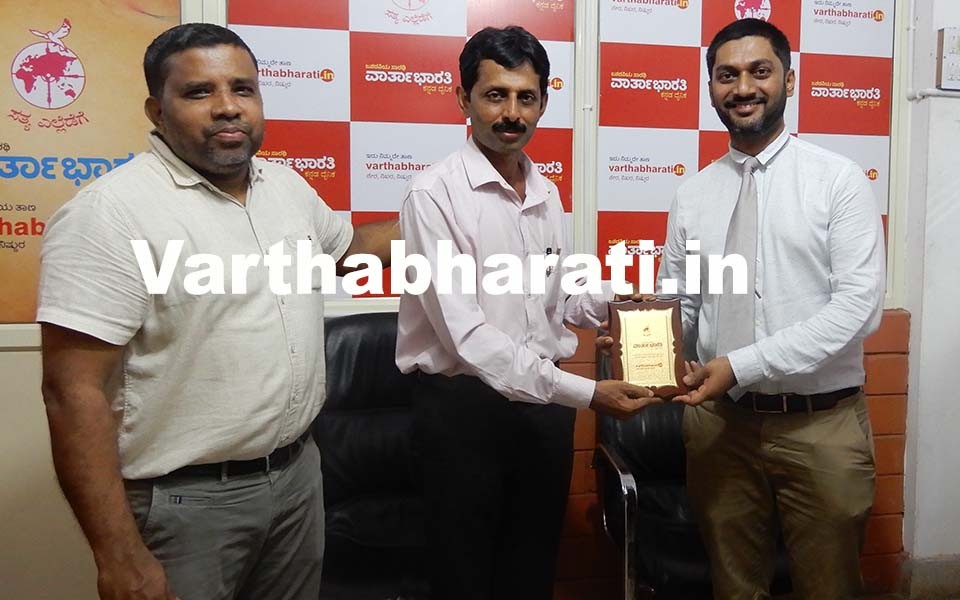
Vartha Bharati Bureau Chief Pushparaj B.N. handing over memento to Dr. Safwan Ahmed at 'Vartha Bharati' office. Kannada News Editor BM Basheer was also present.
Let the Truth be known. If you read VB and like VB, please be a VB Supporter and Help us deliver the Truth to one and all.
Man arrested with Rs 2.54-crore heroin in Mumbai

Mumbai (PTI): Police have arrested a man and seized over 500 grams of heroin worth Rs 2.54 crore in the illicit market from him in Mumbai, officials said on Friday.
The police's Anti-Narcotics Cell (ANC) made the drug seizure in Santacruz in the western suburbs. The operation was conducted by the Kandivali unit of the ANC on Thursday as part of a special crackdown against drug trafficking in the area, they said.
Acting on specific inputs, an ANC team conducted a raid in Santacruz (East) and intercepted a man. During a search, the team recovered 508 grams of high-grade heroin from his possession, an official said.
The seized contraband, a highly addictive, opioid drug derived from morphine, is estimated to be worth Rs 2.54 crore in the international market, he informed.
Following the seizure, a case was registered against the man under relevant sections of the Narcotic Drugs and Psychotropic Substances (NDPS) Act, 1985, and he was formally placed under arrest in the early hours of Friday.
The police are currently investigating the source of the drug and trying to identify the intended recipients of the consignment, he said.


