
India’s Philippine engagement while navigating diplomatic complexities

A confrontation took place on December 10 in the waters of the South China Sea, specifically in the waters of Ren’ai Reef and Scarborough Shoal, where a Chinese Coast Guard ship hosed a Philippines Supply ship. Not long after this incident, a warship from the Indian Navy arrived in the Philippines. On December 12, the anti-submarine warfare corvette, the INS Kadmata, of the Indian Navy arrived in Manila, the capital of the Philippines, and immediately began a joint exercise with the Philippine Navy.
It is believed that this indicates that the maritime relationship between the two countries is getting stronger. The ship’s journey to Manila underscores the Indian Navy’s dedication to maintaining maritime peace in the region.
The procurement of BrahMos supersonic cruise missiles from India by the Philippines bolsters Manila’s strategic approach to the South China Sea. In addition to providing a line of credit to support Philippine defence requirements, New Delhi intends to dispatch a defence attaché to Manila to bolster the security partnership.
In a discussion between Indian and Filipino diplomats in June, India amended its position on the South China Sea Arbitration of 2016, which supports Manila’s territorial claims over China. The altered stance on the arbitration—which opposed China’s claims in the South China Sea, including the Nine-Dash Line, and favoured the Philippines in a territorial dispute—comes at a time when India is increasing its security engagement with South-East Asian countries.
During the 5th India-Philippines Joint Commission on Bilateral Cooperation, which took place in New Delhi from June 27 to June 30, Philippine Secretary of Foreign Affairs Enrique Manalo and Indian External Affairs Minister Subrahmanyam Jaishankar met to discuss a variety of issues between the two countries, India revealed its new stance on the ruling that was handed down in 2016. The statement was released in conjunction with the meeting.
According to the statement, one of the issues that the two diplomats emphasised was their shared interest in a free, open and inclusive Indo-Pacific area. The expansion of India-Philippines relations was acknowledged in the statement, which also characterized the two Indo-Pacific nations as dynamic, young democracies with rapidly growing economies.
The joint statement also emphasised the importance of adhering to international law and promoting peaceful resolution of disputes. The two nations referenced the United Nations Convention on the Law of the Sea (UNCLOS) and the arbitral ruling issued in 2016 regarding the South China Sea.
India’s ambassador to Manila, Shambhu Kumaran, expressed a position similar to that of New Delhi on July 12, which was the seventh anniversary of the verdict made by the arbitral tribunal. He stated that, although every nation is responsible for upholding international law, larger nations may have a greater responsibility to ensure that international law is respected.
Before India changed its stance, New Delhi had just acknowledged the award’s outcome. On the other hand, India has been more supportive of countries throughout the region, such as the Philippines, due to the escalation of the Sino-Indian border conflict over the past few years and its involvement in the Quad’s vision of a Free and Open Indo-Pacific.
India has previously stated that it recognizes that China is the only major power that poses a direct threat to its security interests, both on its border and in the Indian Ocean, even though India has previously committed to a non-aligned position and is reluctant to take sides in issues involving major power competition.
According to experts, India can take a moral stance supporting international law without identifying with any major powers if it endorses the arbitral tribunal’s ruling in 2016. This allows India to continue to support its security objectives from the same perspective. Many nations that can reap the benefits of the arbitral tribunal’s decision from 2016 are consumers, or prospective customers, of India for the sale of Indian defence products, especially BrahMos.
Even though India has expanded its efforts in South-East Asia, the nation continues to exhibit pragmatic restraint to prevent the security architecture in the South China Sea from being undermined to a critical level. To avoid giving the impression that it is interfering in the international affairs of the region, the Government of India is taking extra precautions.
China’s military footprint in the Indian Ocean may be comparable to India’s if India engages in more aggressive military actions in the South China Sea. Beijing has characterized New Delhi’s recent support for Manila and its endorsement of the 2016 international tribunal ruling as an attempt to determine where China’s ‘red line’ rests. However, this does not imply that India will not continue to broaden its assistance to South-East Asian states, such as the Philippines, and to participate in strategic engagement with them.
In recent times, New Delhi has undertaken measures to fortify its security alliances with several South-East Asian nations, such as Vietnam and the Philippines. The Association of South-East Asian Nations (ASEAN) and India established a comprehensive strategic partnership in 2022. The inaugural maritime exercises between the two organizations commenced in 2023.
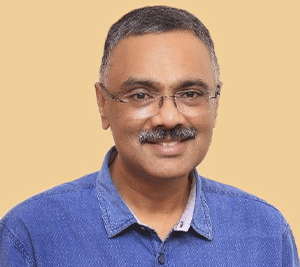
Girish Linganna
Let the Truth be known. If you read VB and like VB, please be a VB Supporter and Help us deliver the Truth to one and all.
KSDL invites innovative technology to check sandalwood theft

Bengaluru (PTI): The Karnataka government has invited farmers, scientists and organisations to come up with innovative technologies to prevent sandalwood theft in the state.
The state-owned Karnataka Soaps and Detergents Limited (KSDL), which manufactures Mysuru Sandal Soap has also planned sandalwood cultivation, state Large and Medium Industries Minister M B Patil said on Thursday.
"In a bid to promote sandalwood cultivation, the KSDL has planned a major initiative. As part of it, farmers, scientists, and organisations possessing information on advanced equipment or innovative technologies to prevent sandalwood theft have been invited to approach KSDL and share the details," Patil said in a statement.
Those interested in this initiative will be given an opportunity to demonstrate such technologies before the organisation, the minister said, adding if the proposed solutions are found suitable and effective, steps will be taken for consideration and implementation.
Patil stated that the cost involved in deploying technologies aimed at preventing sandalwood theft would be borne by KSDL.
Further, with a view to encouraging sandalwood cultivation, four farmers who have supplied the highest quantity of sandalwood to KSDL will be honoured with awards on the occasion of the birth anniversary of Nalwadi Krishnaraja Wadiyar on June 4, he said.
On the same occasion, police personnel and forest officials who have made notable progress in apprehending sandalwood thieves and registering cases, along with members of the public who have provided credible information leading to such action, will also be recognised and rewarded, the minister added.
Patil observed that farmers cultivating sandalwood trees on their lands have been facing increasing threats due to theft in recent years. Illegal felling and theft of sandalwood trees have continued for decades.
Although stringent laws are in place to curb such activities, the number of cases resulting in convictions remains very low, he noted.
"In this context, it becomes the responsibility of the organisation to extend both legal and technical support to farmers and encourage them to take up sandalwood cultivation on a larger scale," he said.
According to him, over the past three years, KSDL has procured 174.5 metric tonne of sandalwood directly from farmers across the state and transferred Rs 6.08 crore to their respective accounts.


