
This two-hundred-year-old mysterious cemetery in Chitradurga has more questions than answers

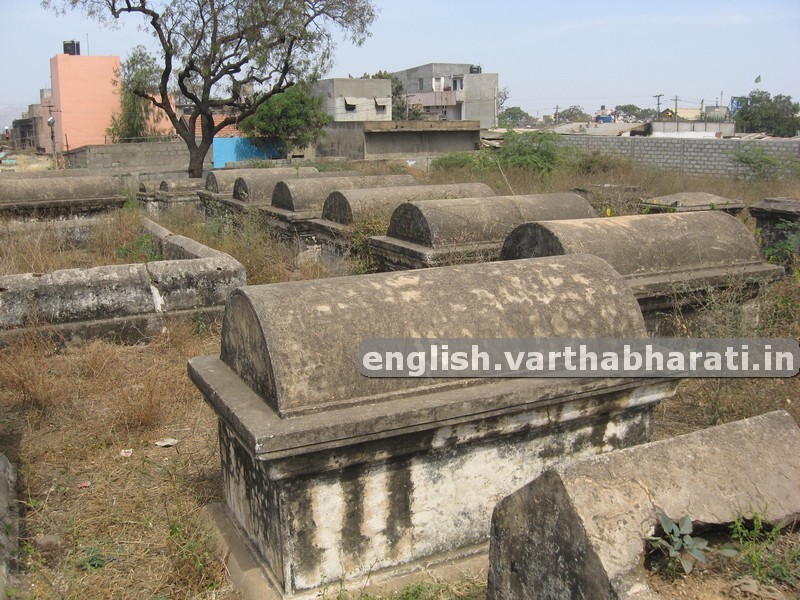
Chitradurga: Passing by the District Head Post Office (HPO) of Chitradurga city, people seldom notice the cemetery located right opposite the HPO. The unusually tall and mini pyramid-like gray structures hardly evoke any curiosity among any passersby. This ancient cemetery which is synonymous to the enigma is located right in the heart of historic Chitradurga city which is only 190 kilometers from Karnataka State’s capital; Bengaluru.
Though Chitradurga city which is a prominent district of central Karnataka is known for its historic Fort, however, this over two-century-old graveyard has remained more like a persona-non-grata for the people here.
Ironically, this mystique and intriguing cemetery which is located in the prime business locality of the city has found no place in the history of Chitradurga.
The Chitradurga City Municipal Council though has the record of this graveyard being owned by the Churches of South India (CSI) for over three decades, however, no record is available with the CMC about the previous owner of it.
Surprisingly, even the CSI has no knowledge about the previous owner(s) and the history of it.
Since there are no official documents available even with the eminent researchers and historians of the Chitradurga district, therefore it is no surprise that this cemetery has a history that is sharply conflicting, contradicting, and mostly created out of the thick rumors.
The over two-century-old enchanting cemetery stands testimony to the British Kingdom who ruled the district for a brief period over two hundred years ago.
Whoever makes some efforts to dig deep into the history of this fascinating yet mystifying place, he/she ends up boggling with more questions than answers.
Though some records available with the historians here confirms beyond doubt that this ancient monument was indeed constructed by the British, however any other details attached to this ancient graveyard is not clear and quite conflicting.
Some four historians of the city have made extensive research on the history of Chitradurga, but when it comes to the history of this Christian cemetery, all the historians make conflicting revelations.
“ Leave alone the history books, even the Chitradurga Gazetteer has no mention about this monument which is standing and battling with the history and the elements for over two hundred years”, said Historian K. Venkannachar.
In the book titled, The History of Chitradurga written by noted historian Dr. M. V. Srinivas in 1979, which was edited by Venkannachar, mentions feebly about the British rule in Chitradurga.
The book explains that in 1799, Chitradurga was under the control of the Mysore ruler, Tipu Sultan, but later it was captured by the British Kingdom after the demise of Tipu Sultan in the fourth Mysore war. The British ruled Chitradurga for less than a year before handing over the city to Mysore Wadeyars.
“During this period, there was gruesome sectarian violence erupted between England and France which is also known as the Anglo-French war, in which Roman Catholics and Protestants soldiers fought each other.
Significantly, the repercussions of the violence spread over many parts of the globe, and even to Chitradurga. Here too, the British soldiers who belong to both sects fought with each other. In this sectarian violence, several soldiers killed. It is believed that the cemetery has the graves of all those soldiers and their family members who died in the violence”, Venkannachar elaborates.
However, he asserts that this history has no documental proof, and is merely based on the legend passed by the successive generations.
Another history Professor, Lakshman Telagavi, gives a completely different version.
According to him, during the British regime, a warehouse storing a huge quantity of gunpowder blasted which killed several soldiers. The British army constructed the cemetery to bury them.
Dr. B. Rajashekharappa, a historian and epigraphist, who vehemently refutes the first two incidents, has even more conflicting details to offer.
He says that during a brief British rule, there was a fight erupted among the soldiers per se, over the treasure found here.
The two groups of soldiers fought over the treasure which resulted in the death of many soldiers and their family members.
Later, the bodies of these victims were buried at the cemetery here somewhere between 1799 and 1780.
Though none of the historians have any record to substantiate their claims, however apparently the date of the incident is the only aspect that is common in their researches.
The dates mentioned by these historians can also be seen on the existing epitaphs inside the cemetery which goes back to 1803. The tombs might have been constructed even before that, but since several epitaphs have been stolen, it is not possible to establish the precise date of construction of the cemetery.
Irrespective of its confusing history, apparently no efforts have been made to preserve this enchanting monument which is under abysmal condition. Several people are now using it for defecation. The filth can be seen spread across the beautiful monument. In the absence of proper care and vigilance, several epitaphs carved in granite stone have already been stolen. A few cenotaphs which are battling with elements are in dilapidated condition.
Though this enigmatic structure is under the possession of CSI, when asked why no care has been taken to maintain it, the authorities cry for funds.
The officials of the Archeological Survey of India (ASI), said that despite the structure being over two hundred years old, it has still not been included under the list of heritage monuments of Chitradurga. As per the ASI guidelines, any monument or structure which is over a hundred years old could be considered as a heritage monument.
“Unfortunately, in 1951 when the ASI conducted a survey, it did not include this graveyard in the list of heritage monuments. It only included those monuments that fell within the 300 acres of Chitradurga Fort”, the officials said.
Let the Truth be known. If you read VB and like VB, please be a VB Supporter and Help us deliver the Truth to one and all.
AIITA welcomes Karnataka’s ban on obscene songs in school events

Bhatkal: The Karnataka unit of the All India Ideal Teachers Association (AIITA) has welcomed the Karnataka government’s decision to strictly ban school children from dancing to obscene songs during educational and cultural programmes in government, aided, and private schools across the state.
AIITA Karnataka State President M. R. Manvi congratulated the government for taking what he termed an important step to preserve the sanctity of education.
“Such decisions to safeguard the dignity of school children and uphold the values of education are the need of the hour. This rule should not be limited to government schools alone but must be strictly implemented in all private educational institutions as well,” he said.
He further urged the government to address other concerns within school programmes.
“The government should not only prohibit obscene dances in the name of school anniversaries, but also ensure that plays and dialogues that incite religious hatred are avoided. Schools should be centres of harmony, not platforms for spreading hatred,” he added.
According to a recent circular issued by the Department of School Education and Literacy, obscene dances are adversely affecting the mental health and moral values of students.
In this regard, schools have been advised to use songs that promote nationalism, positive thinking, the greatness of Kannada culture, and value-based traditions instead of inappropriate content during programmes.
The circular also emphasises that students should be dressed in decent attire.
AIITA also backed the department’s warning that disciplinary action would be taken against head teachers if such guidelines are violated. The association has further demanded that district Deputy Directors of Public Instruction strictly monitor the implementation of these rules.


