
Fact Check: 'Chhapaak' trends on Twitter- and no its screen villain is neither 'Nadeem' nor 'Rajesh'

New Delhi, Jan 8: A day after Deepika Padukone visited the JNU campus to express solidarity with students who had been attacked, her film "Chhapaak" made another splash on Wednesday over the name of its antagonist.
While Deepika was the focus of many a discussion on social media and beyond for showing up at a public meeting in the university, the film based on the life of acid attack survivor Laxmi Agarwal, was also making news for quite another reason.
In what could well be a storm in a 'Twitter cup', "Nadeem Khan" and "Rajesh" began trending on the microblogging site after a magazine article claimed the name of the antagonist had been changed. By 4 pm, 'Nadeem Khan' clocked close to 60,000 tweets and 'Rajesh' close behind with 50,000.
In 2005, Laxmi was disfigured for life when a man called Nadeem Khan and three others allegedly hurled acid at her in Delhi's upscale Khan Market.
In the film based on her life, the narrative remains the same but the names have been changed. So, Laxmi is 'Malti' Agarwal and Nadeem becomes 'Babboo' aka 'Bashir Khan'.
On Wednesday, Swarajya magazine wrote an article headlined, "The Ways Of Bollywood: In Deepika Padukone-Starrer Chhapaak, Acid Attacker Naeem Khan Becomes Rajesh'."
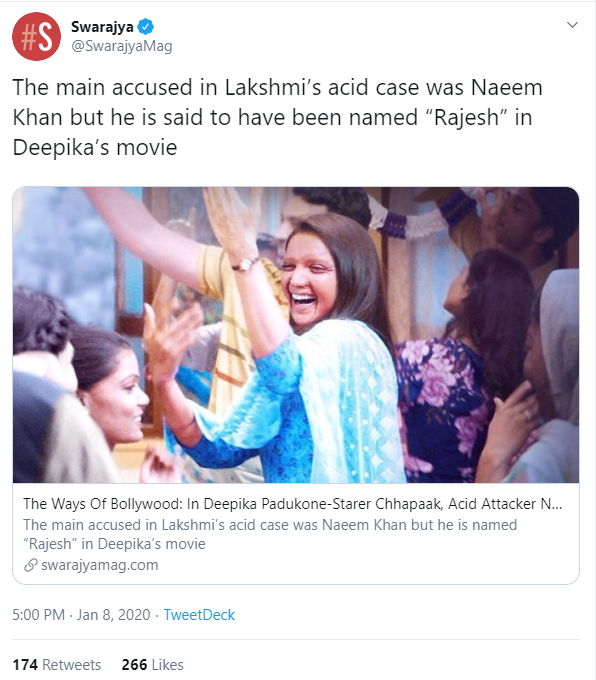
"As part of a backlash against Padukone's JNU 'meet and greet', social media users researched the names of the characters involved in the movie Chhapaak and conspicuously found the name of main perpetrator Naeem Khan absent," the article alleged.
But in the Meghna Gulzar directed film, there is no mention of any Nadeem or Naeem Khan. Moreover, Rajesh is the name of Malti's boyfriend.
Minister of State for Environment, Forest and Climate Change Babul Supriyo jumped into the controversy, saying it was another example of "absolute hypocrisy".
"...When you say all characters are fictitious and don't have any resemblance with living beings and all of that, this is absolute hypocrisy. When you change the name which also changes the religion, it has been done very deliberately," Supriyo told a TV channel when asked to comment on the controversy.
South Delhi BJP MP Ramesh Biduri also called for a boycott of the movie.
With Deepika grabbing attention by going to JNU, many appreciated her 'silent solidarity' but others criticised her for "supporting the Leftists" and said it was a promotional stunt ahead of the release.
"#Boycott Chhapaak" was trending on Twitter as was "#ISupportDeepika".
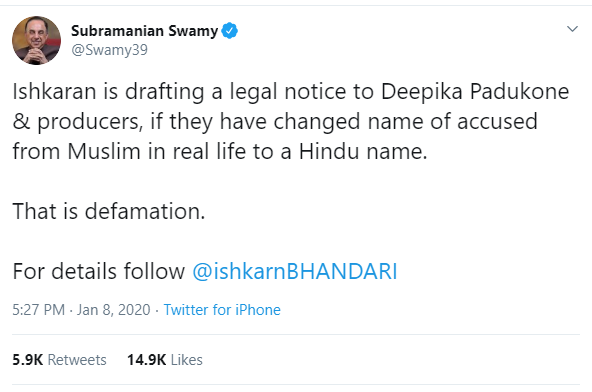
#Chhapaak trends on Twitter - and no its screen villain is neither 'Nadeem' nor 'Rajesh'.
— Radhika Sharma (@KhayalaBibi) January 8, 2020
Unlike the #FakeNews peddlers, I was fortunate to watch a special screening of the film last evening.
Here goes, my report for @PTI_News. https://t.co/HhNIEjRDya
Let the Truth be known. If you read VB and like VB, please be a VB Supporter and Help us deliver the Truth to one and all.
Congress using hijab issue to pacify minority anger, alleges Karnataka LoP R Ashoka

Bengaluru: Leader of Opposition in the Assembly R. Ashoka has accused the Congress government of using the hijab issue to placate what he described as discontent among minority voters after the Davanagere by-election.
In a post on X on Wednesday, Ashoka alleged that the state government, instead of addressing issues such as price rise, corruption, farmers’ distress and law and order, was attempting to retain its minority vote base by reviving the hijab issue.
Referring to the 2022 dress code introduced by the BJP government, which prohibited hijab in schools and colleges, Ashoka said the Karnataka High Court had upheld the policy and emphasised the importance of discipline in educational institutions.
He questioned the Congress government’s move to revisit the issue and asked whether setting aside the court-backed policy to benefit one community could be described as secularism.
Ashoka further alleged that while the government was willing to permit hijab, it continued to prohibit saffron shawls.
He accused the government of dividing students on religious lines rather than treating schools and colleges as spaces of equality.
Drawing a comparison with Mamata Banerjee’s government in West Bengal, Ashoka claimed that excessive appeasement politics had harmed the state and warned that the Congress in Karnataka could face a similar political response.
He said voters in Karnataka would teach the Congress a lesson for what he termed “vote-bank politics” and for compromising constitutional and judicial principles.


