
Ajman: K’taka Ministers visit Thumbay Medicity, to explore collaboration in Medical Education
Collaboration in healthcare, skill development discussed

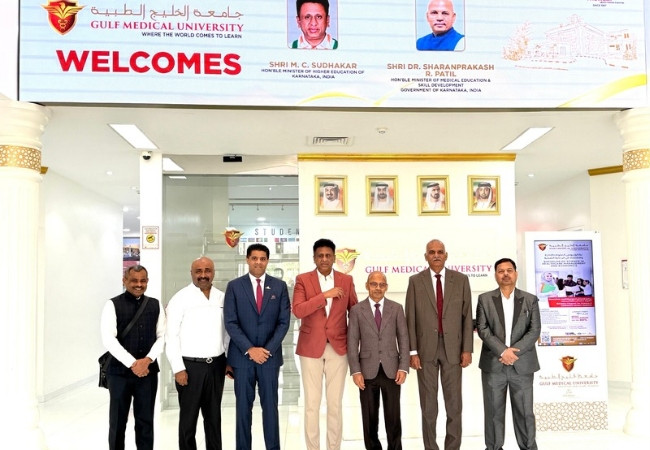
Ajman: Two ministers from the Karnataka government visited Thumbay Medicity in Ajman to study possible collaboration in medical education, healthcare and skill development. Thumbay Medicity, founded by Dr. Thumbay Moideen, houses Gulf Medical University (GMU) and a network of teaching hospitals and training centres.
The delegation included Dr. Sharanprakash R. Patil, Minister for Medical Education and Skill Development, and Dr. M. C. Sudhakar, Minister for Higher Education. They were received by Akbar Moideen Thumbay, Vice President – Healthcare Division, Thumbay Group, along with Prof. Manda, Chancellor of GMU, and members of the university’s senior leadership.
The visit began at Gulf Medical University with a tour of its academic and research facilities, including simulation centres, laboratories and interprofessional learning spaces that bring together students from more than 111 nationalities. The ministers then toured the Thumbay Physical Therapy and Rehabilitation Hospital, the Thumbay Dental Hospital and the Thumbay University Hospital, which is among the largest academic hospitals in the UAE.
Speaking during the visit, Dr. Sharanprakash R. Patil said: “Walking through Thumbay Medicity gives a clear sense of how a strong vision can transform education and healthcare. The way Dr. Thumbay Moideen has built this entire ecosystem in such a short time is truly remarkable. His commitment to global-standard training, innovation, and service is evident at every corner of Gulf Medical University and its hospitals. We look forward to exploring collaborations that will benefit students, clinicians, and institutions in Karnataka.”
Dr. M. C. Sudhakar said: “It is inspiring to see how far Dr. Thumbay Moideen has taken the Thumbay name on the global stage. Being from Karnataka, he has made us proud with what he has created here in the UAE. Thumbay Medicity stands as a world-class model for integrated higher education and healthcare. The academic environment at GMU, the diversity of students, and the strong research focus open meaningful opportunities for joint programs, exchange pathways, and collaborative research with institutions back home.”
Dr. U.T. Iftikhar Ali, Chairman of the State Allied and Health Care Council, and Mohd Mohsin, Principal Secretary to the Karnataka government, were also part of the delegation.
Let the Truth be known. If you read VB and like VB, please be a VB Supporter and Help us deliver the Truth to one and all.
Congress using hijab issue to pacify minority anger, alleges Karnataka LoP R Ashoka

Bengaluru: Leader of Opposition in the Assembly R. Ashoka has accused the Congress government of using the hijab issue to placate what he described as discontent among minority voters after the Davanagere by-election.
In a post on X on Wednesday, Ashoka alleged that the state government, instead of addressing issues such as price rise, corruption, farmers’ distress and law and order, was attempting to retain its minority vote base by reviving the hijab issue.
Referring to the 2022 dress code introduced by the BJP government, which prohibited hijab in schools and colleges, Ashoka said the Karnataka High Court had upheld the policy and emphasised the importance of discipline in educational institutions.
He questioned the Congress government’s move to revisit the issue and asked whether setting aside the court-backed policy to benefit one community could be described as secularism.
Ashoka further alleged that while the government was willing to permit hijab, it continued to prohibit saffron shawls.
He accused the government of dividing students on religious lines rather than treating schools and colleges as spaces of equality.
Drawing a comparison with Mamata Banerjee’s government in West Bengal, Ashoka claimed that excessive appeasement politics had harmed the state and warned that the Congress in Karnataka could face a similar political response.
He said voters in Karnataka would teach the Congress a lesson for what he termed “vote-bank politics” and for compromising constitutional and judicial principles.


