
Gulf Medical University Celebrates 21 Years of Excellence in Education, Healthcare and Research

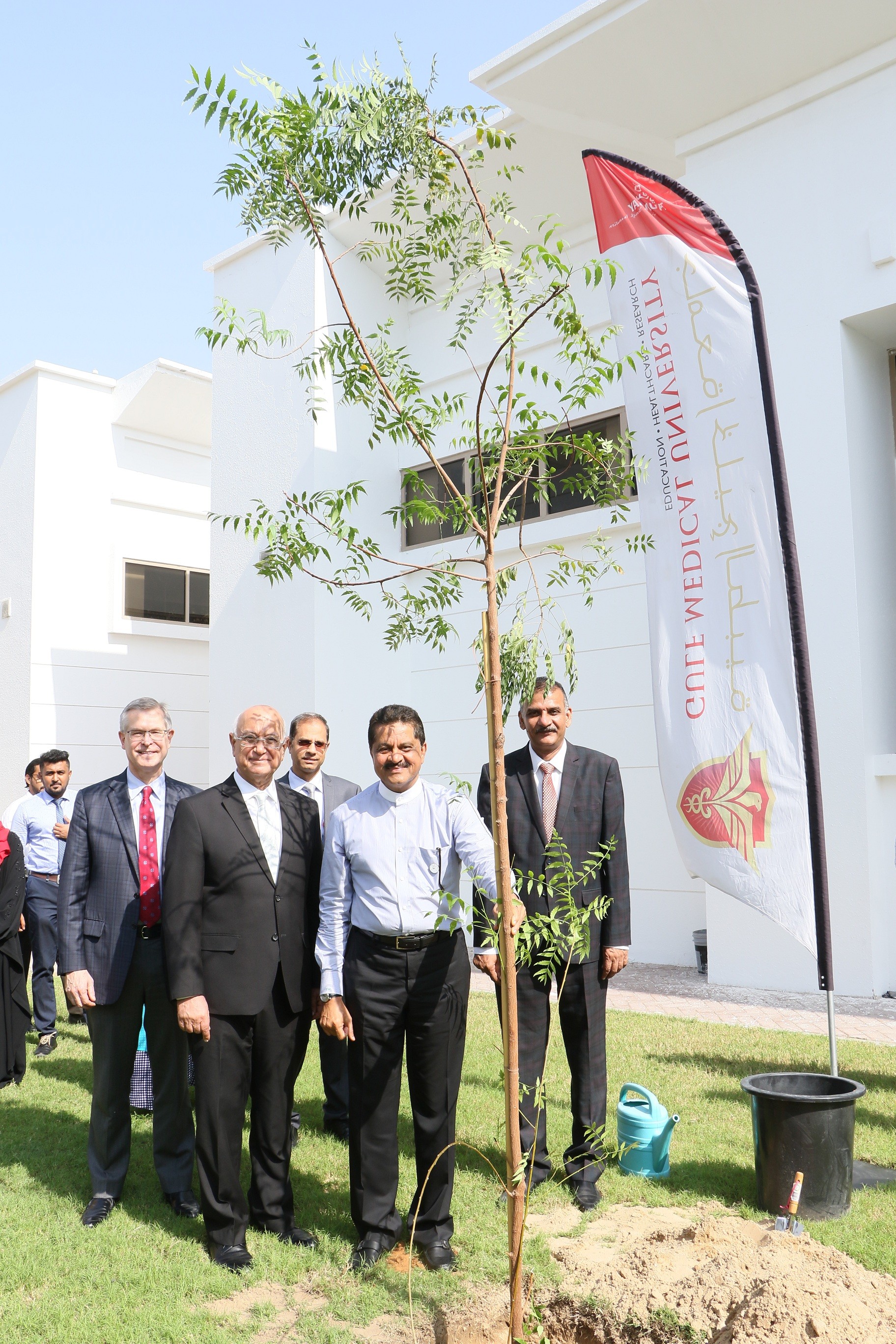
Gulf Medical University (GMU), Ajman, the biggest private medical university in the Middle East region celebrated its 21st anniversary with a cake-cutting ceremony and a tree-planting event at the university campus, on 5th November 2019. The ceremony was attended by Dr. Thumbay Moideen – Founder, President Board of Trustees GMU, Prof. Hossam Hamdy – Chancellor of GMU, Prof. John R. Raymond – President & CEO of the Medical College of Wisconsin, USA & Member of the Board of Trustees, GMU, Prof. Manda Venkatramana - Vice Chancellor Academics, the Deans of the colleges of GMU as well as other staff and students.
Addressing the gathering, Dr. Thumbay Moideen said that he was grateful to the Almighty, the rulers of the country and his team at GMU, for the continued success and growth of the University. “The completion of 21 years is a significant landmark for Gulf Medical University, as we transform into a leading Academic Health System delivering futuristic medical education at the same providing state-of-the-art healthcare and leading innovative research.”
Elaborating on the future strategic directions of GMU, Prof. Hossam Hamdy said, “GMU is committed to producing healthcare professionals of the future. We are now moving towards becoming a research-intensive university. The type of research which we are running here in cancer immunology and genetics is a very important area. The science of medical education, focusing on the futuristic views of education is another important area of research at GMU. We have the highest number of publication, in reputed journals, regarding medical education; how to build medical schools and health professionals of the future.”
Prof. John R. Raymond said that he was impressed with the growth of GMU, and its approach to medical education and research. “GMU is a dynamic organization. The quality of the faculty and students are quite outstanding. They are deeply committed to doing things collaboratively and innovatively. The student community here is a fine example of inclusion and diversity, which brings strength to the institution. What impresses me the most is the vision and the leadership of GMU. The University also places a lot of emphasis on inter-professional education, blending real-world skills with modern technology. Besides, there is a remarkable synergy between the academic health centers that constitute the GMU Academic Health System.”
A neem tree was planted in the University campus during the 21st anniversary celebrations, as a symbol of growth and purification.
GMU has collaboration agreements with around 68 top international universities in Europe, United States, Japan and Far East, giving the students opportunities for trainings abroad. Graduate programs are now being offered jointly and in collaboration with the University of Arizona, United States, Virginia Commonwealth University, United States, Medical College of Wisconsin, United States, FAIMER, United States, CenMedic, United Kingdom and Tokyo Medical and Dental College, Japan. GMU also provides merit-based scholarships to students.
Offering a total of 26 accredited programs through its 6 colleges, the University has been at the forefront of attaining international recognitions, some of the recent ones being the College of Medicine’s recent accreditation based on ‘World Federation of Medical Education’ standards, becoming the first in the UAE and the Gulf region to achieve this feat. The Doctor of Pharmacy (PharmD) program offered by our College of Pharmacy was recognized by the Accreditation Council for Pharmacy Education (ACPE), making it the first internationally certified entry-to-practice PharmD program in UAE. Recently, GMU also hosted the prestigious MRCPUK PACES (Practical Assessment of Clinical Examination Skills) exam in collaboration with the Federation of the Royal Colleges of Physicians of the United Kingdom, joining the exclusive list of international PACES exam centers in the region.
.JPG)
Let the Truth be known. If you read VB and like VB, please be a VB Supporter and Help us deliver the Truth to one and all.
Malayalam film director Ranjith remanded in sexual assault case; FEFKA takes action

Kochi (PTI): A court here on Wednesday sent noted Malayalam film director Ranjith to judicial custody after he was arrested late last night in connection with an attempted sexual assault case.
Following his remand, the director claimed that the accusations against him were "false" and that he would be able to prove it.
He made the claim before reporters while being taken inside the sub-jail here.
Even as the director claimed innocence, state Culture Minister Saji Cherian indicated that the government and the police were with the victim, and the Film Employees Federation of Kerala (FEFKA) recommended suspension of Ranjith's membership from the directors and writers unions.
The police said that the victim was "traumatised" by the incident and had to undergo counselling and psychiatric treatment before she could come forward with the complaint.
Kochi City Police Commissioner S Kaliraj Mahesh Kumar said that a Special Investigation Team was formed after recording the victim's statement, and then the allegations were discreetly verified before moving forward with the arrest.
"It should not happen to any woman, especially at the workplace," he told reporters here.
The officer also said that the director had attempted to remove himself from the area.
Kumar also said that the biggest challenge before the police was to maintain the confidentiality of the case and protect the identity of the victim.
He also said that there were several witnesses to the alleged sexual assault, as the incident happened on a shooting set.
The officer said that the evidence collection was progressing, and the director's custody will be sought when required.
FEFKA general secretary B Unnikrishnan told reporters here that there was no complaint made to the Internal Complaints Committee (ICC) in connection with the incident.
FEFKA is an association of several craft unions in the Malayalam film industry.
Ranjith was taken into custody from the Idukki district on Tuesday evening, and subsequently, his arrest was recorded.
He was produced at the residence of a magistrate here in the morning and remanded to judicial custody for 14 days.
The case against Ranjith was registered by Kochi City Police a few days ago based on the victim's complaint.
Earlier in the day, Cherian told reporters that "such acts will not be accepted by the government or the society" and that the government and the police were with the victim.
Ranjith was appointed as chairman of the Kerala State Chalachitra Academy in 2022 and resigned from the post in 2024.
The minister said that the director was appointed to the post because he was qualified for it, and at that time, there were no such allegations against him.
"He carried forward the academy in a good way. When such allegations came up earlier, he had left the position. We are viewing the repetition of the same allegations against him seriously. Neither the police nor the government is protecting him," he said.
He said that the quick action taken against the director is an outcome of the recent changes in the movie sector, including holding of the cinema conclave and the state film policy.
"Let the investigation take its course," he added.
The minister also said that anyone in the film sector having similar bad experiences can come forward with a complaint and stand firm on it, as the government will be with them.
According to the police, the woman actor alleged that the director had invited her to a caravan during the shooting of a film and attempted to sexually assault her.
Ranjith had earlier faced allegations of sexual harassment following revelations in the Justice K Hema Committee report on harassment and abuse in the Malayalam film industry.
In 2024, a case was registered against Ranjith after a Bengali actress filed a complaint with the Kochi City Police Commissioner.
The complaint, sent via email, alleged that Ranjith had touched her inappropriately with sexual intent after inviting her to act in the film Paleri Manikyam in 2009.


