
'Are we not citizens of this country,' asks Kolkata's 'Shaheen Bagh' as CAA protests continue

Kolkata, Jan 12: Protests in the city against the amended Citizenship Act has broadened the outlook of many people who had stopped interacting with their friends from other communities over recent socio-political developments in the country.
One among them is Muzaffar Ali, a garments trader from Beniapukur area, who had felt hesitant to discuss with his friends from other communities about certain "sensitive issues" and "felt ostracised".
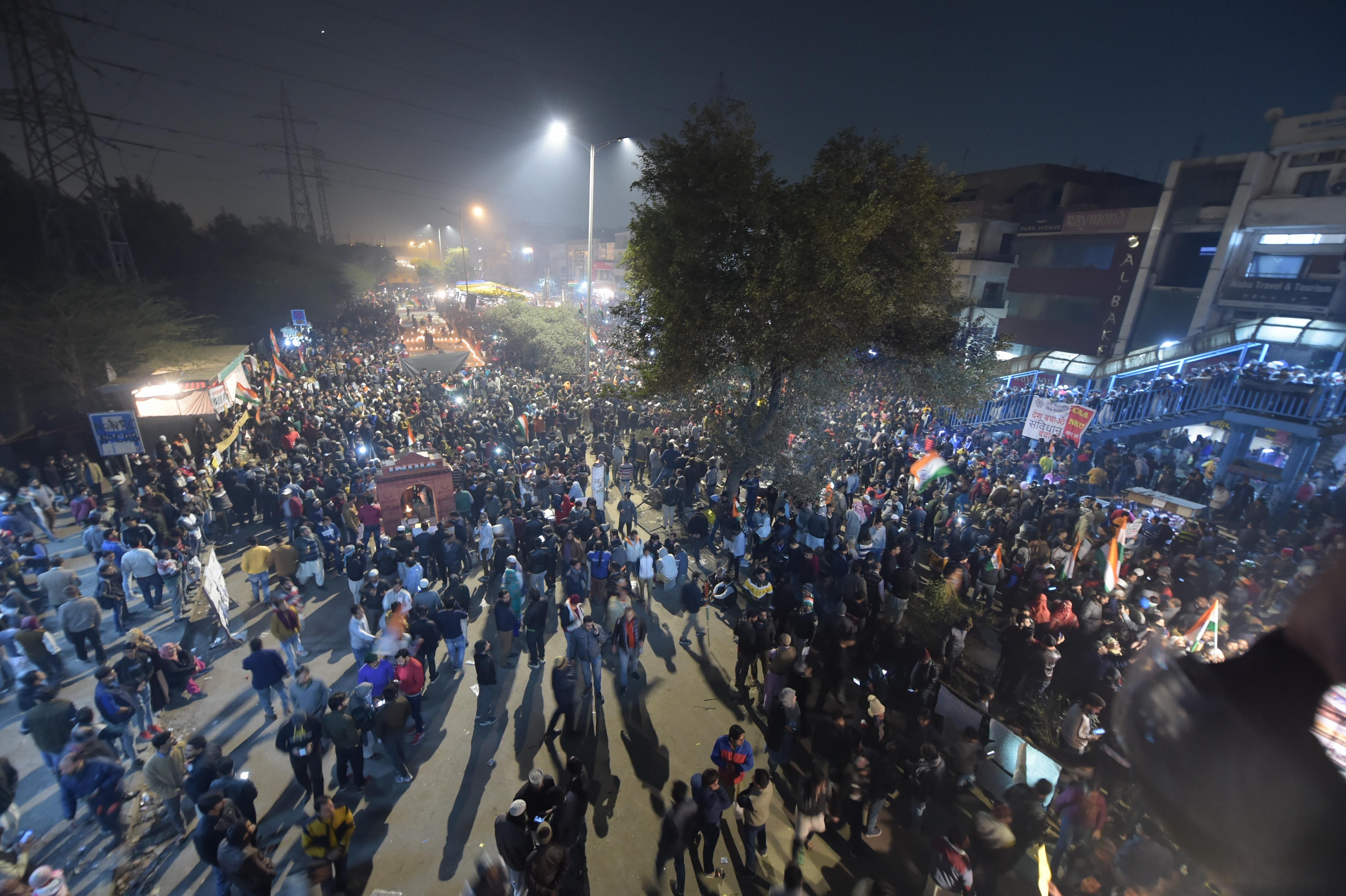
Ali, in his 40s, now participates in anti-CAA rallies and an indefinite demonstration by women in Park Circus area, being touted as Kolkata's 'Shaheen Bagh', against the new citizenship law.
The businessman, who participated in one such rally at Zakaria Street recently, said he discovered a new side of the city, as strangers from other communities, many of them in their youth, turned up in droves at protests against the contentious law.
"From bright young boys and girls to social activists, writers and artistes, many people have assembled at a protest site in Park Circus and are giving speeches from a makeshift podium. This is a spontaneous, apolitical movement against CAA and NRC," Ali told PTI on Sunday.
Ali said he had never participated in similar rallies with people of other communities in the past.
"The outpour has made me realise the love and bonding among people and I have started to open up. My two school- going sons have told their friends from other communities that they will never part ways," he said.
Around 30 women have been staging a sit-in protest against CAA, the National Register of Citizens (NRC) and the National Population Register (NPR) in Park Circus since January 7 on the lines of the Shaheen Bagh protest, mainly led by Muslim women, in Delhi.
Nirufa Khatoon, one of the protesters, said, "I was born here. My grandfather was born here. During partition, my predecessors had opted to stay back in India as it is our motherland."
"But now, I am afraid that the BJP wants to take my right to live in my city. Are we not citizens of this country?" she said, vowing not to withdraw the stir till the Centre takes concrete steps to revoke CAA, NRC and NPR.
Another woman participant, Sabina said, "After several discussions, we had decided to begin the sit-in as the Muslim women, of all generations, expressed eagerness to take part in a dharna when our male family members were already out on the streets. Ours will be a peaceful protest."
Also present in the sit-in was Moutusi Banerjee, a former Calcutta University alumna who is working with a production house.
"I had first participated in a rally from Sealdah to Esplanade where thousands of people had raised slogans against CAA, NRC and NPR. Since then, I had been planning to join the Park Circus protest and finally, I am here," she said.
The women agitators have been joined by Ali and other men of the locality including Firoz Islam, a fruit-seller by profession.
"It has become my duty to be on the side of those who have left behind their work for a greater cause. I cannot stop my business as my earning depends on it. But, I can express my solidarity," Islam said.
Let the Truth be known. If you read VB and like VB, please be a VB Supporter and Help us deliver the Truth to one and all.
Ordinance issued to increase number of Supreme Court judges from 34 to 38

New Delhi (PTI): The government has promulgated an ordinance to increase the strength of the Supreme Court from the present 34 judges to 38, including the Chief Justice of India.
The law ministry notified the ordinance on Saturday, which amended the Supreme Court (Number of Judges) Act, 1956, to increase the sanctioned strength of the top court.
So far, the sanctioned strength of the top court was 34, including the Chief Justice of India (CJI). Now, the number of judges has been increased by four, taking the sanctioned strength to 38.
The top court will now have 37 judges, other than the CJI.
With the apex court having two vacancies at present, and the ordinance coming into force immediately, the Supreme Court Collegium will now have to recommend six names for appointment as judges in the top court.
A bill will be brought in the Monsoon Session of Parliament to convert the ordinance – an executive order – into a law passed by Parliament.
The Union Cabinet had cleared a draft bill on May 5 to increase the number of apex court judges.
The strength of the Supreme Court was last increased from 30 to 33 (excluding the CJI) in 2019.
The Supreme Court (Number of Judges) Act, as originally enacted in 1956, put the maximum number of judges (excluding the CJI) at 10.
This number was increased to 13 by the Supreme Court (Number of Judges), Amendment Act, 1960, and to 17 by another amendment to the law.
The Supreme Court (Number of Judges) Amendment Act, 1986, augmented the strength of judges from 17 to 25, excluding the CJI.
A fresh amendment in 2009 further increased the strength from 25 to 30.
Article 124(3) of the Constitution lists the qualifications required to become a Supreme Court judge.
An Indian citizen who has either served as a high court judge for at least five years, or as an advocate for 10 years, or is a distinguished jurist, can be appointed to the top court.
The strength of the Supreme Court is increased based on the recommendations of the CJI, who writes to the Union law minister. After consulting the finance ministry, the Department of Justice under the law ministry moves the Cabinet with a draft bill.


