Countries have right to respond to situations but should be mindful of civilian casualty: Jaishankar

New Delhi, Dec 5: Countries have right to respond to situations but they should be mindful of civilian casualties and must observe humanitarian laws, External Affairs Minister S Jaishankar told Rajya Sabha on Thursday.
Responding to supplementaries during the Question Hour regarding India's position on the ongoing conflict between Israel and Palestine, he said, "We condemn terrorism, we condemn hostage-taking. We do believe countries have the right to respond to the situation but countries should be mindful of civilian casualties. They must observe humanitarian law and we would like a ceasefire and an early end of violence."
When asked the reason for India's abstention from a resolution in the UN General Assembly on October 27, 2023, regarding the protection of civilians and upholding legal and humanitarian obligations, Jaishankar said there were many resolutions in the UN General Assembly and in some India abstained and in some, it voted in favour.
According to him, there are several reasons to abstain such as a resolution is not balanced, it is more divisive, it can set a precedence which has consequences for India or it has larger implications.
"In this particular case, we felt that the resolution was not well-drafted and not well-considered. We had reservations on the language. Our concern was not accommodated. That is why we abstained," he said.
Responding to TMC MP Saket Gokhle, who asked about India's position on a ban imposed by the Israeli government on the UN aid agency UNRWA and how India is sending aid to Palestine, Jaishankar said the government has stood by its decision to send humanitarian aid and it has just released the latest tranche of support to the UNRWA.
He further asked that India always supported a two-state solution and in the UN, India abstained on a resolution against Israeli illegal settlement in the West Bank.
What is India's position on the illegal settlement made by Israel in the West Bank in Palestine," Gokhale asked.
"Regarding the two-state solution, we supported the two-state solution. We have been public and unambiguous about that. There should be no cause for confusion regarding a two-state solution," Jaishankar answered.
He reiterated that the wording of resolutions is important for deciding to support them.
Talking about the October 27, 2023 resolution, he said, "There was no reference to terrorism. There was no reference to hostage-taking. In our mind if a resolution doesn't reflect the entirety of a situation, it is not a balanced resolution. A country like India which is itself a victim of terrorism, if we countenance the fact that terrorism is underplayed and ignored, it is not in our interest that we do so (support)."
When asked about India's position on the International Court of Justice's warrant against Israel Prime Minister Benjamin Netanyahu, former Israel Defence Minister Yoav Gallant and a Hamas leader for war crimes, the minister said, "India is not a member of the International Criminal Court. When the International Criminal Court was constituted, the question of our membership was considered. For very good reason and after a great deal of deliberation, India decided not to become a member. With regard to any decision passed by the ICC, it is not binding on us."
Highlighting India's humanitarian assistance to Palestine, he said New Delhi has given assistance to people of Palestine at this particular time by making an annual contribution of USD 5 million to UNRWA the main assistance-providing agency.
"This amount traditionally used to be USD 1 Million. This government decided to raise it from USD 1 million to 5 million," he said.
Jaishankar added that India has provided 70 metric tonnes of aid of which 16.5 was of medicine in 2023.
"We have given 65 metric tons of medicines to the Palestinian Authority and UNRWA in 2024. We have provided 33 metric tons of medicine to Lebanon," he said.
Let the Truth be known. If you read VB and like VB, please be a VB Supporter and Help us deliver the Truth to one and all.
KMES Institutions shine in SSLC result, continue four-decade legacy of education in rural Karkala

Karkala: KMES Institutions of Education at Kukkundooru in Karkala taluk has recorded outstanding results in the 2025-26 SSLC and PUC examinations, continuing a four-decade educational journey that began with just 22 kindergarten students and no building of its own.
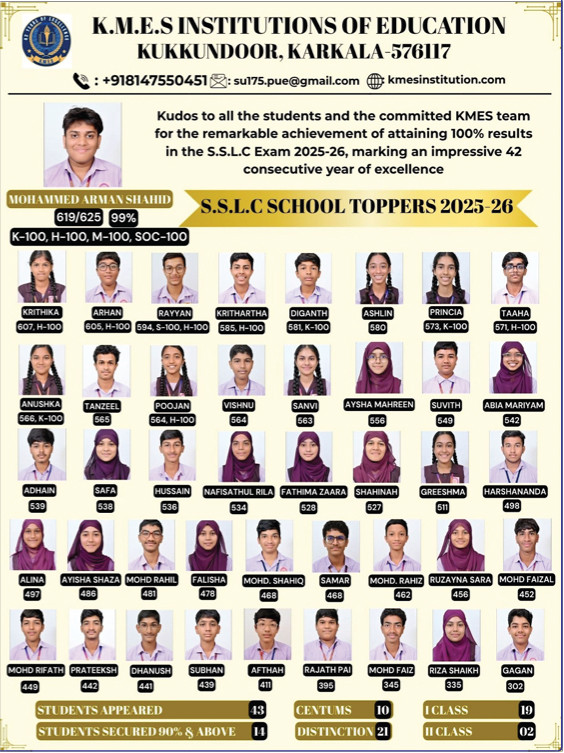
The institution secured a 100 per cent result in the SSLC examinations, with all 43 students passing the examination this year.
Muhammad Arman Shahid emerged as the school topper by scoring 619 marks out of 625, securing 99 per cent and also ranking sixth at the state level. He scored full marks in Kannada, Hindi, Mathematics and Social Science.
Krithika V. Nayak secured the second position in the school with 607 marks and 97.12 per cent, while Arhan stood third with 605 marks and 96.8 per cent.
Out of the 43 students, 21 passed with distinction, 19 secured first class, two students obtained second class and one student passed in third class. Fourteen students scored above 90 per cent.
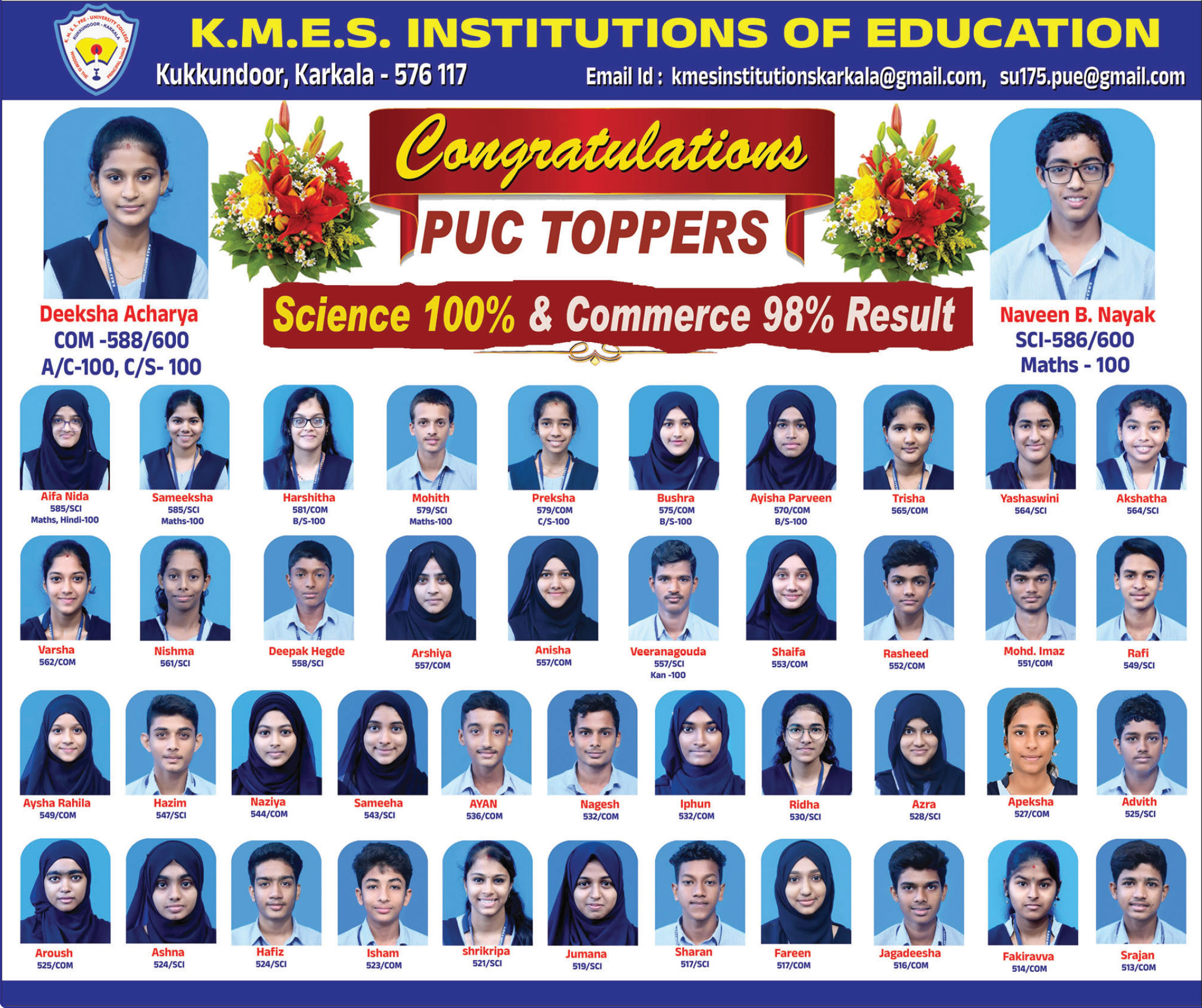
The institution also performed strongly in the PUC examinations. The Science stream recorded a 100 per cent result, with all 44 students passing, while Commerce secured a 98 per cent pass percentage.
Twelve students scored full marks in different subjects, including Mathematics.
In Commerce, Deeksha Acharya topped the college with 588 marks, while Harshitha H. Kini secured the second position with 581 marks.
In Science, Naveen B. Nayak emerged as topper with 586 marks, followed closely by Sameeksha Moily and Aifa Nidha, who both secured 585 marks.
Speaking about the achievement, High School head teacher Shrimati Patkar said the institution has always focused on supporting academically weak students through affordable education and free special classes.
“Our ambition is to provide quality education even to students who struggle in studies. The fees are very low, and free coaching classes are conducted. I have worked here for 28 years and have always found the atmosphere supportive of education,” she said.
Primary School head teacher Lolita Zeena D’Silva appreciated the dedication of the teaching staff and said the school encourages students not only to achieve high marks but also to become role models.
PU College Principal Balakrishna Rao said the institution focuses on value-based education and overall personality development.
“The aim is to help students succeed not only academically but also in cultural activities, sports and leadership. We encourage qualities such as patience, tolerance and discipline,” he said.
Rao also credited the institution’s growth to the support of founders K.S. Mohammed Masood and K.S. Nissar Ahmed, along with President K.S. Imtiaz Ahmed.
Speaking on the occasion, Imtiaz Ahmed said the institution was built on the dream of making quality education accessible to financially backward families in rural areas.
He said the guidance and encouragement of his elder brothers, Mohammed Masood and Nissar Ahmed, along with the contribution of teachers, students and parents, helped transform the institution into a model educational centre.
The KMES Institutions trace their roots back to 1984, when they were founded by senior social activists Haji P.M. Khan, K.S. Nazeer Ahmed and Haji A.S. Rashid Haider.
The institution initially functioned from the Government Urdu School premises as it did not have a building of its own. Classes began with only 22 students in lower kindergarten and two teachers.
Later, under the leadership of K.S. Mohammed Masood and with continuous financial and moral support from non-resident businessman K.S. Nissar Ahmed, the institution gradually expanded.
In 1993, the school shifted to its own building and began conducting classes from LKG to Class 5.
As student admissions increased, Nissar Ahmed personally funded the construction of three additional classrooms to address infrastructure shortages.
The institution’s new school building was completed in 1997, while the PU College building was constructed in 2001.
From humble beginnings in a borrowed building to producing state-level rank holders and consistent academic results, the KMES Institutions have grown into one of the prominent educational centres in the Karkala region.