Delhi to get 10,000 CCTV cameras, 10 gaushalas, street dog shelters: CM Rekha Gupta at R-Day event

New Delhi (PTI): In her maiden address at the Delhi state Republic Day function on Sunday, Chief Minister Rekha Gupta asserted that the city needs to become India's strongest economic hub.
Addressing the function at the Chhatrasal Stadium, she said the India-EU trade deal, which could be announced this week, could benefit Delhi by opening doors for the city's Micro, Small, and Medium Enterprises (MSME) sector to millions of consumers in European Union countries.
The state's Republic Day event is held annually on January 25.
Gupta highlighted her government's work in the past 11 months in Delhi, presenting her report card in healthcare, education, infrastructure, ease of doing business, social welfare, transportation, and rural development, among others.
She noted that years of "chaos and instructions" proved to be the "biggest challenges" when she took charge as chief minister in February 2025, but her government, following Prime Minister Narendra Modi's mantra of 'Sabka Sath Sabka Vikas', has brought real changes on the ground through various welfare measures.
She said that under the 'Safe City Project', the Delhi government will install 10,000 advanced CCTV cameras across the city. Installation of one lakh smart LED lights is underway, and 53 fast-track courts and hybrid courtrooms were also set up, she stated.
After the implementation of the Ayushman Bharat health scheme in Delhi, 6.5 lakh persons have been registered so far, and more than 20,000 people benefited from it, Gupta informed
The government has also set up over 300 Ayushman Arogya health centres in the city, she said, adding that the government has adopted the triple 'A' (advanced, affordable, accessible) model to benefit the Delhi people.
In the education sector, the government passed the Delhi Education Act to check arbitrary fee hikes by private schools to benefit lakhs of parents and students.
An education hub in Narela is being developed with Rs 13,00 crore, and smart classrooms, digital libraries and language labs are being set up in government schools, the chief minister said.
Gupta mentioned that the government has set up 50 Atal canteens, providing meals for 50,000 needy individuals daily for Rs 5 each. Plans are in place to increase this number to 100,000 meals per day.
The Delhi government will also set up 10 gaushalas (cow shelters) for which land has been identified. It is also working on street dog shelters as well as sterilisation and vaccination of the canines, she said.
The chief minister expressed her commitment to making Delhi a "capital of ideas" through initiatives aimed at fostering a vibrant startup ecosystem. She noted that the memorandum of understanding signed with the Reserve Bank of India will ensure adequate funds for developmental projects.
The government is paying special attention to rural pockets of the national capital and allocated Rs 1,700 crore for various development work, while it also allotted Rs 700 crore for better civic infrastructure in the slum clusters, Gupta said.
The government is also working in a planned way to address "legacy issues" like Yamuna cleaning, garbage dumps and pollution in the city, she said.
Plans to strengthen the public transport fleet include adding 11,000 e-buses over the next three years and expanding the metro rail network from the current 396 km to 500 km, Gupta said.
Gupta appealed to residents to cooperate with the Delhi government’s initiatives for city development. She urged private establishments to adopt solar power, implement rainwater harvesting, and utilise decentralised sewage treatment plants.
The chief minister also urged people to use clean fuel-driven vehicles and use public transport to contribute to the government's efforts towards a "clean and green Delhi."
During the state-level ceremony at Chhatrasal Stadium, the chief minister hoisted the national flag and took the salute at the parade, extending Republic Day greetings to the nation and the people of Delhi. She reaffirmed the government’s unwavering commitment to the Constitution, democracy, and national unity.
Personnel from the Delhi Police, fire service and other departments who displayed exemplary courage and dedication to duty were honoured with medals.
The ceremony also featured vibrant cultural performances reflecting India's diversity and patriotic spirit.
Let the Truth be known. If you read VB and like VB, please be a VB Supporter and Help us deliver the Truth to one and all.
KMES Institutions shine in SSLC result, continue four-decade legacy of education in rural Karkala

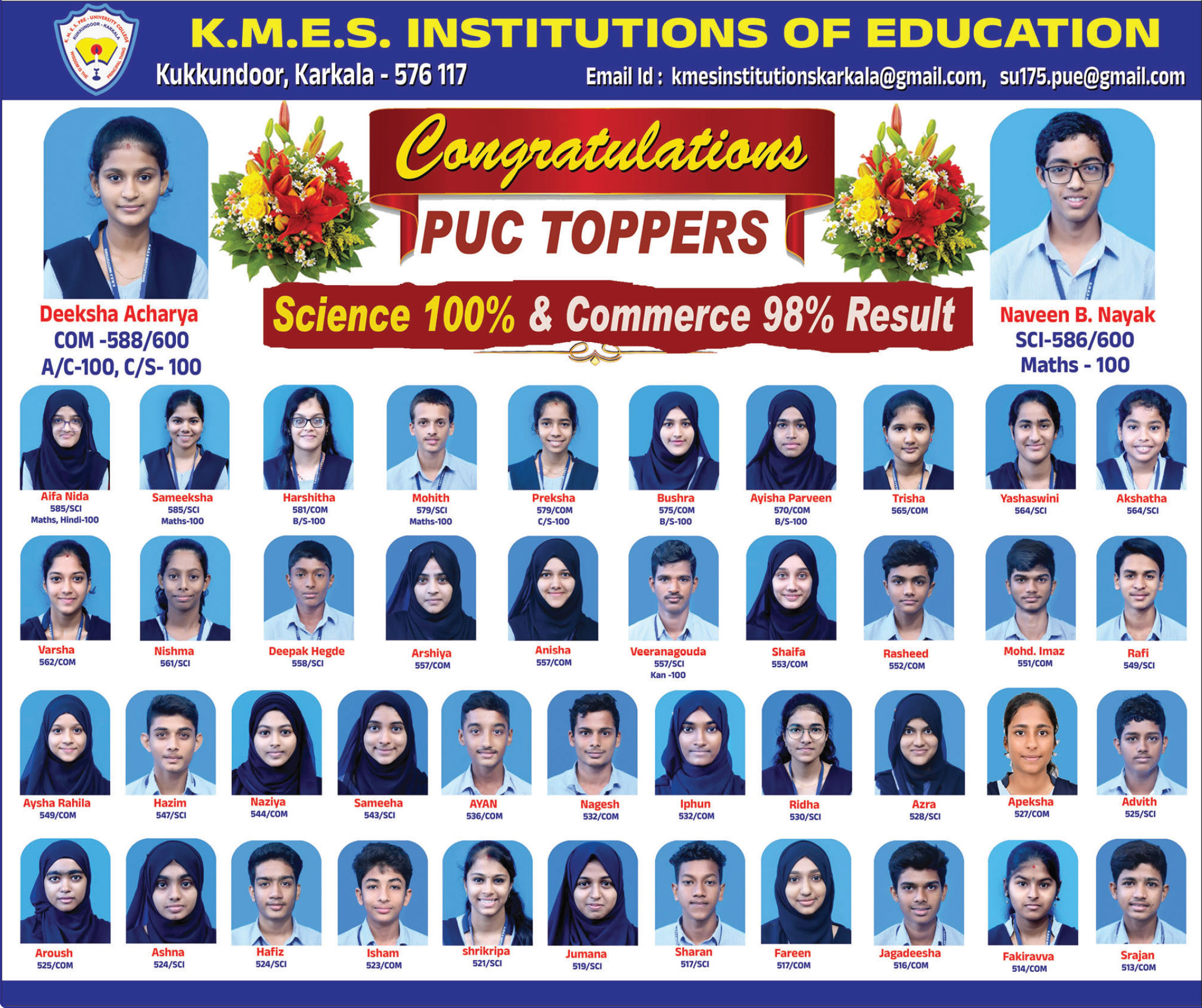
Karkala: KMES Institutions of Education at Kukkundooru in Karkala taluk has recorded outstanding results in the 2025-26 SSLC and PUC examinations, continuing a four-decade educational journey that began with just 22 kindergarten students and no building of its own.
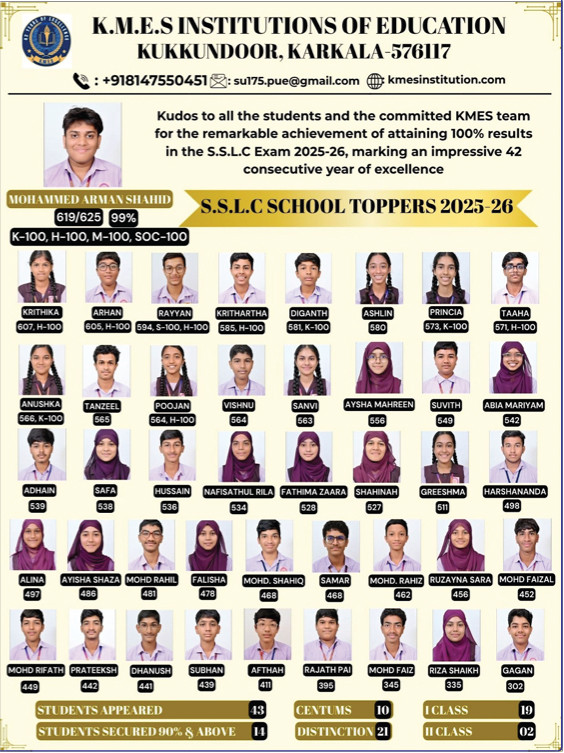
The institution secured a 100 per cent result in the SSLC examinations, with all 43 students passing the examination this year.
Muhammad Arman Shahid emerged as the school topper by scoring 619 marks out of 625, securing 99 per cent and also ranking sixth at the state level. He scored full marks in Kannada, Hindi, Mathematics and Social Science.
Krithika V. Nayak secured the second position in the school with 607 marks and 97.12 per cent, while Arhan stood third with 605 marks and 96.8 per cent.
Out of the 43 students, 21 passed with distinction, 19 secured first class, two students obtained second class and one student passed in third class. Fourteen students scored above 90 per cent.
The institution also performed strongly in the PUC examinations. The Science stream recorded a 100 per cent result, with all 44 students passing, while Commerce secured a 98 per cent pass percentage.
Twelve students scored full marks in different subjects, including Mathematics.
In Commerce, Deeksha Acharya topped the college with 588 marks, while Harshitha H. Kini secured the second position with 581 marks.
In Science, Naveen B. Nayak emerged as topper with 586 marks, followed closely by Sameeksha Moily and Aifa Nidha, who both secured 585 marks.
Speaking about the achievement, High School head teacher Shrimati Patkar said the institution has always focused on supporting academically weak students through affordable education and free special classes.
“Our ambition is to provide quality education even to students who struggle in studies. The fees are very low, and free coaching classes are conducted. I have worked here for 28 years and have always found the atmosphere supportive of education,” she said.
Primary School head teacher Lolita Zeena D’Silva appreciated the dedication of the teaching staff and said the school encourages students not only to achieve high marks but also to become role models.
PU College Principal Balakrishna Rao said the institution focuses on value-based education and overall personality development.
“The aim is to help students succeed not only academically but also in cultural activities, sports and leadership. We encourage qualities such as patience, tolerance and discipline,” he said.
Rao also credited the institution’s growth to the support of founders K.S. Mohammed Masood and K.S. Nissar Ahmed, along with President K.S. Imtiaz Ahmed.
Speaking on the occasion, Imtiaz Ahmed said the institution was built on the dream of making quality education accessible to financially backward families in rural areas.
He said the guidance and encouragement of his elder brothers, Mohammed Masood and Nissar Ahmed, along with the contribution of teachers, students and parents, helped transform the institution into a model educational centre.
The KMES Institutions trace their roots back to 1984, when they were founded by senior social activists Haji P.M. Khan, K.S. Nazeer Ahmed and Haji A.S. Rashid Haider.
The institution initially functioned from the Government Urdu School premises as it did not have a building of its own. Classes began with only 22 students in lower kindergarten and two teachers.
Later, under the leadership of K.S. Mohammed Masood and with continuous financial and moral support from non-resident businessman K.S. Nissar Ahmed, the institution gradually expanded.
In 1993, the school shifted to its own building and began conducting classes from LKG to Class 5.
As student admissions increased, Nissar Ahmed personally funded the construction of three additional classrooms to address infrastructure shortages.
The institution’s new school building was completed in 1997, while the PU College building was constructed in 2001.
From humble beginnings in a borrowed building to producing state-level rank holders and consistent academic results, the KMES Institutions have grown into one of the prominent educational centres in the Karkala region.