
Editors Guild, media bodies voice concern over blocking of Kashmir-based news website

New Delhi, Aug 24: The Editors Guild of India and other media bodies on Thursday voiced concern over the blocking of the website and the de-activation of social media accounts of Srinagar-based news website Kashmir Walla.
The Guild is disturbed by the censorship measures undertaken by the Union Ministry of Electronics and Information Technology without following due processes and against the principles of natural justice, the Editors Guild of India said in a statement here.
A joint statement issued by the Press Club of India, Press Association, Indian Women Press Corps, Delhi Union of Journalists and the Working News Cameraman Association demanded immediate restoration of the Kashmir Walla and Gaon Savera websites.
According to the joint statement, "Apparently, no reason was given for taking such drastic action either to the owners of the websites or the public. The case seems to have not been referred to any Court either. This move raises serious questions about the state of press freedom and freedom of expression in our democratic nation."
The Guild noted that Fahad Shah -- the founder-editor of Kashmir Walla -- has been under arrest since February last year with multiple FIRs, including cases under the Unlawful Activities (Prevention) Act, against him.
"In the judgment of Shreya Singhal v Union of India, the Supreme Court of India had expressly laid down that all reasonable efforts must be made to identify and notify the people whose information is sought to be blocked before access is restricted, as well as a right to appeal. The Guild urges the Ministry to release the orders of suspension in the public domain, and to follow due processes laid down by the Supreme Court," the Editors Guild said.
According to a statement released by Kashmir Walla on August 20, the service providers of their website informed them that the website had been "blocked in India by the Ministry of Electronics and Information Technology under the IT Act, 2000".
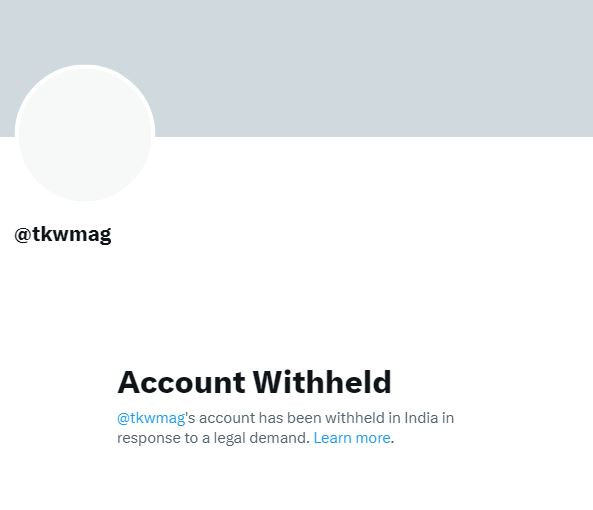
Further, their Facebook and Twitter (now known as X) accounts have also been deactivated "in response to a legal demand", the Guild said.
Let the Truth be known. If you read VB and like VB, please be a VB Supporter and Help us deliver the Truth to one and all.
Two arrested in K'taka for assaulting minors, uploading CSAM content

Bengaluru (PTI): Two men were arrested for allegedly sexually assaulting two minor girls, recording the acts on mobile phones and uploading the videos online as child sexual abuse material, police said on Thursday.
The accused have been identified as Kiran Kumar (29), hailing from Chitradurga district, and Aditya M K (20), hailing from Shivamogga district, they said.
A probe was initiated after information was received from the NCRP portal regarding a suspected instance of creation of Child Sexual Abuse Material (CSAM) for online dissemination, police said.
Accordingly, a case was registered at Kaggalipura Police Station under relevant sections of the IT Act on May 10, they added.
Investigation revealed that two minor girl victims were exploited and videos were created and uploaded to the internet. The child victims have subsequently recorded their statements as per procedure and further necessary legal steps have been taken, Pronab Mohanty Director General of Police, Cyber Command, said in a statement.
Based on the statements of the victims, the accused persons, who allegedly assaulted the minors, recorded the acts on mobile phones and uploaded the videos online, were arrested, he said.
Following the probe, sections 65(2) (rape) and 70 (gangrape) of the Bharatiya Nyaya Sanhita, along with relevant sections of the POCSO Act, have been added to the FIR, police said.
Officials collected relevant information and on May 12, arrested the accused persons and seized three mobile phones belonging to them, in which the videos had allegedly been recorded, he said.
The accused were later produced before the court and taken into police custody for further investigation, he added.
According to him, in CSAM cases, police usually apprehend offenders who have downloaded such content or have kept them in their possession after obtaining them from elsewhere, usually the internet.
"The present case is one of the very few instances where content creators and uploaders have been apprehended," Mohanty added.


