
Former Pakistan spin great Abdul Qadir dies of cardiac arrest

Karachi/New Delhi, Sep 6: Pakistan's master leg-spinner Abdul Qadir died in Lahore on Friday after suffering from a massive cardiac arrest, his family confirmed.
Qadir was 63 years old and is survived by his wife, four sons and a daughter who is married to current Pakistan star batsman Umar Akmal.
Former Pakistan wicketkeeper-batsman, Kamran Akmal, Umar's elder brother, confirmed the tragic news about Qadir's death.
It is learnt that the veteran suffered a cardiac arrest when he was at home and was declared dead on arrival after being rushed to a hospital.
Qadir, who played in 67 Tests and 104 ODIs had a total 368 wickets in his international career, would have celebrated his 64th birthday on 15th September.
"It is a great loss to Pakistan cricket because it was Qadir bhai's leg-spin magic and artistry that inspired a generation of young leg-spin bowlers in Pakistan and around the cricket world," former Pakistan leg-break bowler Danish Kaneria said.
In fact another spin great Mushtaq Ahmed only came into prominence imitating Qadir's action.
For Indian fans, Qadir will forever be etched in memories for his unique angular bowling action. It started in a get-set-go mode where he would licking his lips and using the saliva and the heavy hip pivot was unique in its style.
For all those growing up in the 80's, every mohalla cricket, whether the bylanes of Karachi or colonies in Delhi had their own "Abdul Qadir prototype".
But the fondest memories would certainly be related to 16-year-old Sachin Tendulkar attacking him with great gusto during an exhibition match. Qadir, who was at the twilight of his career, repeatedly tossed it up and Tendulkar would just dance down the track to hit him for four sixes.
There were many stories how Qadir mildly sledged Tendulkar and enticed him to go after him. However may times after that, he had acknowledged that it was that moment in the game, which he made him believe that he has seen something special.
Qadir was a favourite of the Indian media and had been associated with many channels as an expert in earlier years. A raconteur par excellence, Qadir would narrate stories of the famous Indo-Pak cricket matches of 80's when both countries frequently toured.
Qadir, who remained a critic of the Pakistan Cricket Board's policies till the end, worked as chief selector in 2009 and it was the squad that was selected by him that went on to win the ICC World T20 in England.
Qadir had resigned midway through the tournament as chief selector after having differences with the erstwhile PCB chairman Ejaz Butt over the non-selection of fast bowler Shoaib Akhtar.
Always a colourful character, Qadir was a favourite of Pakistan's World Cup winning captain turned prime minister, Imran Khan and he produced some of his best performances under Imran's captaincy taking 9 for 56 in one test against West Indies at Faisalabad.
All four of his sons, Rehman, Imran, Sulaman and Usman have played first class cricket in Pakistan while his youngest Usman (also a leg-spinner like his father) also appeared in the Big Bash T20 league last season and has shown his intention to qualify to play for Australia after being overlooked time and again by Pakistani selectors.
Cricket pundits and writers believe that Qadir's biggest achievement was to keep the art of wrist spin alive during the eras of 70s and 80s when fast bowlers dominated world cricket.
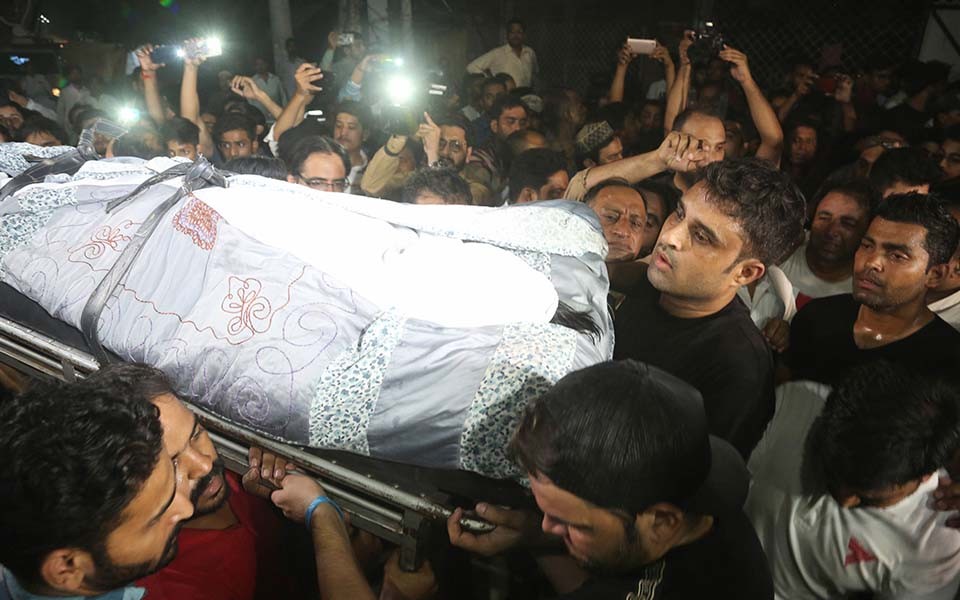
Lahore: People carry the body of former Pakistani cricketer Abdul Qadir in Lahore
Let the Truth be known. If you read VB and like VB, please be a VB Supporter and Help us deliver the Truth to one and all.
'Aurangzebi govt': BJP slams Cong-led Karnataka dispensation over saffron shawl ban in schools

New Delhi (PTI): A political row erupted on Friday over the Congress-led Karnataka government's clarification that saffron shawls would not be allowed in educational institutions, with the BJP alleging that it is pursuing "appeasement and vote-bank politics".
The controversy flared up after Karnataka Chief Minister Siddaramaiah said on Thursday that saffron shawls would not be allowed in educational institutions under the state government's order on religious symbols, while practices already in existence such as hijab, turbans, rudraksha beads and sacred threads (janeu) would continue to be permitted.
BJP national spokesperson Shehzad Poonawalla alleged that the Congress government is pursuing appeasement politics and termed it an "Aurangzebi government".
"This government allows the wearing of hijab inside institutions, which the Supreme Court and high court had not allowed. But you cannot wear a 'bhagwa' (saffron) shawl or 'bhagwa' angavastram. This is the mindset of the Siddaramaiah government," Poonawalla said in a video post on X.
He alleged that the Congress government can go to any extent for appeasement politics and accused the party of "abusing Sanatan" in the past as well.
"They have shown Hindu hatred, from terms like 'bhagwa terror' and 'Hindu terror' to abusing Sanatan.
"We have seen how Congress leaders in Tamil Nadu have abused Sanatan. In Telangana, they said Congress means Muslims. They seek Muslim reservation in the name of vote-bank politics and appeasement," he alleged.
Poonawalla further alleged that the Siddaramaiah government has adopted a discriminatory policy and claimed that it had earlier announced a "Muslim-only budget" and "Muslim colonies".
Speaking to reporters in Mysuru, the chief minister clarified that those religious attire which are in practice will be allowed.
The Karnataka government on Wednesday passed an order allowing students to wear the hijab, sacred thread, Shivadhara and rudraksha in schools.
The order scrapped the BJP government's 2022 order, banning Hijab in government schools following the hijab versus saffron shawl controversy.
"Saffron shawls are not allowed. Those shawls cannot be worn. Turbans, sacred thread, Shivadhara, rudraksha and hijab can also be worn," Siddaramaiah told reporters.
"See, it is not just the hijab. People can also wear sacred threads; Shivadhara rudraksha beads everyone can wear, things according to their beliefs.
"This is allowed up to Class 12, whether it is high school, college or primary school. It applies to all," he added.
Asked whether saffron turbans representing saffron identity would be permitted, the chief minister said only practices already in existence would be allowed and no new practices could be introduced.


