India a messenger of peace in conflict-ridden world: Prez Murmu in address to nation

New Delhi (PTI): Amidst geopolitical tensions escalating across multiple continents, President Droupadi Murmu on Sunday said India is spreading the message of peace in the world which is crucial to secure the future of humanity.
In her address to the nation on the eve of 77th Republic Day, she spoke about various issues including Operation Sindoor and women empowerment, and also touched upon the topics of Vande Mataram and growing economy of the country.
President Murmu outlined India's position as a "messenger" of peace while reinforcing ancient civilisational commitment to universal harmony.
"In our tradition, we have been offering prayers for peace to prevail in the entire universe. The future of humanity can remain secure only if there is peace in the whole world.
"In an atmosphere marked by conflicts in many parts of the world, India is spreading the message of peace," she said.
During her speech, the President also underscored a firm commitment to national security by highlighting the recent success of Operation Sindoor, a precision strike that dismantled terror infrastructure across the border.
ALSO READ: Padma Awards 2026: Dharmendra, V S Achuthanandan among Padma Vibhushan awardees
"Last year, our country launched precision strikes against terror infrastructure...terror centres were destroyed, and many terrorists met their end," she said, highlighting country's "self-reliance" in the field of defence that powered the historic success of Operation Sindoor.
Reflecting on the strength of the Armed Forces, the President recalled personal visits to the Siachen Base Camp and sorties in the Sukhoi, Rafale, and the submarine INS Vaghsheer.
"Based on the strength of the Army, Air Force, and Navy, people have complete trust in our defence-preparedness," she said, linking the military readiness to India's ability to advocate for peace from a position of strength.
In her address, President Murmu hailed the rise of "nari shakti" (women power) as the cornerstone of India's journey toward becoming a developed nation by 2047.
She emphasised that the "active and empowered participation of women is extremely important for the development of the country".
From the depths of rural self-help groups to the frontiers of space and defence, the story of modern India is increasingly being written by its daughters, she said.
The President noted that over 10 crore women associated with self-help groups are currently redefining the grassroots economy.
She said that women now make up nearly 46 per cent of representatives in Panchayati Raj institutions and the Nari Shakti Vandan Adhiniyam is set to take political empowerment to "unprecedented heights", ensuring women-led development remains a national priority.
The past year served as a "golden chapter" for Indian women in the global arena, the President said, as she took special pride in the dominance of India's daughters in sports, specifically citing the historic win at the ICC Women's Cricket World Cup and victory in the Blind Women's T20 World Cup.
President Murmu highlighted that women are making significant marks in the Armed Forces, space research, and entrepreneurship, proving that no field remains a "traditional stereotype" for the women in the country.
The 'Beti Bachao, Beti Padhao' campaign was credited with encouraging girls' education across the country, she said.
"With increasing contribution by women, our country will set an example of an inclusive Republic based on gender equality," the President remarked, signalling that the future of Viksit Bharat is inseparable from the empowerment of its female citizens.
She also underscored India's transformative progress in poverty alleviation, noting that millions of citizens who struggled with poverty for decades have finally been lifted above the poverty line.
Embodying the spirit of 'Antyodaya', the government's focus remains on ensuring these citizens do not fall back into the "poverty trap", she said.
The President affirmed the core ideal that "no one should go hungry in our country", with various central government schemes currently providing vital support to nearly 81 crore beneficiaries.
She emphasized that the path to a 'Viksit Bharat' must be inclusive with special focus placed on tribal and marginalised communities through targeted interventions.
"Such efforts for the welfare of the poor give concrete shape to Mahatma Gandhi's ideal of Sarvodaya (progress for all)," she said.
President Murmu also announced that the Constitution of India is now available in all 22 languages listed in the Eighth Schedule and said the milestone aims to foster "constitutional nationalism", allowing citizens to engage with the nation's foundational document in their mother tongue.
The initiative is part of a broader shift toward "good governance" based on mutual trust, where the gap between the government and the general public is being systematically closed through technology and legislative reform, she said.
The administration has pivoted toward a citizen-centric model by stripping away bureaucratic hurdles. Key efforts include deregulation of thousands of unnecessary rules that have been repealed and compliance requirements eliminated, she added.
The President highlighted that national goals are now being achieved through unprecedented public participation, transforming government campaigns into powerful mass movements.
A primary example of this "revolutionary change" is India's global leadership in the digital economy. Today, more than half of the world's digital transactions occur within India, she said.
Emphasising that building a Viksit Bharat is a "shared responsibility", she called upon local institutions in every village and city to act as instruments of progressive change.
She also highlighted a significant push toward cultural decolonisation saying the government has reaffirmed its commitment to eradicating the "vestiges of colonial mindset" in a time-bound manner.
The President said that today's India is moving forward with a renewed self-confidence, rooted deeply in its glorious traditions and a "Gyan Bharatam" (knowledgeable India) approach.
She emphasized that self-reliance is not merely economic but also cultural and by placing a renewed emphasis on Indian languages and indigenous knowledge systems, the state is providing a distinct cultural foundation for its pursuit of total self-reliance.
President Murmu hailed India's ascent as the world's fastest-growing major economy, attributing this resilience to deep structural reforms and a commitment to self-reliance.
Despite a backdrop of global economic uncertainty, India is now firmly on track to become the world's third-largest economy in the near future, she said.
A cornerstone of this economic transformation has been the Goods and Services Tax (GST), which the President described as the most significant decision for economic integration since Independence.
She said that the journey toward becoming the third largest economy is being guided by the twin principles of 'atmanirbharta' and 'swadeshi' and the government's focus on world-class infrastructure and labour reforms is expected to further accelerate the development of enterprises.
The President also highlighted the ongoing celebrations marking 150 years since the composition of 'Vande Mataram'.
In her address, she emphasised how 'Vande Mataram' transcended linguistic barriers to unify the masses during the freedom struggle. She remarked that translations into various Indian languages have further cemented the song as a universal symbol of oneness.
"From north to south and from east to west, the fabric of our ancient cultural unity was woven by our ancestors. Every effort to promote this spirit of oneness through 'Vande Mataram' is highly commendable," the President added.
Let the Truth be known. If you read VB and like VB, please be a VB Supporter and Help us deliver the Truth to one and all.
KMES Institutions shine in SSLC result, continue four-decade legacy of education in rural Karkala

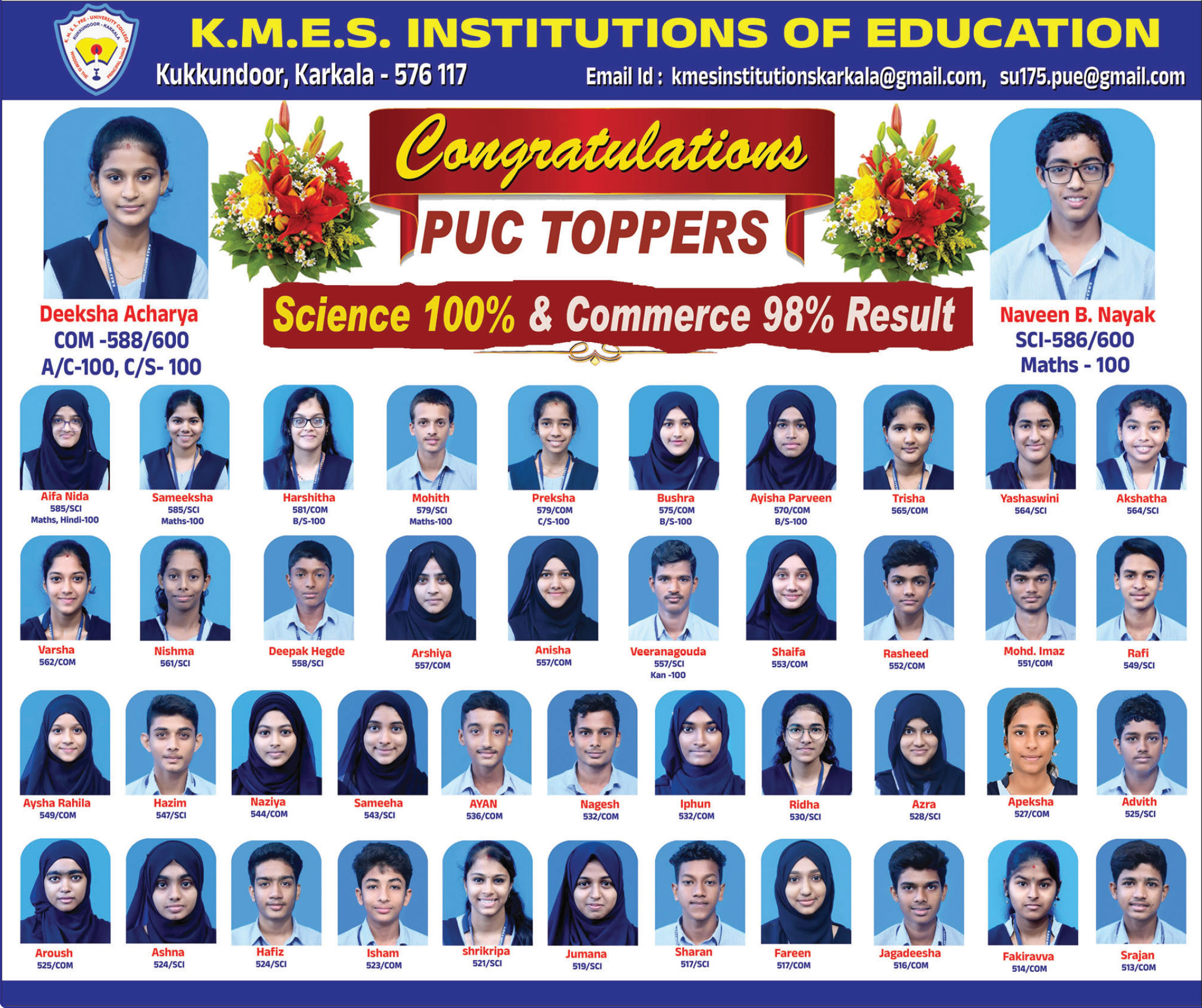
Karkala: KMES Institutions of Education at Kukkundooru in Karkala taluk has recorded outstanding results in the 2025-26 SSLC and PUC examinations, continuing a four-decade educational journey that began with just 22 kindergarten students and no building of its own.
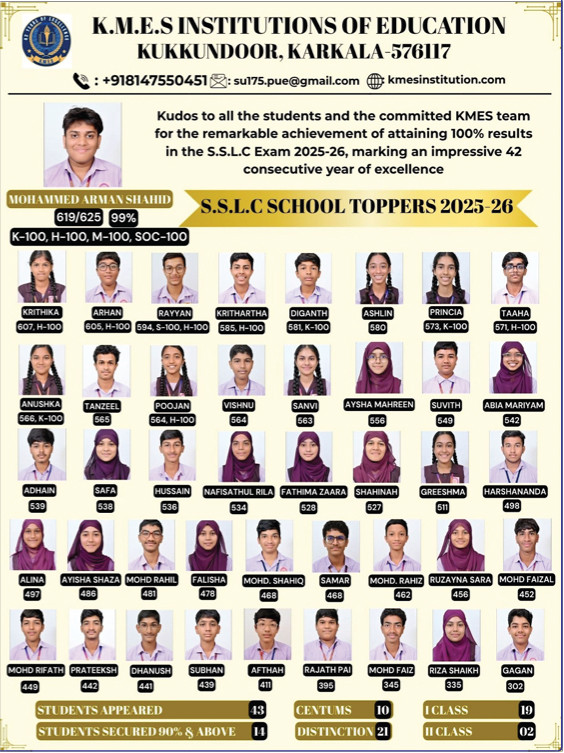
The institution secured a 100 per cent result in the SSLC examinations, with all 43 students passing the examination this year.
Muhammad Arman Shahid emerged as the school topper by scoring 619 marks out of 625, securing 99 per cent and also ranking sixth at the state level. He scored full marks in Kannada, Hindi, Mathematics and Social Science.
Krithika V. Nayak secured the second position in the school with 607 marks and 97.12 per cent, while Arhan stood third with 605 marks and 96.8 per cent.
Out of the 43 students, 21 passed with distinction, 19 secured first class, two students obtained second class and one student passed in third class. Fourteen students scored above 90 per cent.
The institution also performed strongly in the PUC examinations. The Science stream recorded a 100 per cent result, with all 44 students passing, while Commerce secured a 98 per cent pass percentage.
Twelve students scored full marks in different subjects, including Mathematics.
In Commerce, Deeksha Acharya topped the college with 588 marks, while Harshitha H. Kini secured the second position with 581 marks.
In Science, Naveen B. Nayak emerged as topper with 586 marks, followed closely by Sameeksha Moily and Aifa Nidha, who both secured 585 marks.
Speaking about the achievement, High School head teacher Shrimati Patkar said the institution has always focused on supporting academically weak students through affordable education and free special classes.
“Our ambition is to provide quality education even to students who struggle in studies. The fees are very low, and free coaching classes are conducted. I have worked here for 28 years and have always found the atmosphere supportive of education,” she said.
Primary School head teacher Lolita Zeena D’Silva appreciated the dedication of the teaching staff and said the school encourages students not only to achieve high marks but also to become role models.
PU College Principal Balakrishna Rao said the institution focuses on value-based education and overall personality development.
“The aim is to help students succeed not only academically but also in cultural activities, sports and leadership. We encourage qualities such as patience, tolerance and discipline,” he said.
Rao also credited the institution’s growth to the support of founders K.S. Mohammed Masood and K.S. Nissar Ahmed, along with President K.S. Imtiaz Ahmed.
Speaking on the occasion, Imtiaz Ahmed said the institution was built on the dream of making quality education accessible to financially backward families in rural areas.
He said the guidance and encouragement of his elder brothers, Mohammed Masood and Nissar Ahmed, along with the contribution of teachers, students and parents, helped transform the institution into a model educational centre.
The KMES Institutions trace their roots back to 1984, when they were founded by senior social activists Haji P.M. Khan, K.S. Nazeer Ahmed and Haji A.S. Rashid Haider.
The institution initially functioned from the Government Urdu School premises as it did not have a building of its own. Classes began with only 22 students in lower kindergarten and two teachers.
Later, under the leadership of K.S. Mohammed Masood and with continuous financial and moral support from non-resident businessman K.S. Nissar Ahmed, the institution gradually expanded.
In 1993, the school shifted to its own building and began conducting classes from LKG to Class 5.
As student admissions increased, Nissar Ahmed personally funded the construction of three additional classrooms to address infrastructure shortages.
The institution’s new school building was completed in 1997, while the PU College building was constructed in 2001.
From humble beginnings in a borrowed building to producing state-level rank holders and consistent academic results, the KMES Institutions have grown into one of the prominent educational centres in the Karkala region.