
India is the 12th worst country for gender disparity in labour force

New Delhi: India performs poorly when it comes to gender parity in labour force participation, according to data from the United Nations Human Development Report (UNHDR).
Of the 20 countries with the widest difference in male and female labour force participation rates, India — ranked 12th — is the only non-Islamic country.
The UN defines labour force participation rate as the “proportion of the working-age population (ages 15 and older) that engages in the labour market, either by working or actively looking for work, expressed as a percentage of the working-age population”.
In India, the male labour participation rate is 78.8 per cent while the number for females is just 27.2 per cent — a difference of 51.6 per cent.
India is also far below the global female participation average of 48.7 per cent.
The worst performing country in terms of gender disparity is Afghanistan, where the difference is 67.2 per cent, followed by Yemen and the Syrian Arab Republic.
In India’s immediate neighbourhood, all countries except Pakistan perform better.
Pakistan, with a difference of 57.8 per cent, stands fourth in the list, while Bangladesh (46.8) is 18th, Sri Lanka (39) is 25th. Nepal is the best performing South Asian country — it stands 169th with a difference of just 3.2 per cent.
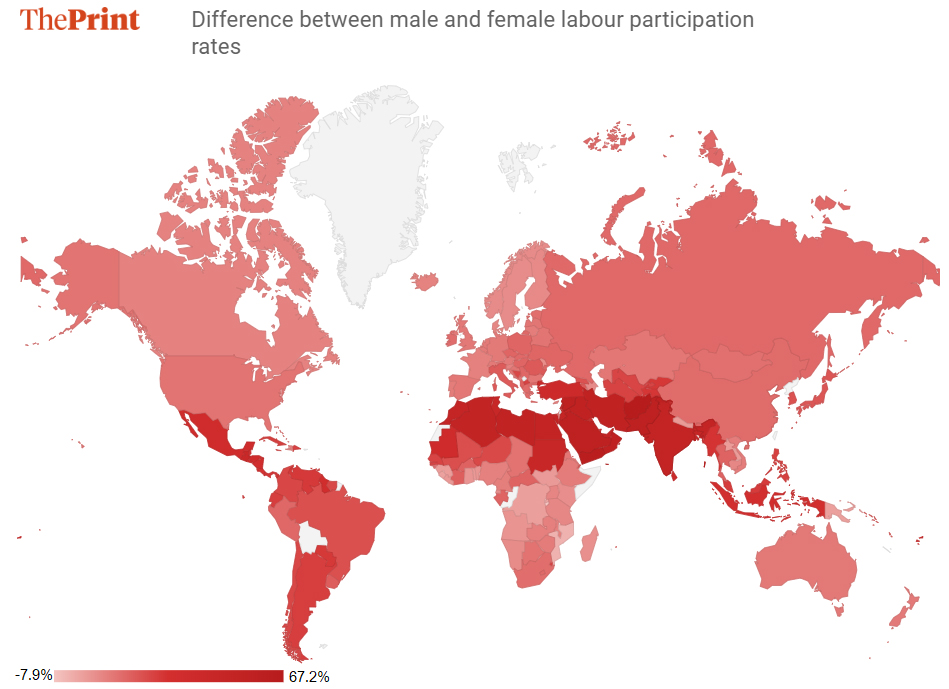
Economic superpowers US and China are not in the top 100 of this list — China is 104th with a difference of 14.6 per cent, while the US is 114th with a difference of 12.6 per cent.
The only two countries in the world where more females are part of the workforce than males are African nations Burundi (difference of -2.7 per cent) and Mozambique (-7.9 per cent).
In Mozambique, 82.5 per cent of working-age females are part of the labour market, as are 74.6 per cent of males. The corresponding figures for Burundi are 80.2 per cent and 77.5 per cent.
Expert opinion
Ashwini Deshpande, professor at the Delhi School of Economics, who specialises in discrimination, gender and affirmative action, said this was a worrying situation for India.
“The female labour force participation rate in India, which is already low, has declined over the last decade. This is not because women don’t want to work. There is a great deal of demand for work, but decent work is not available,” she said.
Deshpande also pointed to the burden of domestic unpaid work the women have to bear.
“On the domestic front, it is the burden of domestic work that keeps women out of the formal labour force. They do a large range of activities that are economic activities, but are unpaid,” she said.
Deshpande refused to buy the train of thought that Islam was a barrier to women’s freedom to work — after all, Muslim-majority countries like Sierra Leone, Azerbaijan and Nigeria are all ranked below 140 in the list.
“It is wrong to focus on Islam as a barrier to women’s labour force participation. Bangladesh is an Islamic country, but has a higher rate of female participation than India,” she said.
Courtesy: theprint.in
Let the Truth be known. If you read VB and like VB, please be a VB Supporter and Help us deliver the Truth to one and all.
Put petty politics aside; it's not about one party, but India: Rahul on TMC's loss in polls

New Delhi (PTI): Congress leader Rahul Gandhi on Tuesday termed the BJP's victory in Bengal and Assam assembly polls a "theft" of the mandate, and a big step forward in the saffron party's mission to "destroy" Indian democracy.
Gandhi also came out in support of the TMC, which has been trounced by the BJP in the polls, and urged those gloating over the loss of Mamata Banerjee's party to put petty politics aside.
"Some in the Congress, and others, are gloating about TMC's loss.They need to understand this clearly - the theft of Assam and Bengal's mandate is a big step forward by the BJP in its mission to destroy Indian democracy," Gandhi said in a post on X.
"Put petty politics aside. This is not about one party or another. This is about India," he said in his post.
The BJP ousted Trinamool Congress from power in Bengal and captured power for the third time in a row in Assam in results of assembly polls declared on Monday.


