Insolvency Code amendment bill tabled in Lok Sabha

New Delhi, July 23 : A bill to amend the Insolvency and Bankruptcy Code, 2016, allowing an allottee of a real estate project to be treated as a financial creditor was introduced in the Lok Sabha on Monday, amid allegations from opposition parties that some changes were intended to "help just one industry".
The Insolvency and Bankruptcy Code (Second Amendment) Bill, 2018 was introduced by interim Finance Minister Piyush Goyal and seeks to replace an ordinance brought by the government earlier this year.
Taking part in the debate, Biju Janata Dal (BJD) member Bhartruhari Mahtab said he is opposed to the move to amend Section 33 of the Code to provide a reduced threshold from 75 per cent of voting share for obtaining the approval of the Committee of Creditors for making an application to the adjudicating authority to pass a liquidation order.
"That is the reason why I say that this is nothing but a fixed match. Bad loan resolution is becoming deep-rooted nexus between the bankers, auditors and promoters, which is undermining serious recovery," he said.
He was supported by some other opposition members as well.
Citing the resolution process of a textile company, Mahtab said two companies had jointly submitted before the Committee of Creditors (CoC) of the textile firm to acquire the company last April but the CoC failed to gather enough votes to act on the resolution plan.
"And here the crux of the problem lies. The proposal got 70 per cent of the votes when 75 per cent were needed. The government stepped in and an ordinance amending the IBC lowered the minimum vote needed for passing a resolution plan to 66 per cent from 75 per cent," he said.
Mahtab said the government "should stand up and do away with this type of crony capitalism".
Rejecting the allegations, Goyal said these are "baseless" and the amendments will have prospective effect.
He said that when the Insolvency and Bankruptcy Code was introduced, the country's banking sector was going through a serious crisis "because of indiscriminate and absolutely baseless lending" that happened during the period 2008 to 2014.
The Minister said the banking system gave money to promoters who had no business to get loans in the first place.
He said the cases being referred to "were also loans, which were given during that period and then subsequently restructured ... because of which the banking system was in dire straits."
Goyal said the laws to recover loans were weak and banks were unable to take back money from "big people", so notices were sent to others.
"No property of factory of big people were seized... The entire responsibility is of Congress," he said.
He said the amendments had been brought on the recommendations of a committee.
Let the Truth be known. If you read VB and like VB, please be a VB Supporter and Help us deliver the Truth to one and all.
National Synodal Assembly 2026 begins in Bengaluru with over 220 delegates

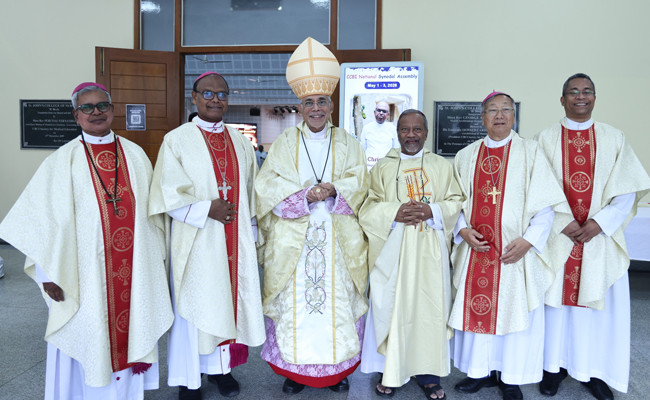
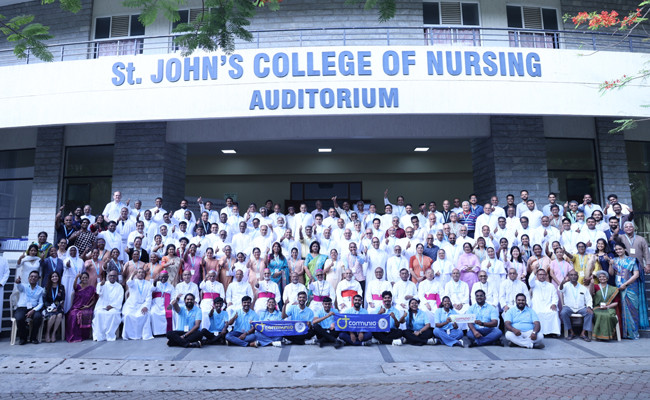
Bengaluru: The Conference of Catholic Bishops of India (CCBI) on May 1 inaugurated its National Synodal Assembly 2026 at St. John’s Medical College, bringing together more than 220 delegates from across the country under the theme Synodal Pilgrims of Hope.
The assembly is part of the global synodal process initiated in 2021 by Pope Francis, which calls for greater participation, dialogue and shared responsibility within the Church. In India, the process has involved consultations at diocesan, regional and national levels.
Participants at the assembly include two Cardinals, 25 Bishops, 65 priests, more than 20 women religious, and over 100 lay faithful, including youth and women leaders.
The gathering began with a Eucharistic celebration led by Filipe Neri Ferrão. In his homily, he described the assembly as a moment of grace and discernment and called on delegates to walk together in prayer, listening and missionary commitment.
He spoke about the importance of the Risen Christ in the mission of the Church and urged the faithful to be witnesses of the Gospel. Referring to the conversion of St Paul, he said every baptised person has a role in spreading the message of Christ. He also highlighted the example of St Joseph the Worker, stressing the dignity of labour and the call to holiness in everyday life.
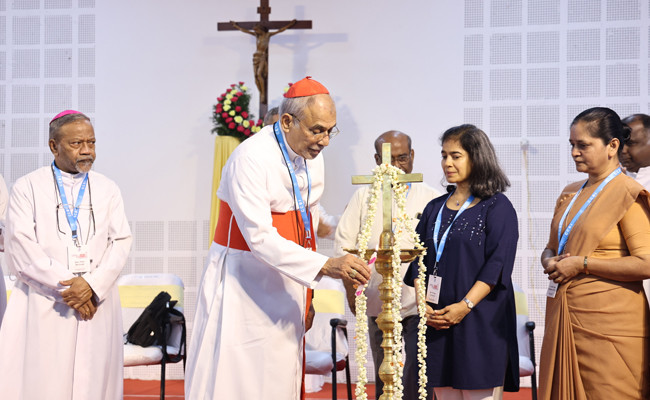
The formal inauguration included the invocation of the Holy Spirit through Veni Creator Spiritus and the lighting of the ceremonial lamp. Deputy Secretary General Fr. Stephen Alathara welcomed the delegates and described the gathering as a spiritual journey.
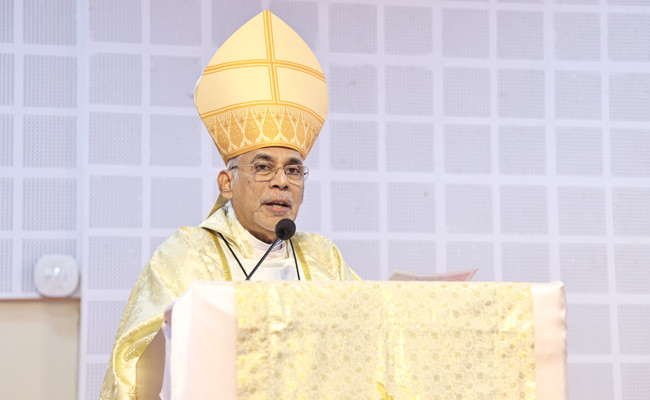
In his presidential address, Cardinal Ferrão referred to the CCBI pastoral plan titled Journeying Towards a Synodal Church: Mission 2033 and called on participants to build on the vision outlined at the 36th Plenary Assembly held in Bhubaneswar in 2025.
Delegates will reflect on four key themes identified from 16 pastoral priorities: interreligious dialogue and peacebuilding, inclusion of the excluded, poverty and integral ecology, and support for children and youth.
The discussions are being conducted through a method of spiritual conversation aimed at encouraging listening, dialogue and collective decision-making. The focus is on translating these discussions into practical actions within the Church.
The assembly also looks ahead to the Jubilee Year 2033, which will mark 2,000 years of the Redemption, and aims to strengthen the Church’s mission in the coming years.
Further consultations are scheduled for September 2026, with the process expected to conclude at the 38th Plenary Assembly of the CCBI in January 2027.
Organisers said the assembly seeks to strengthen unity within the Church and promote participation of all sections, including women and youth, in shaping its future direction.