ISRO commences revised countdown for Proba-3 mission launch

Sriharikota (Andhra Pradesh) (PTI): ISRO on Thursday commenced a revised 8.5 hour countdown for the launch of the European Space Agency's Proba-3 mission.
The Bengaluru-headquartered space agency had originally planned to launch European Space Agency's (ESA) Proba-3 at 4.08 pm on Wednesday from the spaceport here. However, minutes before the lift-off, following the request from the European Space Agency, ISRO rescheduled the launch of PSLV-C59/PROBA-3 to December 5, 4.04 pm.
It was rescheduled following an anomaly detected in the satellite propulsion system.
In an update on Thursday, ISRO said, "PSLV-C59/PROBA-3 Mission. Countdown commenced. Lift-off time 16.04 pm IST, 5th December 2024. Stay tuned as PSLV-C59 prepares to deploy ESA's Proba-3 satellites into orbit."
NewSpace India Ltd, the commercial arm of ISRO has bagged the order from the ESA.
The Proba-3 (Project for Onboard Anatomy) consists of two satellites -- Coronagraph (310kgs) and Occulter (240kgs) -- in which two spacecraft would fly together as one, maintaining precise formation down to a single millimetre to study the Corona, the Sun's outer atmosphere.
The ESA said the Corona is much hotter than the Sun itself and it is where space weather originates. It is also a topic of widespread scientific and practical interest.
For ISRO, besides providing its trusted workhorse PSLV vehicle for the launch, this mission would provide key insights on taking up scientific experiments on the Sun after its maiden mission--Aditya-L1 which was successfully launched in September 2023.
Proba-3 is a technology demonstration mission funded via the General Support Technology Programme. The instruments onboard the satellites would travel closer to the solar rim for up to six hours at a time and each spacecraft would take up approximately a 19-hour orbit around the Earth.
'Probas' is a Latin word, meaning 'Let's try'.
The mission objective is to demonstrate precise formation flying and the two spacecraft inside the satellites would be launched together in a stacked configuration after the desired orbit level is reached.
PSLV-C59 is a 44.5 metre tall rocket and is on its 61st flight and the 26th with the PSLV-XL variant which is normally used to place heavy satellites.
After the lift-off (4.04 pm) the two satellites (Coronagraph and Occulter) would undertake an 18-minute journey to reach the desired orbit.
The two spacecraft after reaching the preparatory conditions, would fly 150 metres apart (as one large satellite structure) in tandem so that the 'Occulter' spacecraft would block out the solar disk of the Sun enabling 'Coronagraph' to study the corona of the Sun or the surrounding atmosphere, for scientific observation.
Let the Truth be known. If you read VB and like VB, please be a VB Supporter and Help us deliver the Truth to one and all.
KMES Institutions shine in SSLC result, continue four-decade legacy of education in rural Karkala

Karkala: KMES Institutions of Education at Kukkundooru in Karkala taluk has recorded outstanding results in the 2025-26 SSLC and PUC examinations, continuing a four-decade educational journey that began with just 22 kindergarten students and no building of its own.
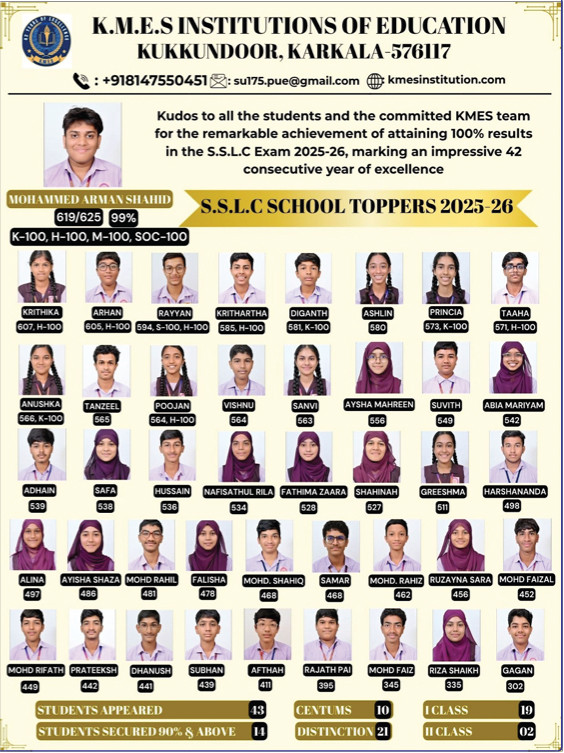
The institution secured a 100 per cent result in the SSLC examinations, with all 43 students passing the examination this year.
Muhammad Arman Shahid emerged as the school topper by scoring 619 marks out of 625, securing 99 per cent and also ranking sixth at the state level. He scored full marks in Kannada, Hindi, Mathematics and Social Science.
Krithika V. Nayak secured the second position in the school with 607 marks and 97.12 per cent, while Arhan stood third with 605 marks and 96.8 per cent.
Out of the 43 students, 21 passed with distinction, 19 secured first class, two students obtained second class and one student passed in third class. Fourteen students scored above 90 per cent.
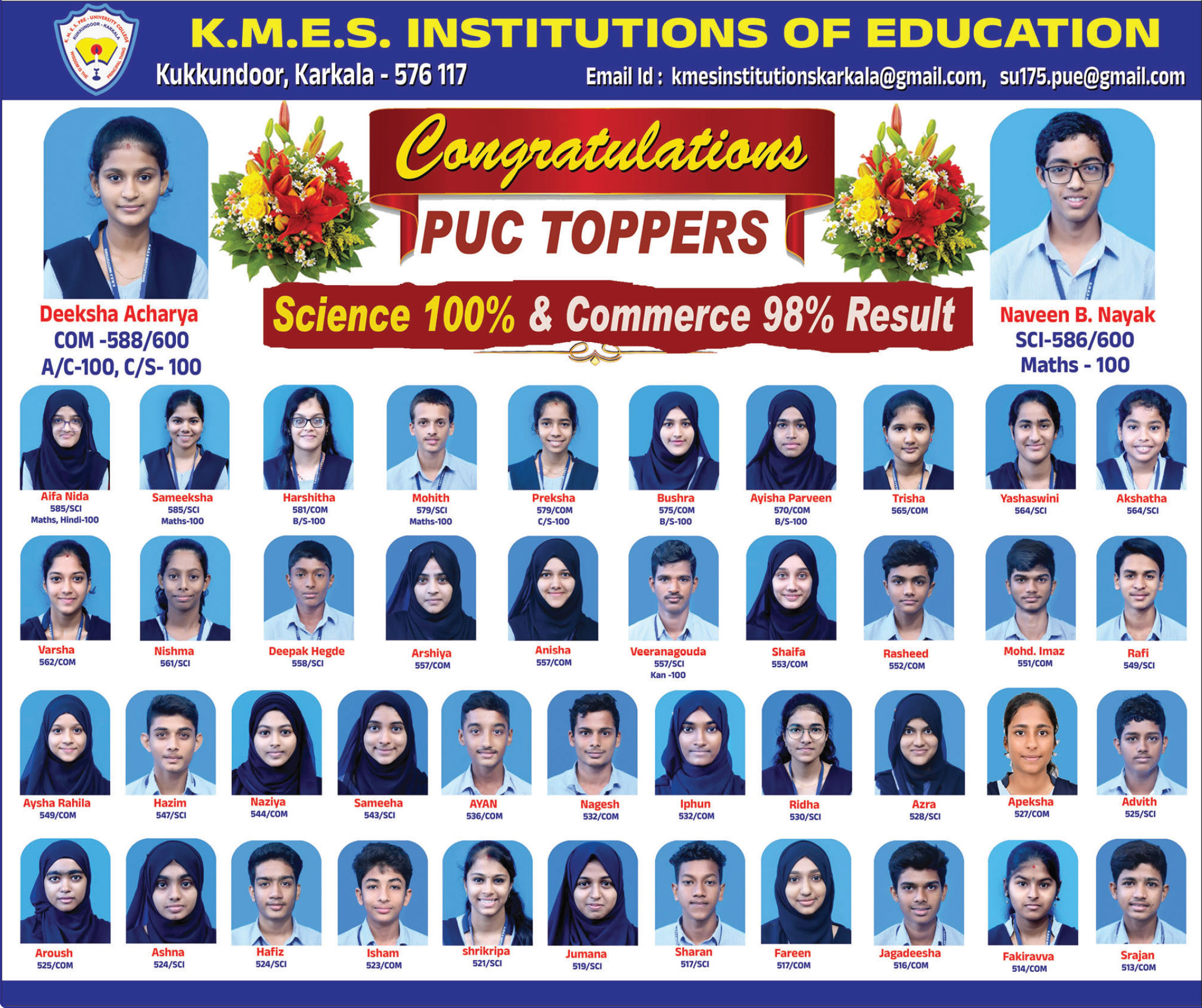
The institution also performed strongly in the PUC examinations. The Science stream recorded a 100 per cent result, with all 44 students passing, while Commerce secured a 98 per cent pass percentage.
Twelve students scored full marks in different subjects, including Mathematics.
In Commerce, Deeksha Acharya topped the college with 588 marks, while Harshitha H. Kini secured the second position with 581 marks.
In Science, Naveen B. Nayak emerged as topper with 586 marks, followed closely by Sameeksha Moily and Aifa Nidha, who both secured 585 marks.
Speaking about the achievement, High School head teacher Shrimati Patkar said the institution has always focused on supporting academically weak students through affordable education and free special classes.
“Our ambition is to provide quality education even to students who struggle in studies. The fees are very low, and free coaching classes are conducted. I have worked here for 28 years and have always found the atmosphere supportive of education,” she said.
Primary School head teacher Lolita Zeena D’Silva appreciated the dedication of the teaching staff and said the school encourages students not only to achieve high marks but also to become role models.
PU College Principal Balakrishna Rao said the institution focuses on value-based education and overall personality development.
“The aim is to help students succeed not only academically but also in cultural activities, sports and leadership. We encourage qualities such as patience, tolerance and discipline,” he said.
Rao also credited the institution’s growth to the support of founders K.S. Mohammed Masood and K.S. Nissar Ahmed, along with President K.S. Imtiaz Ahmed.
Speaking on the occasion, Imtiaz Ahmed said the institution was built on the dream of making quality education accessible to financially backward families in rural areas.
He said the guidance and encouragement of his elder brothers, Mohammed Masood and Nissar Ahmed, along with the contribution of teachers, students and parents, helped transform the institution into a model educational centre.
The KMES Institutions trace their roots back to 1984, when they were founded by senior social activists Haji P.M. Khan, K.S. Nazeer Ahmed and Haji A.S. Rashid Haider.
The institution initially functioned from the Government Urdu School premises as it did not have a building of its own. Classes began with only 22 students in lower kindergarten and two teachers.
Later, under the leadership of K.S. Mohammed Masood and with continuous financial and moral support from non-resident businessman K.S. Nissar Ahmed, the institution gradually expanded.
In 1993, the school shifted to its own building and began conducting classes from LKG to Class 5.
As student admissions increased, Nissar Ahmed personally funded the construction of three additional classrooms to address infrastructure shortages.
The institution’s new school building was completed in 1997, while the PU College building was constructed in 2001.
From humble beginnings in a borrowed building to producing state-level rank holders and consistent academic results, the KMES Institutions have grown into one of the prominent educational centres in the Karkala region.