Many firsts at R-Day Parade: Bhairav Battalion, Suryastra, 61 Cavalry in combat gear

New Delhi (PTI): Newly raised Bhairav light commando battalion and Shaktiban Regiment, rocket launcher system 'Suryastra' with deep-strike capabilities, and key military assets, including indigenous platforms accompanied with personnel, rolling down the Kartavya Path in a "phased battle array formation" -- the 77th Republic Day Parade saw many firsts.
Double-humped Bactrian camels and Zanskar ponies were also part of the ceremonial event for the first time, adding an element of curiosity and excitement among the crowds.
Also, marking a first, the contingent members of the mounted 61 Cavalry were seen in battle gear during the parade.
The 61 Cavalry, known for its imposing presence as its members wear ceremonial uniform and a striking headgear, has traditionally been the leading contingent of the armed forces in the ceremonial parade.
Capt Ahaan Kumar, 26, a third-generation officer, who led the iconic contingent, an honour he had in the 2025 parade as well, returned to Kartvaya Path, along with his charger 'Ranveer', a Hanoverian breed, as the contingent commander thus year as well, albeit in a combat gear.
"For me, leading this historic contingent in a ceremonial uniform gives much greater joy than I had doing it in a combat gear, but yes, it felt very different in this year's parade," he told PTI, after the parade.
The Republic Day Parade also saw many other firsts this time.
A mixed scouts contingent seen in their heavy thermal gear in an operational role, were also part of the parade for the first time, the officials said.
For Lt Amit Choudhary, a second-generation army officer, who led this contingent in the parade, it was both be a personal milestone and a nostalgic nod to his father who was part of the ceremonial parade in 1990.
Dressed up in characteristic multi-layer suits teamed with special boots and polarised sunglasses meant for high terrain and harsh weather, he and his contingent members drew loud cheers from the crowd, as they marched along the Kartavya Path.
The young officer, a resident of Jammu and Kashmir, is currently serving in 2 Arunachal Scouts of the Assam Regiment.
The mixed scouts contingent had members drawn from Ladakh Scouts, Dogra Scouts, Arunachal Scouts, Kumaon Scouts, Garhwal Scouts, and Sikkim Scouts.
The parade also see the debut of the Shaktiban Regiment, which has been set up in the artillery, to boost the Army's firepower capabilities.
The newly raised regiment will be equipped with a drone, counter-drone and loiter munition.
Bhairav light commando battalion had also made its Army Day Parade debut on January 15 in Jaipur. The battalion was raised around October last year.
A Bhairav Battalion of the Sikh Light Infantry regiment took part in the January 26 parade in the national capital.
Bhairav Battalion is a specialised assault infantry unit, bridging the capabilities of conventional infantry and special forces.
"Designed for rapid response and high-intensity operations, it serves as as the first responder on the battlefield," a defence ministry official said.
They embody the ethos of 'Sant Sipahi', fierce in battle yet spiritually composed.
The name 'Bhairav', inspired by the fierce and protective manifestations of Lord Shiva, symbolises "controlled aggression, invincibility and righteous power," the official said.
Other key defence assets showcased during the parade included BrahMos, Akash missile system, Medium Range Surface-to-Air Missile (MRSAM) system, Advanced Towed Artillery Gun System (ATAGS), Dhanush artillery gun, and a static display of some drones.
The Defence Research and Development Organisation (DRDO) showcased its Long Range Anti-Ship Hypersonic Missile (LR-AShM), a hypersonic glide missile capable of engaging static and moving targets, designed to carry various payloads.
Captain Harshita Raghav, who led the Remount Veterinary Corps (RVC) contingent, said the contingent also included raptors (kites) and a few Army dogs.
"These animals are soldiers of the Indian Army only. In fact, they are the silent warriors, making them operationally ready, and understanding the requirements of operations from these animals are two very important aspects. They are true force multipliers of the Indian Army," she told PTI.
Eighteen marching contingents and 13 bands took part in the parade that lasted around 90 minutes.
The dominant theme of this year's parade was 150 years of 'Vande Mataram'.
Let the Truth be known. If you read VB and like VB, please be a VB Supporter and Help us deliver the Truth to one and all.
KMES Institutions shine in SSLC result, continue four-decade legacy of education in rural Karkala

Karkala: KMES Institutions of Education at Kukkundooru in Karkala taluk has recorded outstanding results in the 2025-26 SSLC and PUC examinations, continuing a four-decade educational journey that began with just 22 kindergarten students and no building of its own.
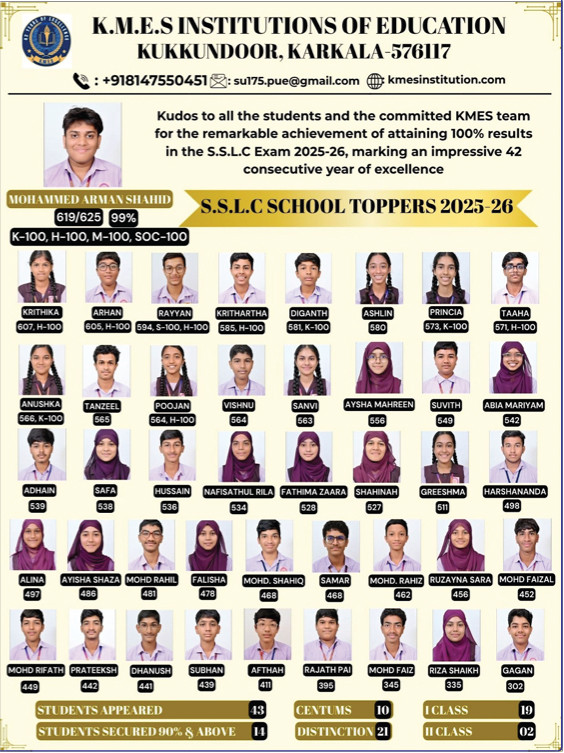
The institution secured a 100 per cent result in the SSLC examinations, with all 43 students passing the examination this year.
Muhammad Arman Shahid emerged as the school topper by scoring 619 marks out of 625, securing 99 per cent and also ranking sixth at the state level. He scored full marks in Kannada, Hindi, Mathematics and Social Science.
Krithika V. Nayak secured the second position in the school with 607 marks and 97.12 per cent, while Arhan stood third with 605 marks and 96.8 per cent.
Out of the 43 students, 21 passed with distinction, 19 secured first class, two students obtained second class and one student passed in third class. Fourteen students scored above 90 per cent.
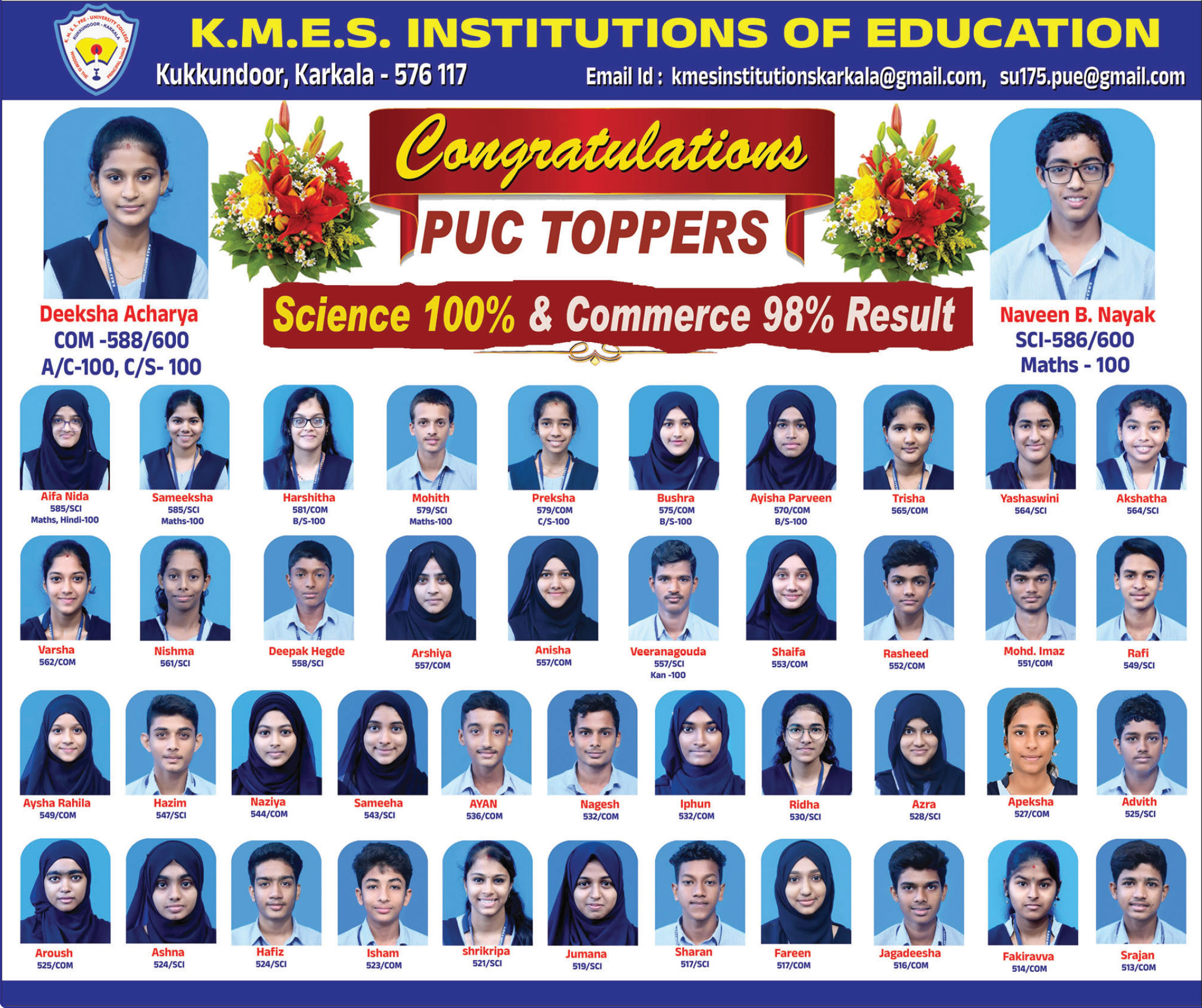
The institution also performed strongly in the PUC examinations. The Science stream recorded a 100 per cent result, with all 44 students passing, while Commerce secured a 98 per cent pass percentage.
Twelve students scored full marks in different subjects, including Mathematics.
In Commerce, Deeksha Acharya topped the college with 588 marks, while Harshitha H. Kini secured the second position with 581 marks.
In Science, Naveen B. Nayak emerged as topper with 586 marks, followed closely by Sameeksha Moily and Aifa Nidha, who both secured 585 marks.
Speaking about the achievement, High School head teacher Shrimati Patkar said the institution has always focused on supporting academically weak students through affordable education and free special classes.
“Our ambition is to provide quality education even to students who struggle in studies. The fees are very low, and free coaching classes are conducted. I have worked here for 28 years and have always found the atmosphere supportive of education,” she said.
Primary School head teacher Lolita Zeena D’Silva appreciated the dedication of the teaching staff and said the school encourages students not only to achieve high marks but also to become role models.
PU College Principal Balakrishna Rao said the institution focuses on value-based education and overall personality development.
“The aim is to help students succeed not only academically but also in cultural activities, sports and leadership. We encourage qualities such as patience, tolerance and discipline,” he said.
Rao also credited the institution’s growth to the support of founders K.S. Mohammed Masood and K.S. Nissar Ahmed, along with President K.S. Imtiaz Ahmed.
Speaking on the occasion, Imtiaz Ahmed said the institution was built on the dream of making quality education accessible to financially backward families in rural areas.
He said the guidance and encouragement of his elder brothers, Mohammed Masood and Nissar Ahmed, along with the contribution of teachers, students and parents, helped transform the institution into a model educational centre.
The KMES Institutions trace their roots back to 1984, when they were founded by senior social activists Haji P.M. Khan, K.S. Nazeer Ahmed and Haji A.S. Rashid Haider.
The institution initially functioned from the Government Urdu School premises as it did not have a building of its own. Classes began with only 22 students in lower kindergarten and two teachers.
Later, under the leadership of K.S. Mohammed Masood and with continuous financial and moral support from non-resident businessman K.S. Nissar Ahmed, the institution gradually expanded.
In 1993, the school shifted to its own building and began conducting classes from LKG to Class 5.
As student admissions increased, Nissar Ahmed personally funded the construction of three additional classrooms to address infrastructure shortages.
The institution’s new school building was completed in 1997, while the PU College building was constructed in 2001.
From humble beginnings in a borrowed building to producing state-level rank holders and consistent academic results, the KMES Institutions have grown into one of the prominent educational centres in the Karkala region.