Monkey hugs Shashi Tharoor, dozes off on his lap in heartwarming encounter

New Delhi, Dec 4: Shashi Tharoor on Wednesday shared an "extraordinary experience" at his home when a monkey ran towards him, hugged him and after being treated to a couple of bananas, rested his head on the Congress MP's chest and dozed off.
Tharoor put out pictures from this unusual encounter on X and went on to narrate the incident that left many users of the platform amused.
"Had an extraordinary experience today. While I was sitting in the garden, reading my morning newspapers, a monkey wandered in, headed straight for me and parked himself on my lap. He hungrily ate a couple of bananas we offered him, hugged me and proceeded to rest his head on my chest and dozed off," the Congress leader said on X.
"I gently began to get up, he leapt off and loped away," Tharoor added.
He said reverence for wildlife is ingrained in him and though he was a bit concerned about the risk of a monkey-bite which would have necessitated rabies shots, he stayed calm and welcomed his presence as non-threatening.
"I am gratified that my faith was borne out and our encounter was entirely peaceful and gentle," Tharoor said.
In the photographs shared by Tharoor, the monkey could be seen nestled in his lap, being fed bananas and then dozing off.
Tharoor is seen calmly reading the newspaper as the monkey rests on his lap.
Reacting to the post, one X user said, "Probably you got the blessings of Hanumaan ji. I zoomed all the pictures to find out which newspaper the bestest Member of Parliament was reading."
Another person wrote, "What a beautiful encounter with nature! Moments like these remind us of the deep, unspoken connection we share with other beings. That monkey’s trust in you speaks volumes about your aura of kindness. Truly, experiences like these make us pause and appreciate the simplicity and warmth of life beyond words."
Reverence for wildlife is ingrained in us, so though i was a bit concerned about the risk of a monkey-bite (which would have necessitated rabies shots), I stayed calm and welcomed his presence as non-threatening. I am gratified that my faith was borne out and our encounter was… pic.twitter.com/thT1ep0Cc9
— Shashi Tharoor (@ShashiTharoor) December 4, 2024
Let the Truth be known. If you read VB and like VB, please be a VB Supporter and Help us deliver the Truth to one and all.
KMES Institutions shine in SSLC result, continue four-decade legacy of education in rural Karkala

Karkala: KMES Institutions of Education at Kukkundooru in Karkala taluk has recorded outstanding results in the 2025-26 SSLC and PUC examinations, continuing a four-decade educational journey that began with just 22 kindergarten students and no building of its own.
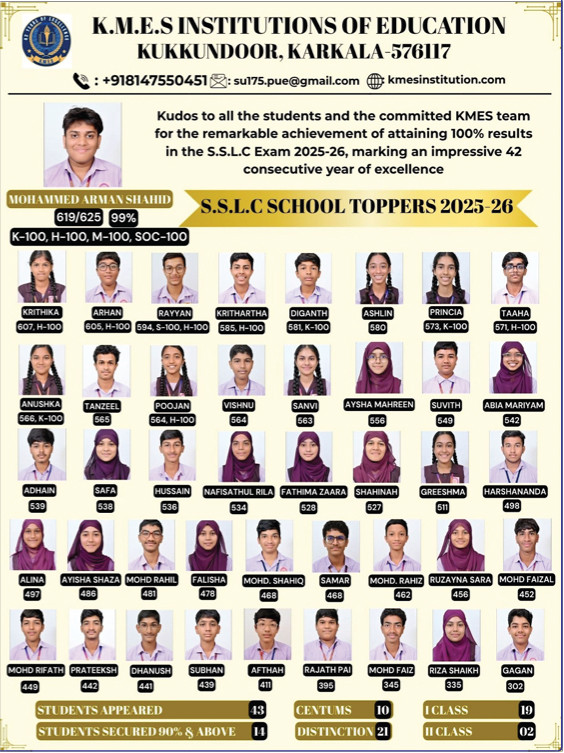
The institution secured a 100 per cent result in the SSLC examinations, with all 43 students passing the examination this year.
Muhammad Arman Shahid emerged as the school topper by scoring 619 marks out of 625, securing 99 per cent and also ranking sixth at the state level. He scored full marks in Kannada, Hindi, Mathematics and Social Science.
Krithika V. Nayak secured the second position in the school with 607 marks and 97.12 per cent, while Arhan stood third with 605 marks and 96.8 per cent.
Out of the 43 students, 21 passed with distinction, 19 secured first class, two students obtained second class and one student passed in third class. Fourteen students scored above 90 per cent.
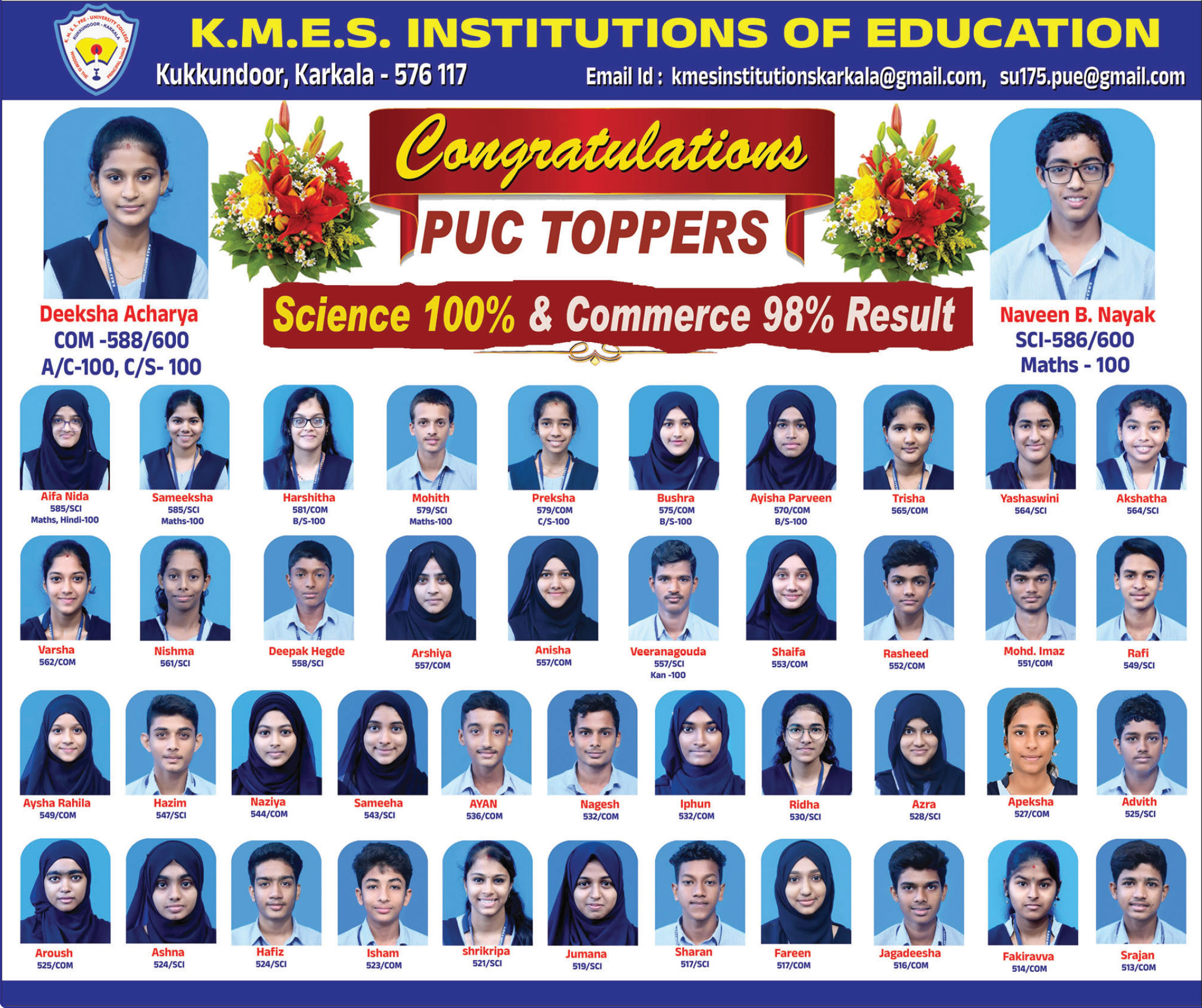
The institution also performed strongly in the PUC examinations. The Science stream recorded a 100 per cent result, with all 44 students passing, while Commerce secured a 98 per cent pass percentage.
Twelve students scored full marks in different subjects, including Mathematics.
In Commerce, Deeksha Acharya topped the college with 588 marks, while Harshitha H. Kini secured the second position with 581 marks.
In Science, Naveen B. Nayak emerged as topper with 586 marks, followed closely by Sameeksha Moily and Aifa Nidha, who both secured 585 marks.
Speaking about the achievement, High School head teacher Shrimati Patkar said the institution has always focused on supporting academically weak students through affordable education and free special classes.
“Our ambition is to provide quality education even to students who struggle in studies. The fees are very low, and free coaching classes are conducted. I have worked here for 28 years and have always found the atmosphere supportive of education,” she said.
Primary School head teacher Lolita Zeena D’Silva appreciated the dedication of the teaching staff and said the school encourages students not only to achieve high marks but also to become role models.
PU College Principal Balakrishna Rao said the institution focuses on value-based education and overall personality development.
“The aim is to help students succeed not only academically but also in cultural activities, sports and leadership. We encourage qualities such as patience, tolerance and discipline,” he said.
Rao also credited the institution’s growth to the support of founders K.S. Mohammed Masood and K.S. Nissar Ahmed, along with President K.S. Imtiaz Ahmed.
Speaking on the occasion, Imtiaz Ahmed said the institution was built on the dream of making quality education accessible to financially backward families in rural areas.
He said the guidance and encouragement of his elder brothers, Mohammed Masood and Nissar Ahmed, along with the contribution of teachers, students and parents, helped transform the institution into a model educational centre.
The KMES Institutions trace their roots back to 1984, when they were founded by senior social activists Haji P.M. Khan, K.S. Nazeer Ahmed and Haji A.S. Rashid Haider.
The institution initially functioned from the Government Urdu School premises as it did not have a building of its own. Classes began with only 22 students in lower kindergarten and two teachers.
Later, under the leadership of K.S. Mohammed Masood and with continuous financial and moral support from non-resident businessman K.S. Nissar Ahmed, the institution gradually expanded.
In 1993, the school shifted to its own building and began conducting classes from LKG to Class 5.
As student admissions increased, Nissar Ahmed personally funded the construction of three additional classrooms to address infrastructure shortages.
The institution’s new school building was completed in 1997, while the PU College building was constructed in 2001.
From humble beginnings in a borrowed building to producing state-level rank holders and consistent academic results, the KMES Institutions have grown into one of the prominent educational centres in the Karkala region.