
Over 35 lakh women form 620 km long human wall across Kerala
Uphold gender equality

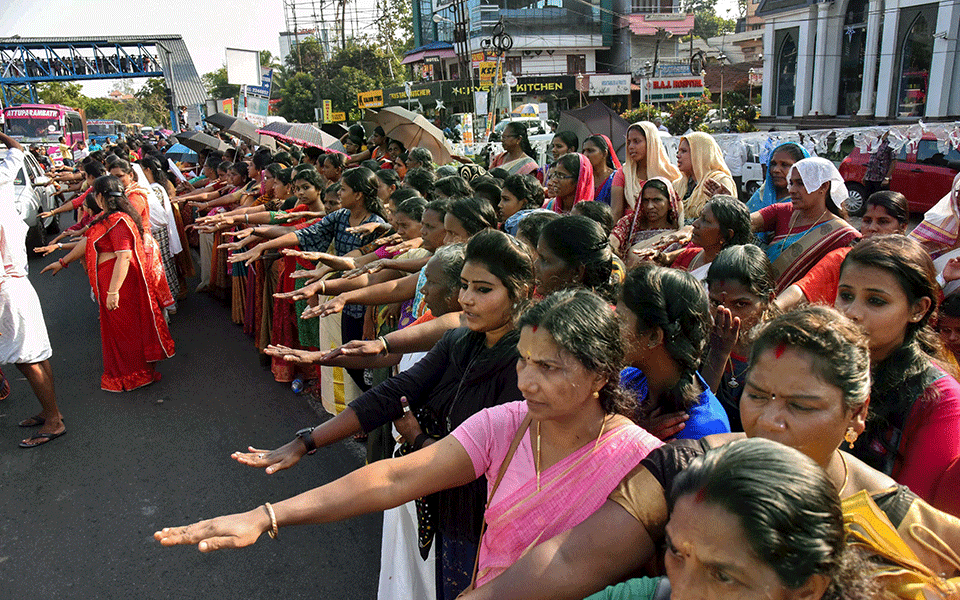
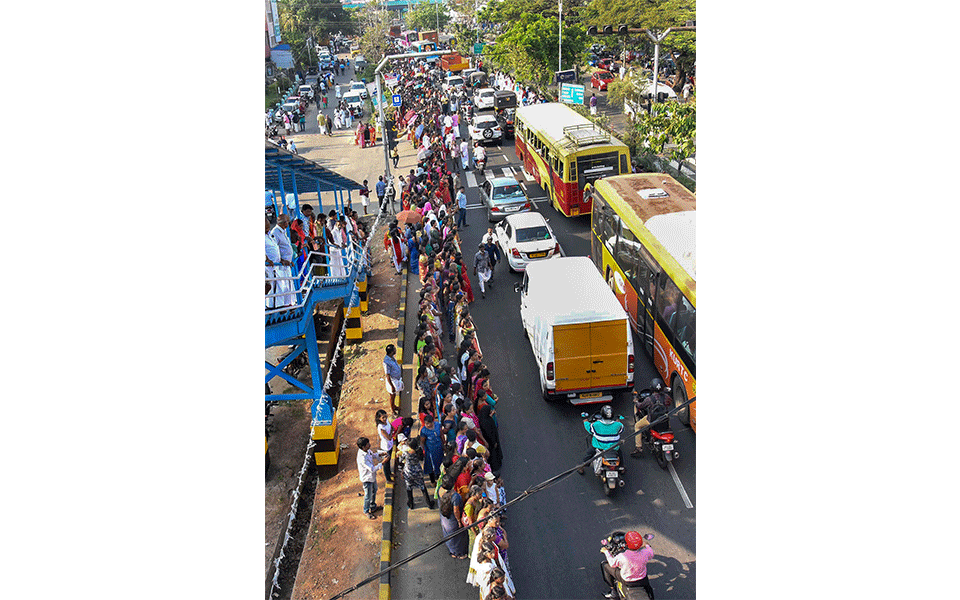
Thiruvananthapuram, Jan 1: In a first, over 35 lakh women stood shoulder-to-shoulder across the national highways in Kerala, creating a 620 km-long human 'wall' from the northern end of Kasaragod to the southern tip here Tuesday as part of a state-sponsored initiative to uphold gender equality.
The event comes days after thousands of devotees lit 'Ayyappa Jyothis' (lighting of sacred lamps) and lined up from Hosangadi in Kasaragod to Kanyakumari, vowing to protect the age-old customs and traditions of Sabarimala.
On Tuesday, women from various walks of life -- writers, athletes, actors, politicians and techies, government officials and homemakers -- stood across the highways crisscrossing through the 14 districts in the state as the event commenced at 4 pm.
Expressing solidarity, thousands of men also lined up parallel forming a second human 'wall'.
The 'Women's wall' was conceived in the backdrop of frenzied protests witnessed in the hill shrine of Lord Ayyappa at Sabarimala after the CPI(M)-led LDF government decided to implement the Supreme Court verdict, allowing all women to pray at the Ayyappa shrine.
Representatives of Universal Record Forum (URF) which records amazing feats across the globe declared the human wall as the "longest women's wall in the world" with participation of over 35 lakh women.
However, CPI(M) state secretary Kodiyeri Balakrishnan claimed 55 lakh women lined up for the 'wall'.
CPI(M) polit bureau member Brinda Karat, who was the last member of the human wall at Thiruvananthapuram, said women in Kerala have scripted history by erecting a "human wall of resistance" against the dark forces.
She also lashed out at the saffron party, saying it was using women for its "toxic, divisive, anti-women political goal" and asked women not to be the pawns in the hands of those who have no thoughts about the future of women.
Chief Minister Pinarayi Vijayan, his cabinet colleagues and Communist veteran V S Achuthanandan were among those who were present at the public meeting here after the formation of the wall.
Vijayan garlanded the statue of Ayyankali, a social reformer, before the start of the event.
The wall has become a movement against gender discrimination faced by women and to protect their Constitutional rights, he said.
The initiative also witnessed a group of the Jacobite faction of the Christian community lining up in support of the wall along with members of the Muslim community.
Former firebrand communist leader and Janadhipathya Samrakshana Samithy supremo, 100-year-old K R Gowri Amma also took part in the event near her home at Alappuzha.
Johnson V Idikula, chairman of the monitoring panel of the URF Adjudication Committee, told PTI they had over 600 volunteers across the state to monitor the event.
"We have recorded the event, clicked pictures and captured videos to prepare a comprehensive report," Idikula said.
However, the main Opposition Congress, which all through had expressed their ire against the wall, said "Kerala society has dismissed the government's much-hyped event."
The BJP state leadership dubbed the wall a "total failure" and waste of government funds and machinery.
G Sukumaran Nair, heading the Nair Service Society (NSS), which kept away from the event, said 'God's Own Country' will turn into 'Devil's Own Country' after formation of such walls.
Violence also marred the initiative as participants of the women's 'wall' at Chettukund in Kasaragod district were attacked, allegedly by some BJP-RSS workers, as they lined up at the National Highway there to form the human chain.
The workers hurled stones at the women and policemen, injuring three personnel, police said, adding that they had to fire in the air and burst teargas shells to disperse the attackers.
Media personnel of two television channels were also attacked by the activists, who reportedly forced them to delete the visuals of the incident.
According to K Sreekanth, BJP Kasaragod district president, the violence was allegedly a handiwork of CPI(M) as the 'Women's wall" was a failure in the northernmost district.
CPI(M) district secretary, M V Balakrishnan, slamming the BJP, alleged that BJP workers had burnt grass and shrubs after sprinkling chilly powder and 13 women were hospitalised inhaling the fumes.
A group of women in New Delhi Tuesday also expressed solidarity with their counterparts in Kerala by holding a demonstration outside Kerala House at the national capital's Jantar Mantar road where members of National Federation of Indian Women held placards saying, "Equality and Justice is Women's Constitutional Right".
The 'Women's wall' was suggested at a meeting called by the Kerala government, following massive protests by right-wing parties and a section of devotees over the government's decision to implement the September 28 apex court order, allowing women of all ages to offer prayers at Sabarimala.
Let the Truth be known. If you read VB and like VB, please be a VB Supporter and Help us deliver the Truth to one and all.
Putin meets Iran's FM Araghchi, says Russia ready to do its best to help bring peace to West Asia

Moscow (PTI): Iran's Foreign Minister Abbas Araghchi on Monday met Russian President Vladimir Putin, who hailed the Iranian people for fighting bravely and heroically for their sovereignty and said Moscow is ready to do its best to help bring peace to West Asia as soon as possible.
Araghchi, who held talks with Omani and Pakistani leadership before arriving in Russia, met Putin in St. Petersburg and thanked him for supporting Iran, state-owned TASS news agency reported.
"Russia is ready to do everything in its power to ensure that peace in the Middle East is achieved as soon as possible," Putin said during his meeting with Araghchi, which was also attended by Russian Foreign Minister Sergey Lavrov.
Revealing that he received a message from Iranian Supreme Leader Mojtaba Khamenei last week, Putin asked Araghchi to convey his "gratitude for this message and best wishes for his health and well-being."
He praised the Iranian people for fighting "bravely and heroically" for their sovereignty, Iran's state-run PRESS TV reported.
"We really hope that, based on the courage and desire for independence, the Iranian people, under the guidance of the new leader, will weather this difficult period of trials and peace will come,” Putin said.
He also stressed that Russia “intends to maintain” its strategic relations with Iran.
Araghchi said that the world witnessed Iran’s strength in countering the US during the recent war, and that the Islamic Republic is a "stable and powerful establishment."
"With their courage, the Iranian people succeeded in resisting the US aggression and will be able to endure it,” he said.
He said that it became clear that Iran has “great friends and allies” like Russia, and conveyed “warmest greetings” from Supreme Leader Mojtaba Khamenei and President Masoud Pezeshkian to the Russian leader.
Araghchi said relations between Moscow and Tehran represent a “strategic partnership at the highest level” and will continue to develop "regardless of circumstances."
"We are grateful to you for the solid and strong positions in support of the Islamic Republic of Iran," he said.
Foreign Minister Lavrov said that the talks between President Putin and the Iranian Foreign Minister were "useful and constructive."
Kremlin Spokesman Dmitry Peskov later said that Russia is "ready to provide any good offices, any mediation services that are acceptable to the parties."
"We will be ready to do everything so that ultimately peace ensues, guaranteed peace, and that there is no return to hostilities," Peskov was quoted as saying by TASS.
He was asked how Moscow can assist in future negotiations on the Iranian settlement.
Araghchi arrived in Russia after his whirlwind trip to Islamabad, which, according to him, was “very productive” and involved “good consultations" with Pakistan's Army Chief Field Marshal Asim Munir, amid uncertainty over the second round of peace talks to resolve the war in West Asia.
"We held good consultations with our friends in Pakistan. The trip was successful. We assessed the outcome of our recent (meetings) and discussed in what direction and under what conditions talks can move on,” Araghchi said in a video posted on his Telegram channel upon his arrival in St Petersburg.
Referring to the second round of talks between the US and Iran to resolve the conflict in West Asia, Araghchi said: "Developments have taken place in the negotiations."
"Despite some progress in earlier rounds, the talks failed to reach their objectives due to the Americans' approach, the excessive demands they made, and the wrong approaches they adopted. Therefore, it was necessary to consult with our friends in Pakistan to review the latest situation,” Iran's official news agency IRNA quoted him as saying.
He said that the trip to Pakistan was a good opportunity to review developments related to the US-Israeli war against Iran, expressing confidence that “these consultations and coordination between the two countries will be highly significant.”
Araghchi arrived at St. Petersburg's Pulkovo Airport early Monday, where he was welcomed by Russian officials and Iran’s ambassador to Russia, Kazem Jalali, the report said.
The first round of peace talks between Iran and the US, held on April 11 and 12, failed to bring the desired result for the parties to the conflict.
The Iranian minister arrived in Islamabad for the second time on Sunday after a short visit to Oman, where he held talks with Sultan Haitham bin Tariq al-Said on security in the Strait of Hormuz and diplomatic efforts to end the Iran-US conflict.
After Araghchi left Pakistan for Oman on Saturday, President Donald Trump announced that US negotiators Steve Witkoff and Jared Kushner would no longer be going to Islamabad for talks with Iran, contending that Washington held all the cards on the matter.
Trump on Sunday reiterated that the US and Iranian officials can talk by phone for a peace solution to the conflict.
On Tuesday, Trump extended the two-week ceasefire with Iran indefinitely to give Tehran more time to prepare a unified proposal to end the war, just hours before the truce was set to expire.
The war began when the US and Israel jointly attacked Iran on February 28, killing Iranian Supreme Leader Ayatollah Ali Khamenei and several top commanders. The retaliation by the Islamic Republic extended the war to the entire Gulf region.


