Prominent activists, lawyers condemn harassment of human rights advocate Nadeem Khan

New Delhi: A coalition of researchers, politicians, and senior Supreme Court lawyers convened at the Press Club of India on Tuesday to denounce the “harassment” of prominent human rights activist Nadeem Khan. The gathering expressed strong disapproval of the recent actions against Khan, who serves as the national general secretary of the Association for Protection of Civil Rights (APCR).
Khan was allegedly “illegally detained” by the Delhi Police for nearly six hours in Bengaluru on Saturday, according to a statement released by the People’s Union for Civil Liberties (PUCL). This incident followed the filing of a First Information Report (FIR) against him on allegations of promoting enmity through a video highlighting hate crimes in India.
The Delhi High Court, however, has extended interim protection to Khan, barring his arrest until Friday. The court noted that the country’s unity was “not so fragile” as to be threatened by such actions.
Tuesday’s event, held to protest the FIR and Khan’s detention, was moderated by writer and activist Farah Naqvi. A panel of distinguished figures, including Supreme Court lawyers Sanjay Hegde, Prashant Bhushan, and Nizam Pasha; Rashtriya Janata Dal (RJD) MP Manoj Jha; former Planning Commission member Syeda Hameed; and Kavita Srivastava from PUCL, voiced their concerns over the alleged targeting of Khan.
Naqvi emphasized that the issue extends beyond Khan and APCR, representing a broader attempt to criminalize fundamental democratic rights. “This is not just about Nadeem or APCR. This case is about delegitimizing our basic rights as citizens,” she remarked. Naqvi also criticized the selective targeting of individuals speaking against injustices, saying, “It appears that only people with ‘certain names’ can raise issues like lynching and bulldozer injustice, while others face criminalisation.”
The PUCL, in its statement, alleged that Khan faced “coercion and intimidation” by Delhi Police officers who arrived at his residence in Bengaluru on November 30 without a warrant. According to the organisation, four officers, including the Shaheen Bagh police station’s Station House Officer (SHO), pressured Khan to travel to Delhi for questioning related to the FIR.
Supreme Court lawyer Nizam Pasha said, “The police first visited his house before the FIR was filed, and just hours later, they were in Bengaluru to arrest him. This raises serious questions about the intent and timing.”
The FIR against Khan was lodged under sections 353 (statements conducing to public mischief), 196 (promoting enmity between groups), and 61 (criminal conspiracy) of the Bharatiya Nyaya Sanhita (BNS). It pertained to a video titled ‘Records of Hindustan in Modi Sarkar’ that documented hate crimes in India.
Senior advocate Prashant Bhushan defended Khan’s efforts to document and address hate crimes, asserting that raising awareness about such issues is a civic responsibility, not a criminal act. He commended APCR for its effective work in protecting civil rights and criticized the pattern of filing FIRs against activists like Khan and Alt News co-founder Mohammad Zubair while perpetrators of hate crimes remain largely unchecked.
Sanjay Hegde also recounted Khan’s impactful interventions, highlighting his role in seeking justice for victims of communal violence. Referring to the case of police inspector Subodh Kumar Singh, who was lynched in Uttar Pradesh in 2018, Hegde said, “Khan brought Singh’s widow to my house, which eventually led to a Supreme Court petition that canceled the bail of the accused. They are now in jail, awaiting trial.”
Kavita Srivastava from PUCL described the FIR as part of a disturbing trend where activists addressing systemic injustices are targeted. “This is about criminalizing advocacy and delegitimizing human rights work,” she said.
As Khan awaits further legal proceedings, the Delhi High Court’s interim protection offers temporary relief.
Let the Truth be known. If you read VB and like VB, please be a VB Supporter and Help us deliver the Truth to one and all.
KMES Institutions shine in SSLC result, continue four-decade legacy of education in rural Karkala

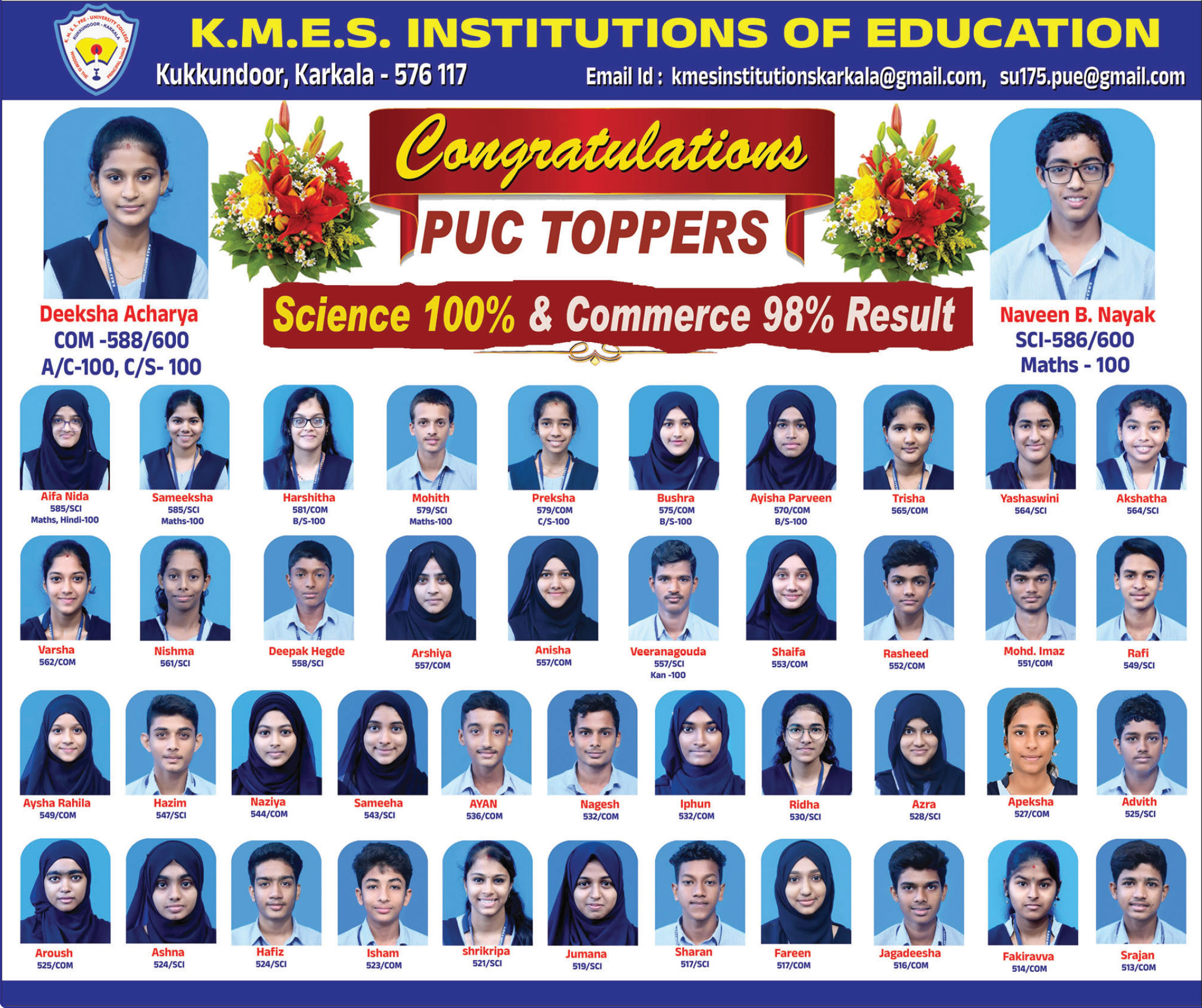
Karkala: KMES Institutions of Education at Kukkundooru in Karkala taluk has recorded outstanding results in the 2025-26 SSLC and PUC examinations, continuing a four-decade educational journey that began with just 22 kindergarten students and no building of its own.
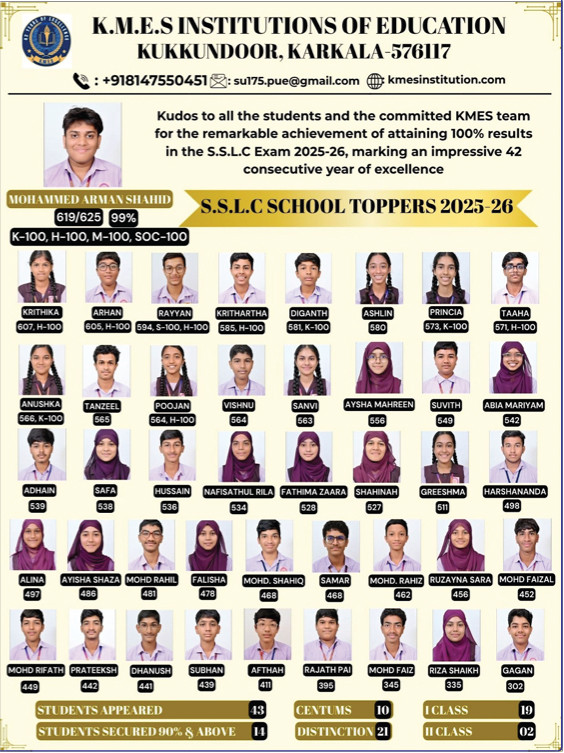
The institution secured a 100 per cent result in the SSLC examinations, with all 43 students passing the examination this year.
Muhammad Arman Shahid emerged as the school topper by scoring 619 marks out of 625, securing 99 per cent and also ranking sixth at the state level. He scored full marks in Kannada, Hindi, Mathematics and Social Science.
Krithika V. Nayak secured the second position in the school with 607 marks and 97.12 per cent, while Arhan stood third with 605 marks and 96.8 per cent.
Out of the 43 students, 21 passed with distinction, 19 secured first class, two students obtained second class and one student passed in third class. Fourteen students scored above 90 per cent.
The institution also performed strongly in the PUC examinations. The Science stream recorded a 100 per cent result, with all 44 students passing, while Commerce secured a 98 per cent pass percentage.
Twelve students scored full marks in different subjects, including Mathematics.
In Commerce, Deeksha Acharya topped the college with 588 marks, while Harshitha H. Kini secured the second position with 581 marks.
In Science, Naveen B. Nayak emerged as topper with 586 marks, followed closely by Sameeksha Moily and Aifa Nidha, who both secured 585 marks.
Speaking about the achievement, High School head teacher Shrimati Patkar said the institution has always focused on supporting academically weak students through affordable education and free special classes.
“Our ambition is to provide quality education even to students who struggle in studies. The fees are very low, and free coaching classes are conducted. I have worked here for 28 years and have always found the atmosphere supportive of education,” she said.
Primary School head teacher Lolita Zeena D’Silva appreciated the dedication of the teaching staff and said the school encourages students not only to achieve high marks but also to become role models.
PU College Principal Balakrishna Rao said the institution focuses on value-based education and overall personality development.
“The aim is to help students succeed not only academically but also in cultural activities, sports and leadership. We encourage qualities such as patience, tolerance and discipline,” he said.
Rao also credited the institution’s growth to the support of founders K.S. Mohammed Masood and K.S. Nissar Ahmed, along with President K.S. Imtiaz Ahmed.
Speaking on the occasion, Imtiaz Ahmed said the institution was built on the dream of making quality education accessible to financially backward families in rural areas.
He said the guidance and encouragement of his elder brothers, Mohammed Masood and Nissar Ahmed, along with the contribution of teachers, students and parents, helped transform the institution into a model educational centre.
The KMES Institutions trace their roots back to 1984, when they were founded by senior social activists Haji P.M. Khan, K.S. Nazeer Ahmed and Haji A.S. Rashid Haider.
The institution initially functioned from the Government Urdu School premises as it did not have a building of its own. Classes began with only 22 students in lower kindergarten and two teachers.
Later, under the leadership of K.S. Mohammed Masood and with continuous financial and moral support from non-resident businessman K.S. Nissar Ahmed, the institution gradually expanded.
In 1993, the school shifted to its own building and began conducting classes from LKG to Class 5.
As student admissions increased, Nissar Ahmed personally funded the construction of three additional classrooms to address infrastructure shortages.
The institution’s new school building was completed in 1997, while the PU College building was constructed in 2001.
From humble beginnings in a borrowed building to producing state-level rank holders and consistent academic results, the KMES Institutions have grown into one of the prominent educational centres in the Karkala region.