R-Day honours: Ashoka Chakra for space hero Shubhanshu Shukla
Shaurya Chakra for 2 women Navy officers

New Delhi (PTI): Group Captain Shubhanshu Shukla, who created history by becoming the first Indian to set foot on the International Space Station (ISS), was on Sunday awarded the Ashoka Chakra, India's highest peacetime gallantry award.
In June last year, Shukla became the second Indian to have gone to space and the first to visit the ISS as part of the historic Axiom-4 mission. His 18-day space odyssey came 41 years after cosmonaut Rakesh Sharma flew aboard the Russian Soyuz-11 space mission.
On the eve of the Republic Day, President Droupadi Murmu approved gallantry awards to 70 armed forces personnel, including six who would receive the honour posthumously.
These include one Ashoka Chakra, three Kirti Chakra, 13 Shaurya Chakra, including one posthumous, one Bar to Sena Medal (gallantry), 44 Sena Medals (gallantry), six Nao Sena Medals (gallantry) and two Vayu Sena Medals.
Two women officers of the Indian Navy -- Lieutenant Commander Dilna K and Lieutenant Commander Roopa A -- were honoured with the Shaurya Chakra award, months after they made history by completing an extraordinary expedition to circumnavigate the globe, covering 21,600 nautical miles (approx 40,000 km) over an eight-month period onboard Indian Naval Sailing Vessel (INSV) Tarini.
The Shaurya Chakra is India's third-highest peacetime gallantry award after the Ashoka Chakra and the Kirti Chakra.
The Kirti Chakra has been conferred on Major Arshdeep Singh from 1 Assam Rifles, Naib Subedar Doleshwar Subba from 2 Para (Special Forces) and Group Captain Prashanth Balakrishnan Nair.
Nair was one of the four astronauts who underwent training for India's first human spaceflight mission, Gaganyaan.
The decision to confer the Ashoka Chakra on Shukla is seen as the government's recognition of the importance of the space sector as the coveted honour is generally bestowed on military personnel for showing "most conspicuous bravery".
As a fighter pilot, Shukla has an impressive record of 2,000 hours of flight experience across various aircraft, including the Su-30 MKI, MiG-21, MiG-29, Jaguar, Hawk, Dornier and An-32.
Shukla served as the pilot for the Axiom Mission-4 (Ax-4) to the ISS and left an indelible mark on India's remarkable advancements in human space exploration.
After the successful space mission, Shukla became a household name as his contributions during the mission, including the conduct of sophisticated experiments, received recognition from global space experts.
The Axiom-4 mission was executed by US-based private firm Axiom Space and it involved the National Aeronautics and Space Administration (NASA), the European Space Agency (ESA) and the Indian Space Research Organisation (ISRO).
Shukla hails from Lucknow. He was commissioned into the fighter stream of the Indian Air Force in June 2006.
Of the 13 Shaurya Chakra awards, 10 were conferred on Army personnel (one posthumous), two went to the Navy and one to a paramilitary official.
The Shaurya Chakra awardees are Lieutenant Colonel Ghatage Aditya Shrikumar from 21 Para (special forces), Major Anshul Baltoo from 32 Assam Rifles, Major Shivkant Yadav from 5 Para (special forces), Major Vivek Mech from 42 Rashtriya Rifles, Major Leishangthem Deepak Singh from 11 Para (special forces) and Captain Yogendra Singh Thaku from 6 Para (special forces).
Subedar P H Moses from 1 Assam Rifles, Baldev Chand (posthumous) from 4 Rashtriya Rifles, Rifleman Manglem Sang Vaiphei from 3 Assam Rifles and Rifleman Dhruba Jyoti Dutta from 33 Assam Rifles were the other recipients of the Shaurya Chakra from the Army.
The president also approved 301 military decorations to armed forces and other personnel.
These include 30 Param Vishisht Seva Medals, four Uttam Yudh Seva Medals, 56 Ati Vishisht Seva Medals, nine Yudh Seva Medals, two Bar to Sena Medals (Distinguished), 43 Sena Medals (Distinguished), eight Nao Sena Medals (Distinguished), 14 Vayu Sena Medals (Distinguished) and 135 Vishisht Seva Medals.
Let the Truth be known. If you read VB and like VB, please be a VB Supporter and Help us deliver the Truth to one and all.
KMES Institutions shine in SSLC result, continue four-decade legacy of education in rural Karkala

Karkala: KMES Institutions of Education at Kukkundooru in Karkala taluk has recorded outstanding results in the 2025-26 SSLC and PUC examinations, continuing a four-decade educational journey that began with just 22 kindergarten students and no building of its own.
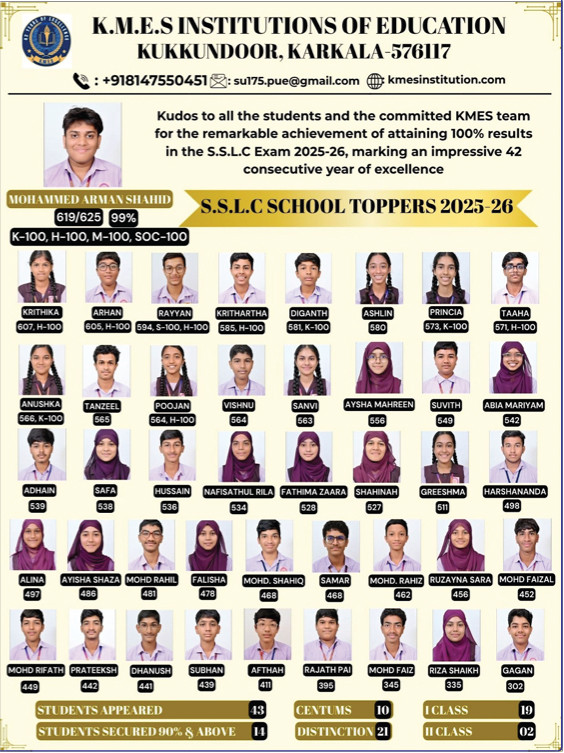
The institution secured a 100 per cent result in the SSLC examinations, with all 43 students passing the examination this year.
Muhammad Arman Shahid emerged as the school topper by scoring 619 marks out of 625, securing 99 per cent and also ranking sixth at the state level. He scored full marks in Kannada, Hindi, Mathematics and Social Science.
Krithika V. Nayak secured the second position in the school with 607 marks and 97.12 per cent, while Arhan stood third with 605 marks and 96.8 per cent.
Out of the 43 students, 21 passed with distinction, 19 secured first class, two students obtained second class and one student passed in third class. Fourteen students scored above 90 per cent.
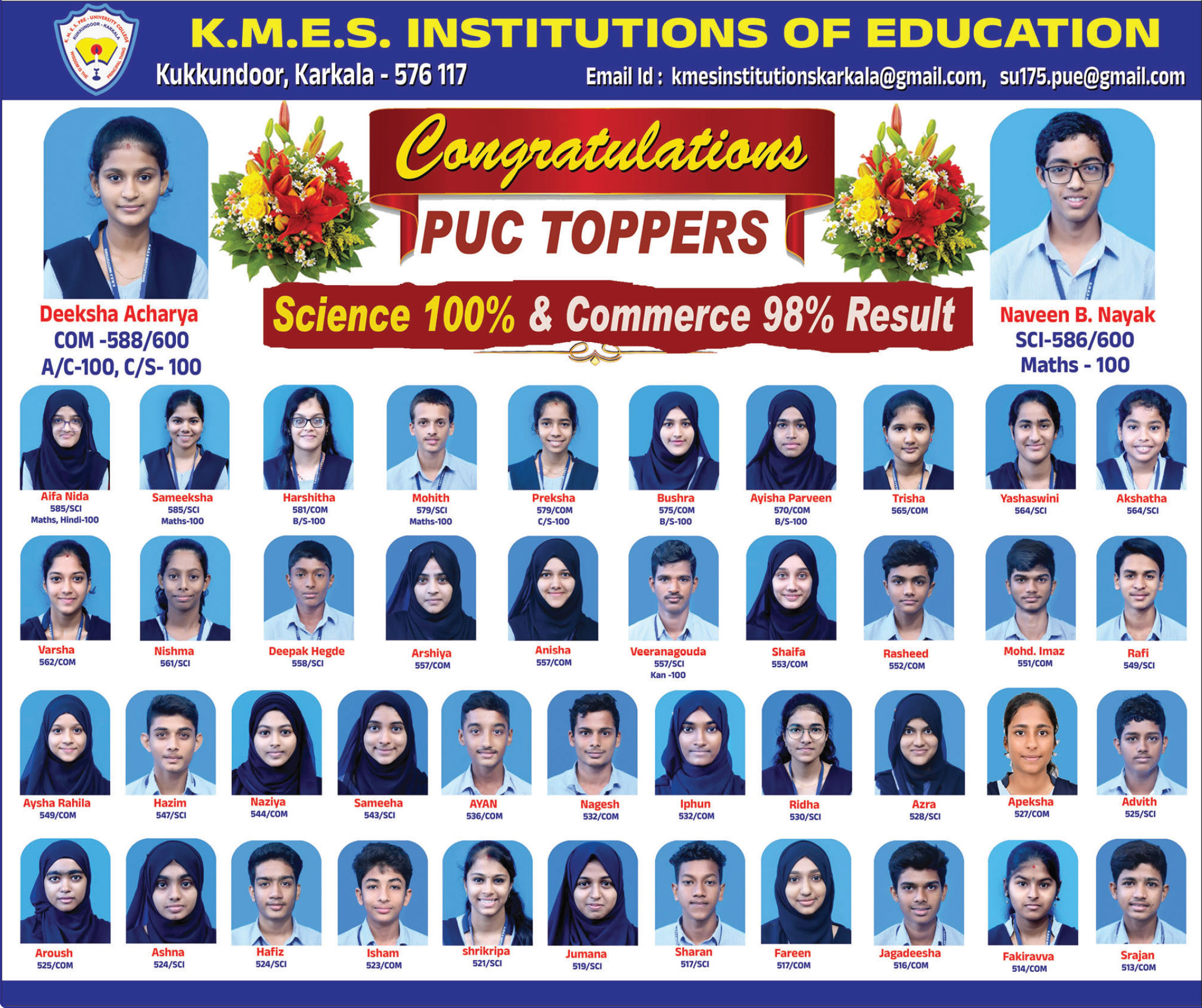
The institution also performed strongly in the PUC examinations. The Science stream recorded a 100 per cent result, with all 44 students passing, while Commerce secured a 98 per cent pass percentage.
Twelve students scored full marks in different subjects, including Mathematics.
In Commerce, Deeksha Acharya topped the college with 588 marks, while Harshitha H. Kini secured the second position with 581 marks.
In Science, Naveen B. Nayak emerged as topper with 586 marks, followed closely by Sameeksha Moily and Aifa Nidha, who both secured 585 marks.
Speaking about the achievement, High School head teacher Shrimati Patkar said the institution has always focused on supporting academically weak students through affordable education and free special classes.
“Our ambition is to provide quality education even to students who struggle in studies. The fees are very low, and free coaching classes are conducted. I have worked here for 28 years and have always found the atmosphere supportive of education,” she said.
Primary School head teacher Lolita Zeena D’Silva appreciated the dedication of the teaching staff and said the school encourages students not only to achieve high marks but also to become role models.
PU College Principal Balakrishna Rao said the institution focuses on value-based education and overall personality development.
“The aim is to help students succeed not only academically but also in cultural activities, sports and leadership. We encourage qualities such as patience, tolerance and discipline,” he said.
Rao also credited the institution’s growth to the support of founders K.S. Mohammed Masood and K.S. Nissar Ahmed, along with President K.S. Imtiaz Ahmed.
Speaking on the occasion, Imtiaz Ahmed said the institution was built on the dream of making quality education accessible to financially backward families in rural areas.
He said the guidance and encouragement of his elder brothers, Mohammed Masood and Nissar Ahmed, along with the contribution of teachers, students and parents, helped transform the institution into a model educational centre.
The KMES Institutions trace their roots back to 1984, when they were founded by senior social activists Haji P.M. Khan, K.S. Nazeer Ahmed and Haji A.S. Rashid Haider.
The institution initially functioned from the Government Urdu School premises as it did not have a building of its own. Classes began with only 22 students in lower kindergarten and two teachers.
Later, under the leadership of K.S. Mohammed Masood and with continuous financial and moral support from non-resident businessman K.S. Nissar Ahmed, the institution gradually expanded.
In 1993, the school shifted to its own building and began conducting classes from LKG to Class 5.
As student admissions increased, Nissar Ahmed personally funded the construction of three additional classrooms to address infrastructure shortages.
The institution’s new school building was completed in 1997, while the PU College building was constructed in 2001.
From humble beginnings in a borrowed building to producing state-level rank holders and consistent academic results, the KMES Institutions have grown into one of the prominent educational centres in the Karkala region.