
Rafale row: Reliance Entertainment confirms it paid 1.4 million Euros for film by Hollande’s partner

Anil Ambani’s Reliance Entertainment has confirmed that it financed 15 per cent of the budget of Tout La-Haut, the French film produced by Julie Gayet, the partner of France’s then President Francois Hollande.
Reliance Entertainment had paid 1.48 million Euros through one of its partners, French financing firm Visvires Capital, towards the production of the film, the company said in a statement.
“Reliance Entertainment had paid the aforesaid only EUR 1.48 million to Visvires Capital on 5th December 2017, as customary only about two weeks before the release of the film on 20th December 2017,” the company said in a statement.
Besides films, the Reliance Group has made several other successful co-investments with Visvires Capital, including inter alia in Sula Wines and Grover Vineyards, prior to the film co-financing, the statement said.
VisVires Capital is founded by Ravi Viswanathan, a Singapore-based French businessman of Indian origin who is a longstanding friend of Ambani.
“Reliance Entertainment has not signed any agreement with Ms. Julie Gayet or her company, Rouge International, and nor has any payment ever been made by Reliance Entertainment to either of them in relation to the film, nOmber One,” the company statement quoted a spokesperson while giving these details.
‘nOmber One’ was the title of the film when it was announced; it was released under the title ‘Tout La-Haut’.
Anil Ambani’s company also said that it received EUR 300,000 from the film’s French producer for providing physical production services for extensive location shooting in difficult mountainous terrains in Ladakh. Directed by Serge Hazanavicius and featuring French actor Kev Adams, Tout La-Haut was shot in Nepal and Ladakh, besides France.
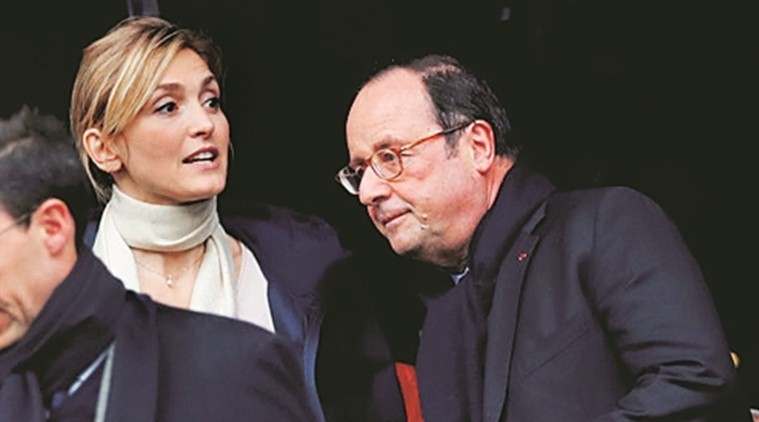
Anil Ambani’s Reliance Entertainment entered into a deal to produce a film with Hollande’s partner and actor Julie Gayet. In this photo, Hollande with Gayet. (Reuters)
Last month, The Indian Express reported that Reliance Entertainment had announced on January 24, 2016, that it had entered into an agreement with Gayet’s firm, Rouge International, to jointly produce a French film. Two days later, Prime Minister Narendra Modi and Hollande signed an MoU in New Delhi for the purchase of 36 Rafale fighter jets from France in flyaway condition.
Responding to that report, Hollande had told a French newsportal, Mediapart.fr, on September 21, “We didn’t have a say in that. It was the Indian government that proposed this service group (Reliance), and Dassault who negotiated with Ambani. We didn’t have a choice, we took the interlocutor who was given to us.”
In response to a question by news agency AFP on September 21, Hollande said Reliance Group’s name had appeared as part of a “new formula” in negotiations over the Rafale deal, which was decided by the Modi government after it came to power. Asked if he knew whether India put pressure for the Reliance Group to work with Dassault, Hollande said he was “unaware” and “Dassault alone is capable of answering”, as per AFP.
He had contradicted the Indian government’s claim that the deal between Dassault and Reliance was a commercial pact between two private parties and the government had nothing to do with it.
The deal for 36 jets in a government-to-government agreement was announced by Modi on April 10, 2015 during his visit to Paris, which led to the cancellation of the 126-aircraft deal being negotiated by the previous government. The deal was eventually signed on September 23, 2016 in Delhi between then Defence Minister Manohar Parrikar and his French counterpart.
Under the offsets clause, France is to invest 50 per cent of the total order cost in local contracts in India, worth Rs 30,000 crore. The offset obligations of the deal are to be discharged from September 2019 to September 2023, as per the contract.
The Rafale offset was the first project of this magnitude won by Reliance Defence, which placed it at the centre of a major political row. Opposition parties, including the Congress, have alleged that undue favours had been granted to Ambani’s firm in this deal, a company without any defence manufacturing experience.
Courtesy: indianexpress.com
Let the Truth be known. If you read VB and like VB, please be a VB Supporter and Help us deliver the Truth to one and all.
Man kills woman lecturer, sets car ablaze; dies by suicide in Karnataka

Bengaluru (PTI): A 46-year-old man allegedly killed a woman lecturer by setting fire to the car with her inside, before dying by suicide; his severed body was found by railway police the next day, police said on Tuesday.
The deceased, identified as Ramanjinappa, a resident of Doddaballapura, was a contract worker in the tahsildar’s office, they said.
Police said the man, who was married and had apparently separated from his wife, was in an illicit relationship with a woman identified as Saroja, whose charred body was found inside a gutted car in an isolated area near the Bashetty Industrial Area in Doddaballapura taluk on the outskirts of Bengaluru.
Saroja was also married and had a son, police said.
According to police, on Saturday, the man allegedly borrowed a car from an acquaintance, claiming he had a medical emergency and needed to visit a hospital.
Citing preliminary investigations, a senior police officer said the man picked up the lecturer from a bus stop in Devanahalli. The two spent a couple of hours driving around Nandi Hills and nearby areas.
Later, they reached a secluded spot in Doddaballapura, where it is suspected that an argument ensued inside the car, following which he allegedly hit her on the head with a hammer, the officer said.
He then set the car on fire, reportedly using petrol, and is believed to have died by suicide thereafter, police said.
Locals who saw the burning car alerted the police and fire department, who rushed to the spot, extinguished the fire, and found the woman’s body completely charred inside the vehicle, the officer added.
His severed body was found near railway tracks in Bidadi by the railway police on Sunday, he said.
The motive and whether the crime was premeditated or impulsive are under investigation, he said.
Saroja’s husband filed a complaint accusing Ramanjinappa of killing her, police said, adding that a detailed investigation is underway to establish the exact sequence of events.


