
Rahul constitutes 23-member CWC, drops some senior leaders

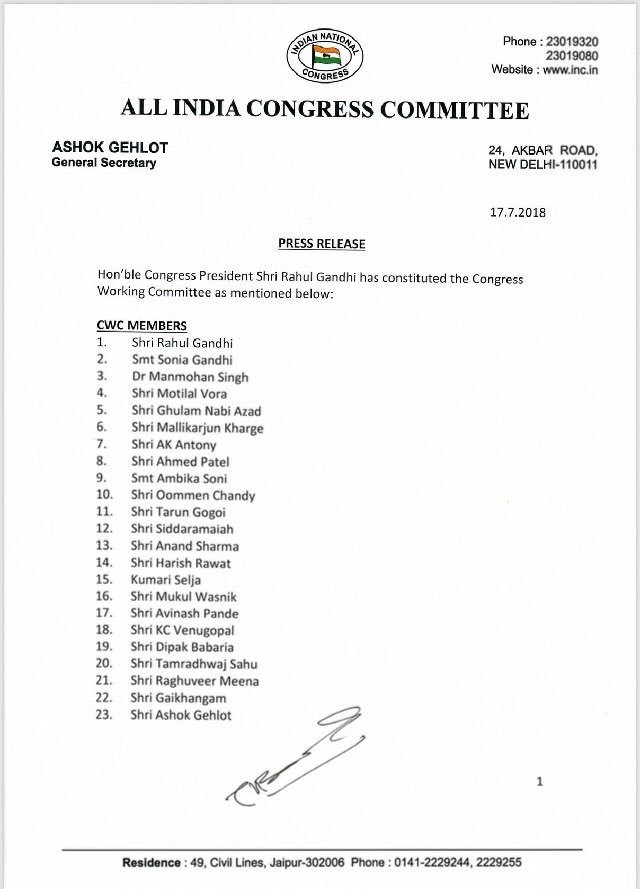
New Delhi, July 17: Congress President Rahul Gandhi on Tuesday constituted the Congress Working Committee (CWC) by appointing 23 members and dropping some senior leaders in his bid to strike a balance between age and experience, and prepare for the 2019 Lok Sabha polls.
Prominent among those dropped from the previous CWC include Digvijay Singh, Janardan Dwivedi, Kamal Nath and Sushilkumar Shinde.
The first CWC to be constituted by Gandhi after his elevation as party chief in December last also seeks to have balance in terms of regional representation.
The first meeting of the new CWC -- the party's highest decision-making body -- will be held on July 22.
The new faces in the CWC include former chief ministers Oommen Chandy (Kerala), Tarun Gogoi (Assam), Siddaramaiah (Karnataka) and Harish Rawat (Uttarakhand).
Former Union Minister Kumari Selja, party MP from Durg Tamradhwaj Sahu, former MP Raghuveer Meena and former Manipur Deputy Chief Minister Gaikhangam are the other new faces in the CWC.
Sahu is the only Congress MP in the Lok Sabha from Chhattisgarh where assembly polls will be held at the end of this year.
Apart from Digvijay Singh, Janardan Dwivedi, Kamal Nath and Sushilkumar Shinde, those dropped include Punjab Chief Minister Capt. Amarinder Singh and former Haryana Chief Minister Bhupinder Singh Hooda.
Kamal Nath was earlier this year appointed chief of the party's Madhya Pradesh unit.
C.P. Joshi, B.K. Hariprasad, Karan Singh, Oscar Fernandes, Mohan Prakash, Hemo Prova Saikia and Sushila Tiriya have also been dropped.
The new CWC does not include any of the three Congress chief ministers.
United Progressive Alliance (UPA) Chairperson Sonia Gandhi and former Prime Minister Manmohan Singh will be the senior members of the new CWC that will form the core team of the party for the state elections this year and the 2019 Lok Sabha polls.
The leaders who have been retained include Ghulam Nabi Azad, Ahmed Patel, Mallikarjun Kharge, Ashok Gehlot, Motilal Vora, A.K. Antony, Amika Soni, Anand Sharma, Mukul Wasnik, Avinash Pande, K.C. Venugopal and Dipak Babaria.
There are several young faces in the 18 permanent invitees of the new CWC.
The permanent invitees include former Delhi Chief Minister Sheila Dikshit; former Union Minister P. Chidambaram; party MPs Jyotiraditya Scindia, Gaurav Gogoi, Rajeev Satav, Rajni Patil; former MPs Tariq Hameed Karra, P.L. Punia, P.C. Chacko, R.P.N. Singh, Jitendra Singh and Ram Chandra Khuntia; and party's communications incharge Randeep Singh Surjewala.
Other permanent invitees include Shaktisinh Gohil, Anugrah Narayan Singh, A. Chella Kumar, Balasaheb Thorat and Asha Kumari.
The special invitees are party leaders K.H. Muniyappa, Arun Yadav, Deepender Hooda, Jitin Prasada and Kuldeep Bishnoi, and chiefs of party's frontal organisations apart from president of the party's student wing National Students' Union of India (NSUI).
The CWC was announced four months after the All India Congress Committee (AICC) plenary session in March ratified the election of Gandhi as party chief and authorised him to reconstitute the party's top decision-making body.
Ahead of the plenary, Gandhi had turned the existing CWC into a steering committee.
Let the Truth be known. If you read VB and like VB, please be a VB Supporter and Help us deliver the Truth to one and all.
AIITA welcomes Karnataka’s ban on obscene songs in school events

Bhatkal: The Karnataka unit of the All India Ideal Teachers Association (AIITA) has welcomed the Karnataka government’s decision to strictly ban school children from dancing to obscene songs during educational and cultural programmes in government, aided, and private schools across the state.
AIITA Karnataka State President M. R. Manvi congratulated the government for taking what he termed an important step to preserve the sanctity of education.
“Such decisions to safeguard the dignity of school children and uphold the values of education are the need of the hour. This rule should not be limited to government schools alone but must be strictly implemented in all private educational institutions as well,” he said.
He further urged the government to address other concerns within school programmes.
“The government should not only prohibit obscene dances in the name of school anniversaries, but also ensure that plays and dialogues that incite religious hatred are avoided. Schools should be centres of harmony, not platforms for spreading hatred,” he added.
According to a recent circular issued by the Department of School Education and Literacy, obscene dances are adversely affecting the mental health and moral values of students.
In this regard, schools have been advised to use songs that promote nationalism, positive thinking, the greatness of Kannada culture, and value-based traditions instead of inappropriate content during programmes.
The circular also emphasises that students should be dressed in decent attire.
AIITA also backed the department’s warning that disciplinary action would be taken against head teachers if such guidelines are violated. The association has further demanded that district Deputy Directors of Public Instruction strictly monitor the implementation of these rules.


