Republic Day: Kerala Guv says Centre, states not enemies, should work together for Viksit Bharat

Thiruvananthapuram (PTI): Kerala Governor Rajendra Vishwanath Arlekar on Monday said Centre and states were not enemies and that they should working jointly for the country's development.
He unfurled the national flag to mark the 77th Republic Day celebrations at the Central Stadium here.
Later, inspecting the parade, the Governor received the salute from various police and armed forces contingents.
Chief Minister Pinarayi Vijayan and other state ministers also attended the event.
In his speech after the parade, Arlekar said the Centre and the states were not enemies and must work unitedly.
He said that in a parliamentary form of democracy, it does not mean that the Centre and the states should function in opposing roles.
"We are not enemies — neither the Centre nor the states. Everyone has to follow the path of coming together, hand in hand, for the progress of this country. Only then can we achieve Viksit Bharat (developed India)," Arlekar said.
He said coordinated efforts were required to achieve the goal of Viksit Bharat by 2047.
"The aim of achieving Viksit Bharat can be realised only through Viksit Kerala," he said.
He also congratulated the recipients of the Padma awards and remembered former Kerala Chief Minister V S Achuthanandan, who was honoured with the Padma Vibhushan posthumously.
"Achuthanandan created a legacy not only in the political field but also in the social sphere," Arlekar said.
He appealed to the people of Kerala to actively participate in the upcoming Assembly elections and exercise their franchise.
"Let us show that Kerala is moving towards 100 per cent voting this time. Voting is not just a privilege and a duty, but also a right" he said.
Earlier, in his Republic Day message, the governor called upon citizens to commit themselves to the goal of Viksit Bharat and highlighted the enduring significance of Vande Mataram as a symbol of national integration and inspiration.
Arlekar said India's performance as a nation was rooted in its ethos and traditions, adding that the country is the world's oldest democracy. It is regarded as the "mother of democracy".
"That is why the world is watching India's performance," he said, adding that the nation has great expectations from the next generation and future leaders.
India was moving ahead without obstacles and emerging as a global leader in several fields, he said, while stressing that the past should not be forgotten.
"This democratic form of governance has been achieved by the people themselves. As stated in our Constitution — ‘We, the People’ — we dedicate the Constitution to ourselves," he said.
He said India had never envisioned itself as a theocratic nation and had declared that every religion, belief and path would be respected and allowed to flourish, calling it the beauty of India's cultural democracy.
Referring to economic growth, Arlekar said it was often argued that democracies could not grow as fast as other systems, but India had disproved that notion.
"For many years now, we have shown that even as a democracy, we can grow economically at a high pace. We are the fastest-growing major economy in the world and will become a developed nation in the near future," he said.
He said this achievement was not an overnight miracle but the result of sustained contributions by the people towards economic and social progress, adding that the nation was grateful to all its people.
Speaking about Kerala, the Governor said the state was indebted to its earlier generations of leaders and reformers who laid a strong cultural foundation. He said Kerala had always been considered a leader in dharma, culture and modern fields such as education, healthcare and social reform.
He said Kerala had led the country in several areas, including digitalisation, and that the state government's digitisation efforts had yielded positive results.
"Our tradition and modernisation have come together to strengthen our economy and society. Kerala has once again shown the way in agriculture, industry and educational reforms," he said.
Noting that Kerala is a 100 per cent literate state, Arlekar said the state should continue to lead in this field while striving for excellence in other sectors.
Recalling the national song Vande Mataram, the Governor said it had been deeply ingrained in the minds and hearts of the people and had inspired generations in the freedom struggle. He noted that the song is completing 150 years this year.
"Let us celebrate 150 years of Vande Mataram with great joy, as it has always guided and inspired us," he said.
Meanwhile, the Republic Day parade was led by first-in-command Wing Commander Vikas Vasisht of the Indian Air Force and second-in-command Captain Abhishek Dube of the Indian Army.
Platoons from the Indian Army's Madras Regiment Battalion, Indian Air Force, Malabar Special Armed Police, India Reserve Battalion, Kerala Women Police, Rapid Response and Rescue Team, Thiruvananthapuram City Police, Fire and Rescue Services, Excise and Forest departments, Sainik School, NCC cadets, National Service Scheme volunteers, Students Police Cadets, Bharat Scouts and Guides, and Aswarooda Sena took part in the parade.
Let the Truth be known. If you read VB and like VB, please be a VB Supporter and Help us deliver the Truth to one and all.
KMES Institutions shine in SSLC result, continue four-decade legacy of education in rural Karkala

Karkala: KMES Institutions of Education at Kukkundooru in Karkala taluk has recorded outstanding results in the 2025-26 SSLC and PUC examinations, continuing a four-decade educational journey that began with just 22 kindergarten students and no building of its own.
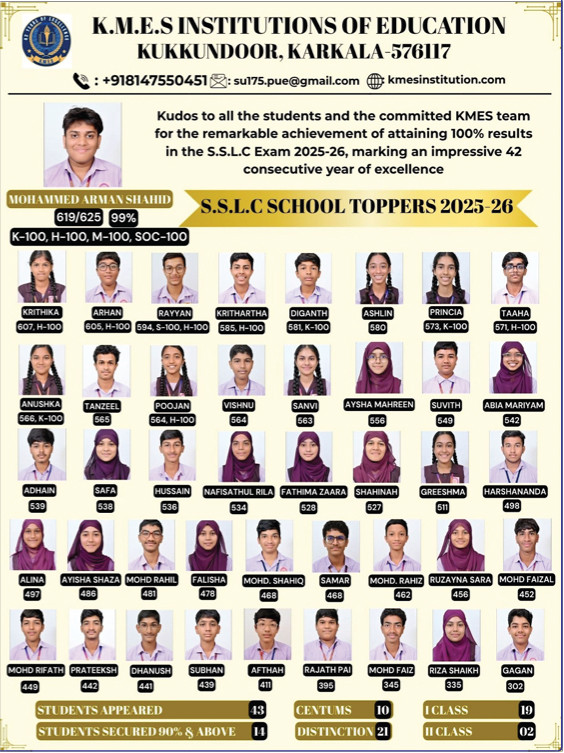
The institution secured a 100 per cent result in the SSLC examinations, with all 43 students passing the examination this year.
Muhammad Arman Shahid emerged as the school topper by scoring 619 marks out of 625, securing 99 per cent and also ranking sixth at the state level. He scored full marks in Kannada, Hindi, Mathematics and Social Science.
Krithika V. Nayak secured the second position in the school with 607 marks and 97.12 per cent, while Arhan stood third with 605 marks and 96.8 per cent.
Out of the 43 students, 21 passed with distinction, 19 secured first class, two students obtained second class and one student passed in third class. Fourteen students scored above 90 per cent.
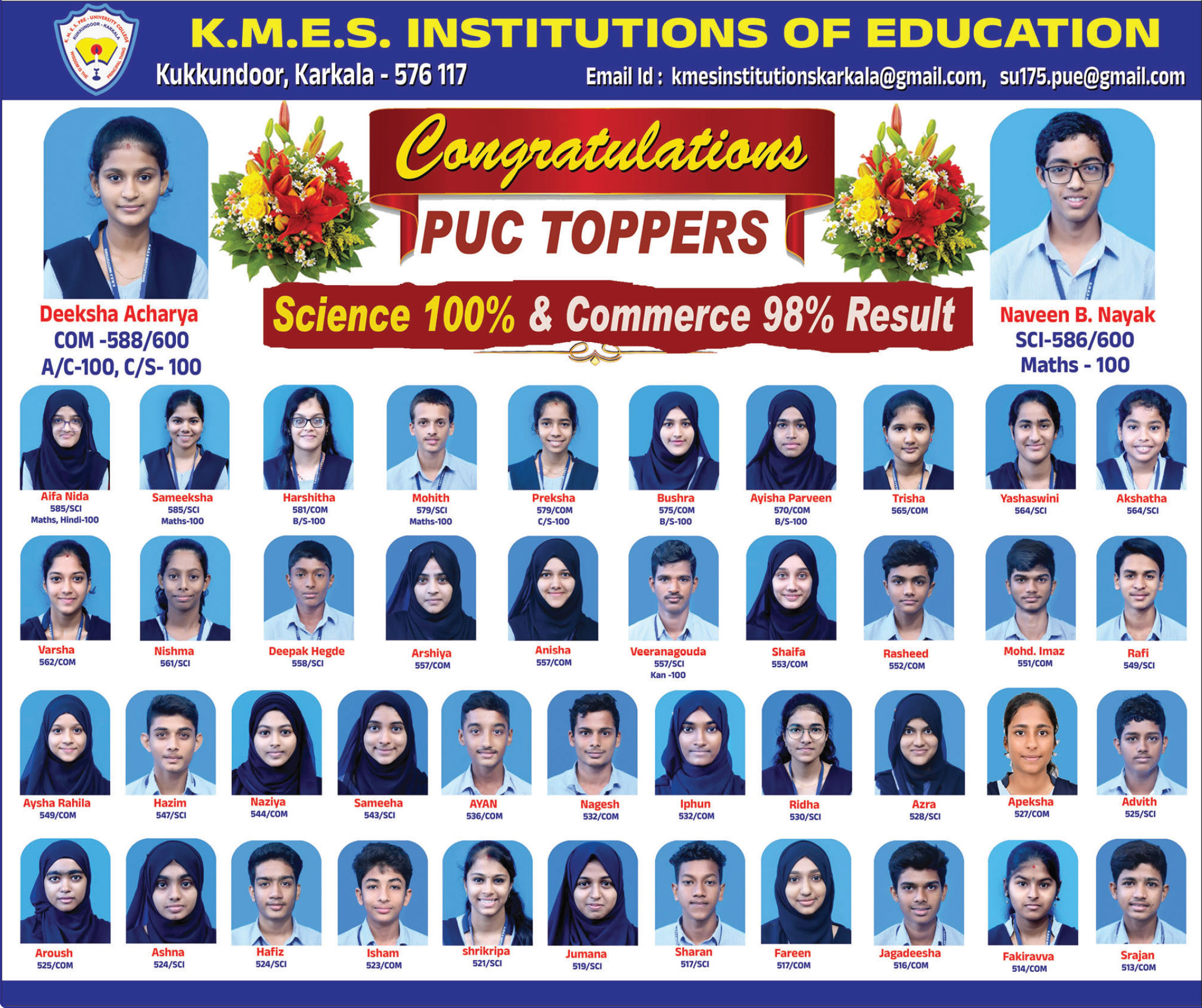
The institution also performed strongly in the PUC examinations. The Science stream recorded a 100 per cent result, with all 44 students passing, while Commerce secured a 98 per cent pass percentage.
Twelve students scored full marks in different subjects, including Mathematics.
In Commerce, Deeksha Acharya topped the college with 588 marks, while Harshitha H. Kini secured the second position with 581 marks.
In Science, Naveen B. Nayak emerged as topper with 586 marks, followed closely by Sameeksha Moily and Aifa Nidha, who both secured 585 marks.
Speaking about the achievement, High School head teacher Shrimati Patkar said the institution has always focused on supporting academically weak students through affordable education and free special classes.
“Our ambition is to provide quality education even to students who struggle in studies. The fees are very low, and free coaching classes are conducted. I have worked here for 28 years and have always found the atmosphere supportive of education,” she said.
Primary School head teacher Lolita Zeena D’Silva appreciated the dedication of the teaching staff and said the school encourages students not only to achieve high marks but also to become role models.
PU College Principal Balakrishna Rao said the institution focuses on value-based education and overall personality development.
“The aim is to help students succeed not only academically but also in cultural activities, sports and leadership. We encourage qualities such as patience, tolerance and discipline,” he said.
Rao also credited the institution’s growth to the support of founders K.S. Mohammed Masood and K.S. Nissar Ahmed, along with President K.S. Imtiaz Ahmed.
Speaking on the occasion, Imtiaz Ahmed said the institution was built on the dream of making quality education accessible to financially backward families in rural areas.
He said the guidance and encouragement of his elder brothers, Mohammed Masood and Nissar Ahmed, along with the contribution of teachers, students and parents, helped transform the institution into a model educational centre.
The KMES Institutions trace their roots back to 1984, when they were founded by senior social activists Haji P.M. Khan, K.S. Nazeer Ahmed and Haji A.S. Rashid Haider.
The institution initially functioned from the Government Urdu School premises as it did not have a building of its own. Classes began with only 22 students in lower kindergarten and two teachers.
Later, under the leadership of K.S. Mohammed Masood and with continuous financial and moral support from non-resident businessman K.S. Nissar Ahmed, the institution gradually expanded.
In 1993, the school shifted to its own building and began conducting classes from LKG to Class 5.
As student admissions increased, Nissar Ahmed personally funded the construction of three additional classrooms to address infrastructure shortages.
The institution’s new school building was completed in 1997, while the PU College building was constructed in 2001.
From humble beginnings in a borrowed building to producing state-level rank holders and consistent academic results, the KMES Institutions have grown into one of the prominent educational centres in the Karkala region.