Rs 1,000 monthly aid promise for Punjab women to be fulfilled in next budget: CM reiterates

Hoshiarpur (PTI): Punjab Chief Minister Bhagwant Mann on Sunday reiterated that his government will fulfil its promise of giving Rs 1,000 to every woman, with provisions to be made in the forthcoming state budget.
Addressing a gathering after inaugurating an eco-tourism project at the Saleran Dam here, Mann asserted that the AAP government is generating employment by developing Punjab's tourism destinations.
"In the Punjab budget, the promise of Rs 1,000 to every woman will be fulfilled," he said here.
Mann, while speaking at the state-level Maghi Mela gathering in Sri Muktsar Sahib on January 14, had assured that the Aam Aadmi Party's (AAP) poll promise of providing Rs 1,000 per month to every woman in the state would be fulfilled soon.
The AAP government has drawn flak from rival parties, who have accused it of making lofty promises at the time of polls, but failing to deliver after coming to power.
Mann also expressed hope that the Union government would announce a special package for Punjab in the upcoming Union Budget, saying, "Punjab's contribution to the nation in every sector deserves recognition".
In his address at Saleran Dam, Mann said film shoots and destination weddings at places such as Amritsar, Patiala and Chimraud Lake have already led to increased employment opportunities. He said the Saleran Dam project will compete with the tourism destinations of Himachal Pradesh.
The AAP government has revived 52 rest houses that had fallen into disrepair and are now generating around Rs 1 crore in monthly rental revenue. He alleged that previous dispensations had sold government properties to their associates at throwaway prices, while the present regime had recovered those assets.
Speaking to reporters, Mann said, "Today we have inaugurated the Saleran Dam eco-tourism project to further strengthen tourism infrastructure in the state. The Chohal Dam project is already running successfully, and this new initiative will be another attraction for tourists".
The project has been conceived at a cost of Rs 2.80 crore and is expected to generate more than Rs 18 lakh in annual revenue, he said.
ALSO READ: India a messenger of peace in conflict-ridden world: Prez Murmu in address to nation
"This project will attract tourists to the area, create job opportunities for local youth and significantly boost their income," he added.
Highlighting the facilities created under the project, the CM said, "A special playground spread over 16,000 square feet has been constructed for children, with a multi-play station and other recreational activities."
"Four eco huts have been constructed for tourists to stay, and a cafeteria with seating capacity for 80 people has also been built," he said. A large amphitheatre has been developed to offer scenic views of the dam, he said.
Lamenting the alleged neglect of these regions in the past, Mann said the previous governments failed to tap their tourism potential despite their natural beauty.
"Strenuous efforts are already underway to develop the entire region so that tourism in the state gets a major boost," he said.
Referring to steps taken by his government to revive the state's tourism infrastructure, Mann said, "The state government has revived 75 abandoned rest houses, which are now generating revenue of around Rs 1 crore".
On the economic and agricultural initiatives, Mann said, "The Punjab government has partnered with a Japanese company which will invest Rs 1,300 crore to boost horticulture in the state".
This would help save precious groundwater while promoting crop diversification, he said.
On law and order, the chief minister said it was ironic that those who once patronised gangsters were now questioning the situation.
He cited state government's initiatives like 'Yudh Nashean Virudh' and 'Gangsteraan te Vaar' aimed at cracking down on drug smugglers and gangsters.
Mann also said anti-drone technology has been deployed along the International Border and has shown encouraging results in curbing the inflow of drugs and weapons.
"Our aim is to stop cross-border terrorism and narco-terrorism. Punjab is the first state in the country to adopt this technology," he said.
Let the Truth be known. If you read VB and like VB, please be a VB Supporter and Help us deliver the Truth to one and all.
KMES Institutions shine in SSLC result, continue four-decade legacy of education in rural Karkala

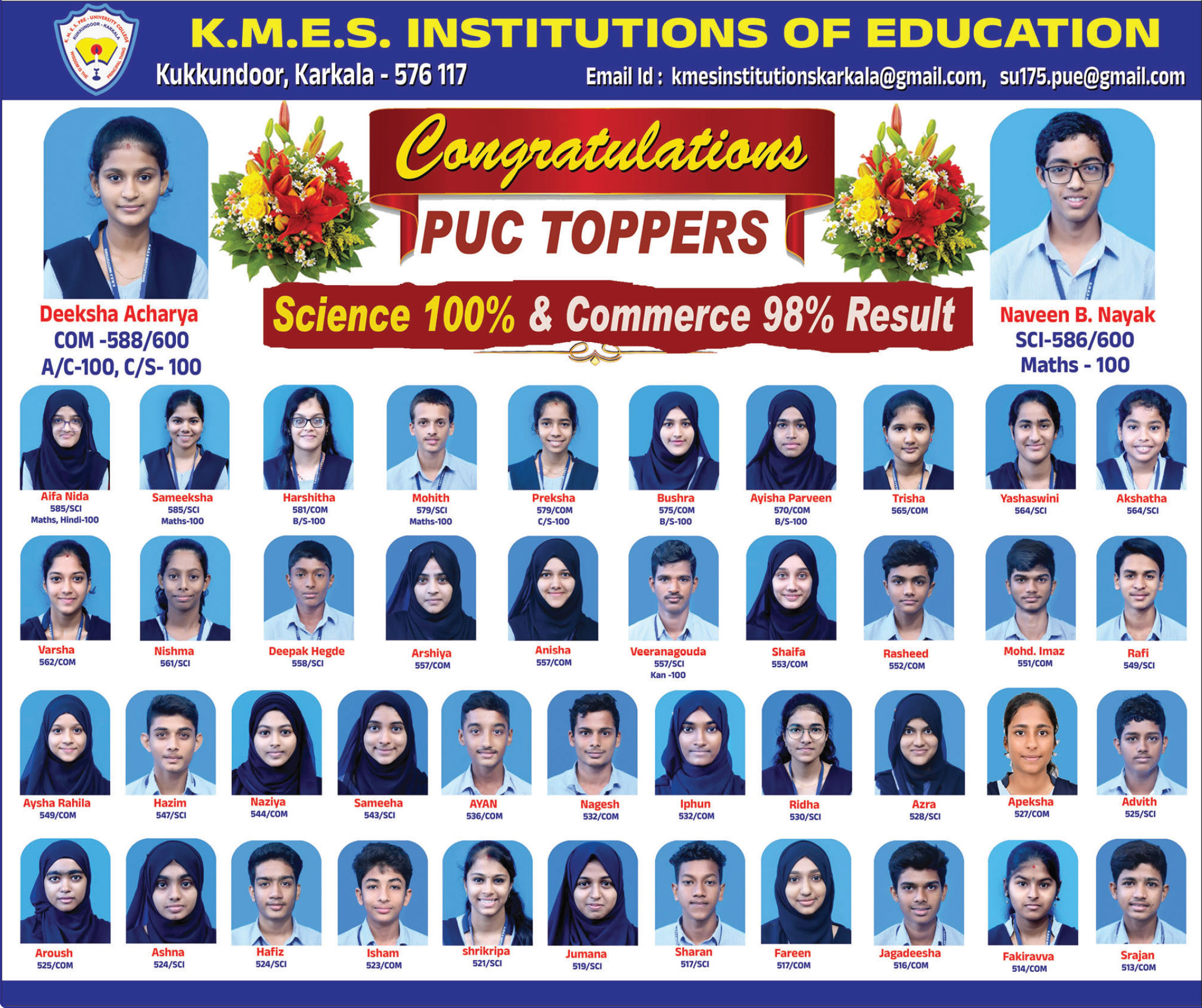
Karkala: KMES Institutions of Education at Kukkundooru in Karkala taluk has recorded outstanding results in the 2025-26 SSLC and PUC examinations, continuing a four-decade educational journey that began with just 22 kindergarten students and no building of its own.
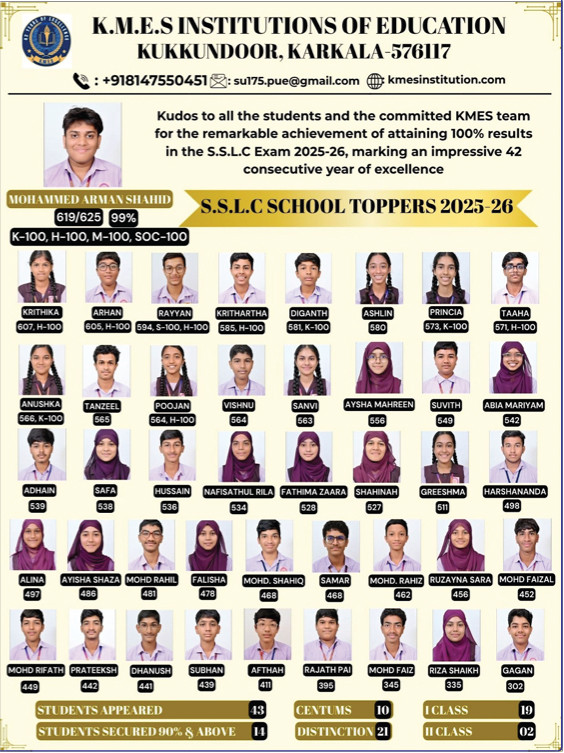
The institution secured a 100 per cent result in the SSLC examinations, with all 43 students passing the examination this year.
Muhammad Arman Shahid emerged as the school topper by scoring 619 marks out of 625, securing 99 per cent and also ranking sixth at the state level. He scored full marks in Kannada, Hindi, Mathematics and Social Science.
Krithika V. Nayak secured the second position in the school with 607 marks and 97.12 per cent, while Arhan stood third with 605 marks and 96.8 per cent.
Out of the 43 students, 21 passed with distinction, 19 secured first class, two students obtained second class and one student passed in third class. Fourteen students scored above 90 per cent.
The institution also performed strongly in the PUC examinations. The Science stream recorded a 100 per cent result, with all 44 students passing, while Commerce secured a 98 per cent pass percentage.
Twelve students scored full marks in different subjects, including Mathematics.
In Commerce, Deeksha Acharya topped the college with 588 marks, while Harshitha H. Kini secured the second position with 581 marks.
In Science, Naveen B. Nayak emerged as topper with 586 marks, followed closely by Sameeksha Moily and Aifa Nidha, who both secured 585 marks.
Speaking about the achievement, High School head teacher Shrimati Patkar said the institution has always focused on supporting academically weak students through affordable education and free special classes.
“Our ambition is to provide quality education even to students who struggle in studies. The fees are very low, and free coaching classes are conducted. I have worked here for 28 years and have always found the atmosphere supportive of education,” she said.
Primary School head teacher Lolita Zeena D’Silva appreciated the dedication of the teaching staff and said the school encourages students not only to achieve high marks but also to become role models.
PU College Principal Balakrishna Rao said the institution focuses on value-based education and overall personality development.
“The aim is to help students succeed not only academically but also in cultural activities, sports and leadership. We encourage qualities such as patience, tolerance and discipline,” he said.
Rao also credited the institution’s growth to the support of founders K.S. Mohammed Masood and K.S. Nissar Ahmed, along with President K.S. Imtiaz Ahmed.
Speaking on the occasion, Imtiaz Ahmed said the institution was built on the dream of making quality education accessible to financially backward families in rural areas.
He said the guidance and encouragement of his elder brothers, Mohammed Masood and Nissar Ahmed, along with the contribution of teachers, students and parents, helped transform the institution into a model educational centre.
The KMES Institutions trace their roots back to 1984, when they were founded by senior social activists Haji P.M. Khan, K.S. Nazeer Ahmed and Haji A.S. Rashid Haider.
The institution initially functioned from the Government Urdu School premises as it did not have a building of its own. Classes began with only 22 students in lower kindergarten and two teachers.
Later, under the leadership of K.S. Mohammed Masood and with continuous financial and moral support from non-resident businessman K.S. Nissar Ahmed, the institution gradually expanded.
In 1993, the school shifted to its own building and began conducting classes from LKG to Class 5.
As student admissions increased, Nissar Ahmed personally funded the construction of three additional classrooms to address infrastructure shortages.
The institution’s new school building was completed in 1997, while the PU College building was constructed in 2001.
From humble beginnings in a borrowed building to producing state-level rank holders and consistent academic results, the KMES Institutions have grown into one of the prominent educational centres in the Karkala region.