
Rural distress deepens: Wage growth dips, non-farm jobs hit

Rural wages have grown 3.8 per cent year-on-year in December, the lowest ever for this month. Together with depressed farm prices — annual wholesale inflation in December was minus 0.07 per cent for “food” and 4.45 per cent for “non-food” articles — they point to an overall picture of rural stress going beyond agriculture ahead of the Lok Sabha elections starting next month.
The national daily rural wage rate, based on a simple average for 25 agricultural and non-agricultural occupations, stood at Rs 322.62 in December 2018, 3.84 per cent higher than the Rs 310.69 for the same month of the previous year. Given annual rural consumer price index (CPI) inflation of 1.5 per cent, it means wages rose just over 2.3 per cent in “real” terms.
The average year-on-year wage growth for December during 2014 to 2018, under the NDA government, worked out to 4.7 per cent in nominal terms and a mere 0.5 per cent in real terms after netting out inflation of 4.2 per cent. In comparison, for the same month of the preceding five years (2009 to 2013) when the UPA was in power, nominal rural wages grew by an annual average of about 17.8 per cent. While CPI inflation for agricultural workers, too, averaged 11.1 per cent, the real growth in wages was still higher at 6.7 per cent a year.
The last five years, in other words, have seen a slowdown in rural wages even after adjusting for inflation, which has been far lower than during the UPA regime.
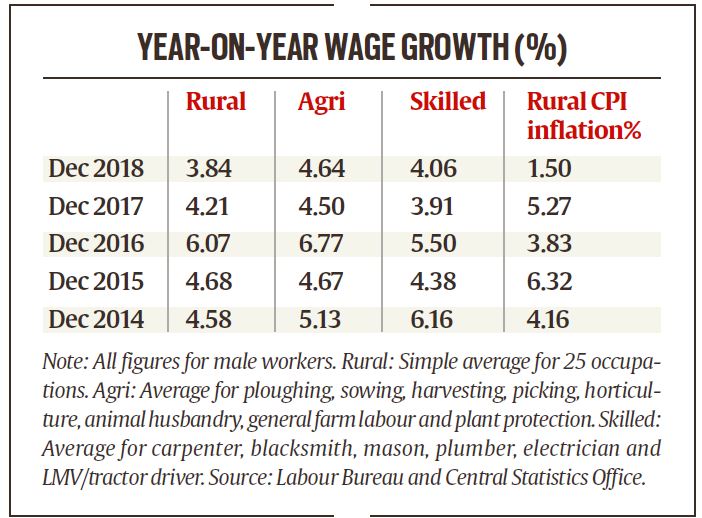
Interestingly, the lower wage growth in the last five years has not been confined to agriculture-related work. The Labour Bureau’s data shows the average growth in December for eight main agricultural occupations — ploughing, sowing, harvesting, picking, horticultural labour, animal husbandry work, general farm operations (irrigation) and plant protection — to be at 5.14 per cent, which is higher than the 4.68 per cent for general wages. Thus, even as farmers have experienced very low price increase or even deflation for their produce, agricultural wage growth hasn’t fallen as much, thereby translating into a double margin squeeze.
On the other hand, the December year-on-year wage growth for skilled workers – carpenters, blacksmiths, masons, plumbers, electricians and light motor vehicle/tractor drivers – has lagged behind overall rural wage growth in three out of the last five years (see table). Even lower has the average growth in wages been for construction (roads, dams, well-digging, industrial projects, etc.: 4.38 per cent) and general non-agricultural labour (porters, loaders, etc.: 4.32 per cent).
Simply put, the crisis in rural India now isn’t just about farm incomes, which, The Indian Express reported on March 3, had slumped to a 14-year-low in the October-December 2018 quarter. The crisis is equally off-farm as on-farm. And that’s an ominous sign before the polls kick off.
Courtesy: indianexpress.com
Let the Truth be known. If you read VB and like VB, please be a VB Supporter and Help us deliver the Truth to one and all.
Prasoon Joshi appointed chairman of Prasar Bharati

New Delhi (PTI): Noted lyricist, writer and communications expert Prasoon Joshi has been appointed as the chairman of Prasar Bharati, India's public service broadcaster.
The Ministry of Information & Broadcasting appointed Joshi to the key post, according to an official statement on Saturday.
Joshi, a distinguished creative professional with wide-ranging contributions across literature, advertising, cinema, and public communication, and known for his impactful writing and deep cultural sensibility, has played a significant role in shaping contemporary Indian media narratives, the statement said.
Joshi's body of work spans acclaimed film lyrics, advertising campaigns, and socially resonant storytelling that connects with diverse audiences across the country.
On his appointment, Union Minister of Information & Broadcasting Ashwini Vaishnaw said, "My heartfelt congratulations to Shri Prasoon Joshi ji on his appointment as chairman of the Prasar Bharati Board. Prasoon ji is a rare creative spirit celebrated across the world in advertising, literature, art and cinema, yet his heart beats unmistakably for India."
Vaishnaw said Joshi's words carry the fragrance of the country's soil, and his vision reflects the timeless essence of Indian culture.
"Under his stewardship, Prasar Bharati will discover renewed energy, deeper purpose, and a fresh creative voice. My very best wishes to him for a memorable and meaningful tenure ahead," the minister said.
Before this appointment, Joshi has served as chairperson, Central Board of Film Certification (CBFC), Mumbai since August 2017.
He contributed to strengthening film certification processes while engaging with stakeholders across the film industry and his tenure at CBFC reflected a balanced approach towards creative expression and regulatory responsibility, the statement said.
Earlier, he had also served as CEO, McCann World Group India and Chairman, McCann World Group Asia Pacific (a subsidiary of McCann Erickson). Joshi is also one of the Trustees of Indira Gandhi National Centre for Arts since 2016.
With his extensive experience in creative industries and public communication, Joshi is expected to bring a unique perspective to the leadership of Prasar Bharati at a time when public broadcasting is navigating rapid technological transformation and evolving audience expectations, it said.
Established under the Prasar Bharati (Broadcasting Corporation of India) Act, 1990, and operational since 1997, Prasar Bharati is India's statutory autonomous public service broadcaster.
It comprises two major divisions: All India Radio (AIR)-- one of the largest radio networks in the world, reaching millions across urban and rural India in multiple languages and dialects; and Doordarshan (DD) -- India's national television broadcaster, offering a wide range of programming including news, education, entertainment, and cultural content.


