
SC verdict on Babri no setback, say Muslim petitioners

New Delhi, Sep 27: The Supreme Court ruling that rejected a plea for referring the Babri Masjid-Ram Janmabhoomi dispute to a larger Constitution Bench is not a setback, a number of Muslim petitioners asserted on Thursday.
By a majority 2-1 judgement, the Supreme Court rejected a plea for referring the case to a larger Constitution Bench and referred the case to a three-judge bench to be set up that will begin hearing from October 29.
Advocate Zafaryab Jilani, the convenor of the Babri Masjid Action Committee, said the verdict was no setback.
"It is not at all a setback. It just means that the trial will start now. The court has clarified that the observations made by a Supreme Court bench in the Ismail Farooqi case of 1994 were made in a particular context and not related to this case. I think that serves the purpose," Jilani told the media.
All India Muslim Personal Law Board (AIMPLB) member Maulana Khalid Rashid Firangimahali echoed him.
"The positive aspect of today's decision is that the court has made it very clear that Ismail Farooqi case will have no impact on the Ayodhya case. As far as the masjid and namaz and the religious aspects are concerned, it is an established fact that mosques are built to offer namaz and they are an integral part of our religion," he told the media.
"Our main contention is that the whole land belongs to the Sunni Waqf Board and whatever the Allahabad High Court said, legally I think it cannot be said that you can divide the land between the three parties when you have not decided as to whom does it belong. So our main contention is that the whole land should be given to the Sunni Waqf Board," he added.
BJP Rajya Sabha member Subramanian Swamy said the Modi government should acquire the land and hand it over to the representative bodies of the Hindus.
"There is no need to talk about whose property is this, whether Ram Janmabhoomi nyas or others. What we have to understand is if the Hindus have a fundamental right to pray at the spot where the faith tells them that Lord Rama was born," Swamy told CNN-News18.
"The government has s right to acquire properties including mosques. I would urge the Modi government to immediately acquire the entire land and hand it over to some representatives of the Hindua which include the various Akahras and the Vishwa Hindu Parishad," he added.
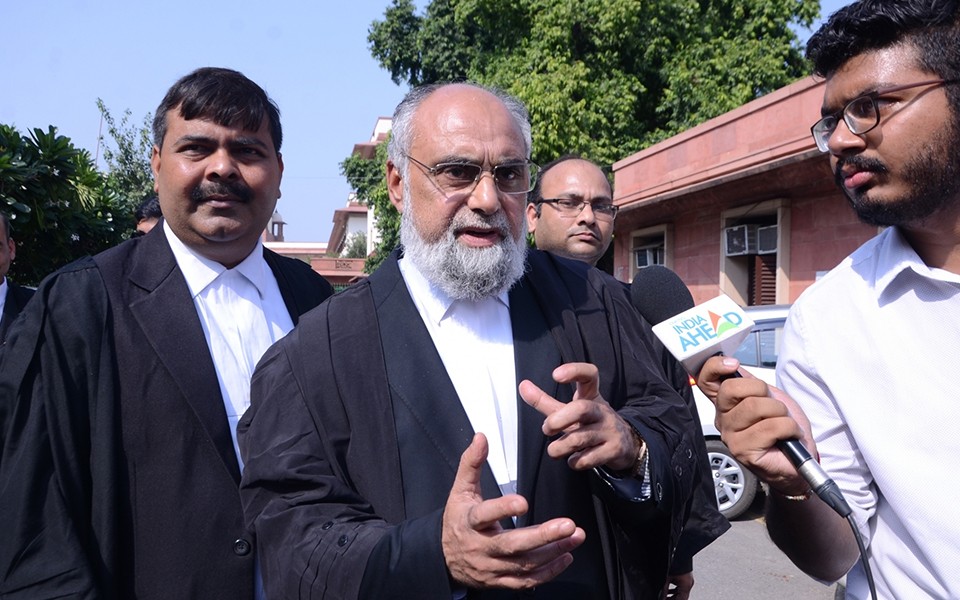
Senior advocate Shakeel Ahmed Syed, representing Sunni Waqf Board, talks to the media outside the Supreme Court, in New Delhi on Sept 27, 2018. The Supreme Court on Thursday rejected a plea for referring the Ramjanambhoomi-Babri Masjid dispute to a larger Constitutional Bench and decided that a newly set up three-judge bench will hear the case from October 29.
Let the Truth be known. If you read VB and like VB, please be a VB Supporter and Help us deliver the Truth to one and all.
Man kills woman lecturer, sets car ablaze; dies by suicide in Karnataka

Bengaluru (PTI): A 46-year-old man allegedly killed a woman lecturer by setting fire to the car with her inside, before dying by suicide; his severed body was found by railway police the next day, police said on Tuesday.
The deceased, identified as Ramanjinappa, a resident of Doddaballapura, was a contract worker in the tahsildar’s office, they said.
Police said the man, who was married and had apparently separated from his wife, was in an illicit relationship with a woman identified as Saroja, whose charred body was found inside a gutted car in an isolated area near the Bashetty Industrial Area in Doddaballapura taluk on the outskirts of Bengaluru.
Saroja was also married and had a son, police said.
According to police, on Saturday, the man allegedly borrowed a car from an acquaintance, claiming he had a medical emergency and needed to visit a hospital.
Citing preliminary investigations, a senior police officer said the man picked up the lecturer from a bus stop in Devanahalli. The two spent a couple of hours driving around Nandi Hills and nearby areas.
Later, they reached a secluded spot in Doddaballapura, where it is suspected that an argument ensued inside the car, following which he allegedly hit her on the head with a hammer, the officer said.
He then set the car on fire, reportedly using petrol, and is believed to have died by suicide thereafter, police said.
Locals who saw the burning car alerted the police and fire department, who rushed to the spot, extinguished the fire, and found the woman’s body completely charred inside the vehicle, the officer added.
His severed body was found near railway tracks in Bidadi by the railway police on Sunday, he said.
The motive and whether the crime was premeditated or impulsive are under investigation, he said.
Saroja’s husband filed a complaint accusing Ramanjinappa of killing her, police said, adding that a detailed investigation is underway to establish the exact sequence of events.


