Those facing graver allegations granted bail, says Umar Khalid

Umar Khalid, who was arrested under Unlawful Activities Prevention Act (UAPA) for his alleged involvement in Delhi Riots of 2020, has argued that many with more serious allegation were granted bail and some, with similar alleged offences, were not even booked by Delhi Police, a report in The Indian Express stated on Thursday.
Senior Advocate Kapil Sibal who represented him in the Supreme Court advised him to withdraw his plea in February citing ‘change in circumstances’ and his request for bail was moved to a trial court. His lawyer, advocate Trideep Pais, who appeared before Delhi’s Karkardooma Court on March 21 stated that “The factual basis on which three accused in the case have been granted bail have several overlaps with me”. He requested the court to consider Khalid’s entitlement to a bail of parity as UAPA was interpreted differently by a Supreme Court judgment in 2023, the newspaper reported.
“The court must be satisfied with the probative value of evidence at the stage of examining bail,” said Pais. He also brought it to the notice of court that no terrorist act was used to book his client. The continued incarceration of the accused was cited as another change of circumstances by the advocate. He also stated that there were no witnesses in many of the 15 instances cited by the prosecution to show the involvement of Umar Khalid. Out of the four allegedly conspiring WhatsApp groups mentioned by the prosecution, Khalid wasn’t part of two groups. Pais stated that many other members of these groups weren’t even booked by the police.
“In one group, Khalid didn’t even send a single message. In the fourth WhatsApp group which Khalid was a part of, he sent only five messages – three of which were Google Maps locations,” the Indian Express quoted Pais stating. Khalid’s advocate made a reference to his sharing a message from police requesting to stop the protest. “The two accused who were in Northeast Delhi during the riots are on bail. They’re in the same group as [Umar Khalid]… they’re far more involved in the group… a witness also made a direct allegation of rioting against these two,” said Pais. He questioned the decision of prosecution accusing only 2 out of 7 people who attended an alleged meeting to plan for riots while arguing that participation in a meeting whose contents were unknown to the prosecution was not illegal.
The advocate for Khalid also brought out the disparity between a witness’ statement in court and the charge sheet while stating that co-accused Asif Iqbal Tanha was granted bail by Delhi high court notwithstanding the same witness’ allegations which were far more serious. Pais also made a reference to lack of CCTV footage from Shaheen Bagh to back up the accusations made by the prosecution. He proved to the court that during other alleged conspiracy meetings, the Call Detail Records (CDR) of the other co-accused didn’t match with that of Khalid. The claim of prosecution that the accused gathered on January 8 to disrupt the then US President Donald Trump’s visit to Delhi was absurd as the event was not disclosed by the Indian Government till January 13, Pais argued.
The other co-accused in the case are Devangana Kalita, Natasha Narwal, Asif Iqbal Tanha, former AAP councilor Tahir Hussain, Khalid Saifi, ex-Congress councilor Ishrat Jahan, Safoora Zargar, Sharjeel Imam, Meeran Haider, Gulfisha Fatima, Shifa-Ur-Rehman, Shadab Ahmed, Tasleem Ahmed, Saleem Malik, Mohammed Saleem Khan, Athar Khan, and Faizal Khan.
Out of the 17 booked in the case, only Tanha, Narwal and Kalita are out on bail. The remaining 14 have been in jail for the last four years.
The case, usually referred to as 2020 Northeast Delhi riots ‘larger conspiracy case’, has been in news recently for the courts reprimanding the Delhi Police for its flawed investigation into the riots.
Let the Truth be known. If you read VB and like VB, please be a VB Supporter and Help us deliver the Truth to one and all.
National Synodal Assembly 2026 begins in Bengaluru with over 220 delegates

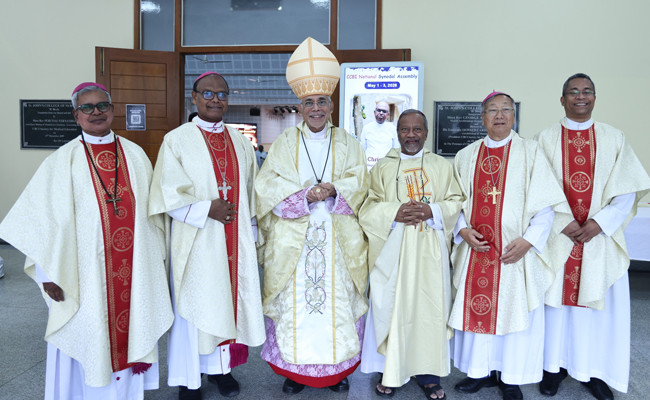
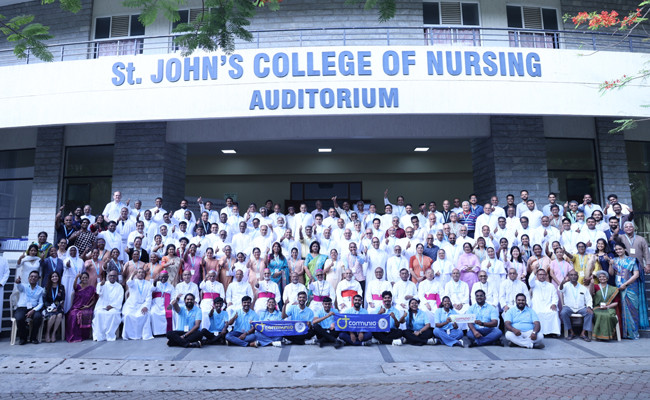
Bengaluru: The Conference of Catholic Bishops of India (CCBI) on May 1 inaugurated its National Synodal Assembly 2026 at St. John’s Medical College, bringing together more than 220 delegates from across the country under the theme Synodal Pilgrims of Hope.
The assembly is part of the global synodal process initiated in 2021 by Pope Francis, which calls for greater participation, dialogue and shared responsibility within the Church. In India, the process has involved consultations at diocesan, regional and national levels.
Participants at the assembly include two Cardinals, 25 Bishops, 65 priests, more than 20 women religious, and over 100 lay faithful, including youth and women leaders.
The gathering began with a Eucharistic celebration led by Filipe Neri Ferrão. In his homily, he described the assembly as a moment of grace and discernment and called on delegates to walk together in prayer, listening and missionary commitment.
He spoke about the importance of the Risen Christ in the mission of the Church and urged the faithful to be witnesses of the Gospel. Referring to the conversion of St Paul, he said every baptised person has a role in spreading the message of Christ. He also highlighted the example of St Joseph the Worker, stressing the dignity of labour and the call to holiness in everyday life.
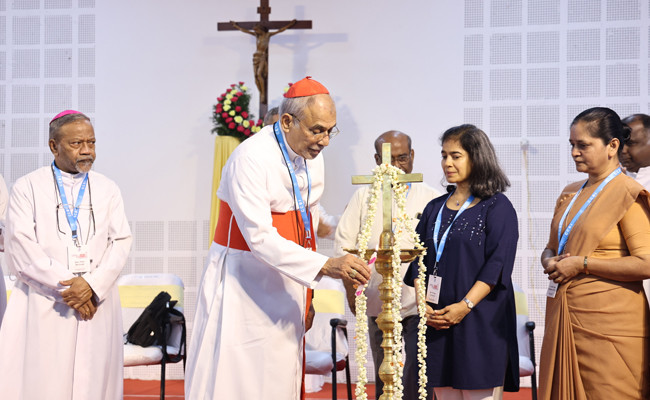
The formal inauguration included the invocation of the Holy Spirit through Veni Creator Spiritus and the lighting of the ceremonial lamp. Deputy Secretary General Fr. Stephen Alathara welcomed the delegates and described the gathering as a spiritual journey.
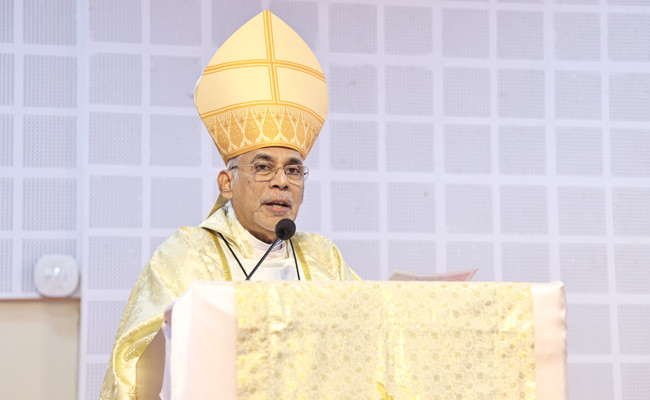
In his presidential address, Cardinal Ferrão referred to the CCBI pastoral plan titled Journeying Towards a Synodal Church: Mission 2033 and called on participants to build on the vision outlined at the 36th Plenary Assembly held in Bhubaneswar in 2025.
Delegates will reflect on four key themes identified from 16 pastoral priorities: interreligious dialogue and peacebuilding, inclusion of the excluded, poverty and integral ecology, and support for children and youth.
The discussions are being conducted through a method of spiritual conversation aimed at encouraging listening, dialogue and collective decision-making. The focus is on translating these discussions into practical actions within the Church.
The assembly also looks ahead to the Jubilee Year 2033, which will mark 2,000 years of the Redemption, and aims to strengthen the Church’s mission in the coming years.
Further consultations are scheduled for September 2026, with the process expected to conclude at the 38th Plenary Assembly of the CCBI in January 2027.
Organisers said the assembly seeks to strengthen unity within the Church and promote participation of all sections, including women and youth, in shaping its future direction.