
Ankola: Fishermen jump into sea protesting against commercial port in Keni

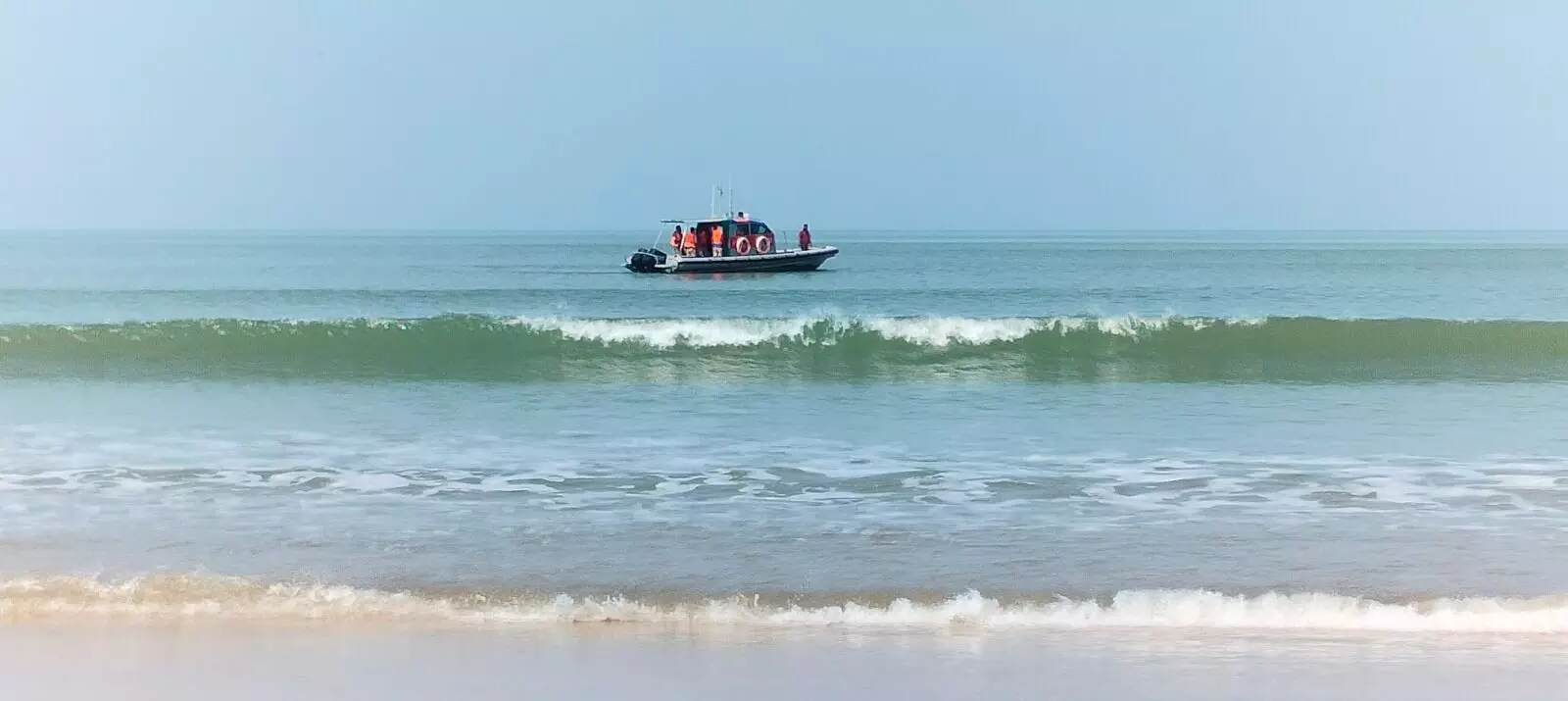
Ankola: Hundreds of fishermen in Keni village, most of whom were found to be women, protested on Monday, and also attempted to commit suicide by jumping into the sea, opposing the construction of a commercial port in Keni.
Three women who fell ill during the protest were shifted to a government hospital in a police ambulance.
Uttara Kannada Deputy Commissioner Lakshmipriya K had denied permission to stage a protest in village under Bavikeri Gram Panchayat in Ankola taluk and Keni village from Monday 6 am to Tuesday 6 am as precautionary measure.
The fishermen, who held the protest in spite of the prohibitory orders by the DC, have warned to continue the stir until the survey of the area for the port, ‘Keni Greenfield’ by JSW, continues. “We will stage the protest again and also commit suicide if the authorities go ahead with the construction of a commercial port in Keni,” they have added.
“Since we are dependent only on the sea for our livelihood, we will continue our protest intensely. Women too are ready to sacrifice their lives if the work on the commercial protest continues. Any such port can only be constructed on our graves,” Shrikanth Durgekar, leader of the fishermen has hit out at the authorities concerned, also asking that fishermen be permitted to continue their work at sea at peace.
Uttara Kannada Superintendent of Police M Narayana, Deputy SP Girish and Inspector Chandrashekhar Mathapathi arrived at Keni and pacified the fishermen, who continued to demand that the survey be halted.
Several leaders of the fishermen, including Durgekar, Sanjeeva Balegara, Shankar Balegar, Hoova Khandekar, Umakantha Hoskota, Chandrakantha Pirankar, Rajeshwari Kenikar, Suraj Harikanthra, participated in the protest.



Let the Truth be known. If you read VB and like VB, please be a VB Supporter and Help us deliver the Truth to one and all.
Xi, Trump reach series of new common understandings: China's foreign ministry

Beijing (PTI): Chinese President Xi Jinping and his US counterpart Donald Trump had an in-depth exchange of views on major issues concerning the two countries and the world, and reached a series of new common understandings, a Chinese foreign ministry spokesperson said Friday.
Xi and Trump, who is on a three-day visit to China, met twice on Thursday and discussed a range of bilateral and global issues.
Trump is due to leave on Friday after a luncheon meeting with Xi.
Summing up the outcomes of Trump’s visit to Beijing, a Chinese Foreign Ministry spokesperson said the two presidents had an in-depth exchange of views on major issues concerning the two countries and the world and reached a series of new common understandings.
They agreed on a new vision of building a constructive China-US relationship of strategic stability to provide strategic guidance for bilateral relations over the next three years and beyond.
The two presidents also agreed to promote the steady, sound and sustainable development of China-US relations, and bring more peace, prosperity and progress to the world, said a statement by the ministry’s spokesperson.
Trump visited China at the invitation of Xi.
The two presidents are meeting in person again for the first time since their Busan meeting last October, and it is the first visit to China by a US president in nine years, the statement said.
On Thursday, President Xi held a welcome ceremony and a banquet for Trump, held talks and visited the Temple of Heaven with him.
VIDEO | Beijing: On second day of bilateral talks, US President Donald Trump (@POTUS) thanks Chinese President Xi Jinping for 'incredible' China trip.
— Press Trust of India (@PTI_News) May 15, 2026
Trump says, "Thank you very much. This has been an incredible visit. I think a lot of good has come of it. We've made some… pic.twitter.com/7A7lbEzLdC


