
If Dolly Chaiwala were from Mangaluru, his stall would’ve been demolished: Actor Raj B Shetty

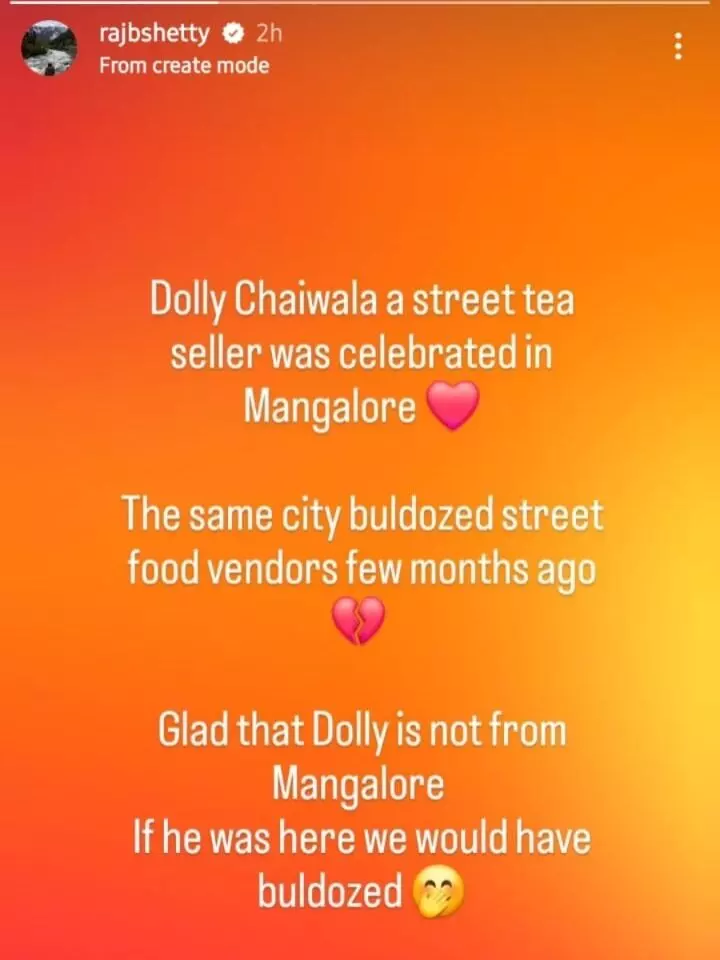
Mangaluru: Actor and director Raj B Shetty has criticised the BJP-led Mangaluru City Corporation’s ‘Tiger Operation’ targeting street vendors. In an Instagram story, he remarked that if Dolly Chaiwala were a street vendor in Mangaluru, his stall too would’ve been demolished.
The statement came after the City Corporation organised a five-day ‘Mangaluru Street Food Fiesta’ near Lady Hill Circle, a location where stalls were previously demolished for causing traffic congestion and encroachments. The irony of holding such an event while evicting local vendors has drawn sharp criticism.
The festival, running from January 18 to 22, featured Dolly Chaiwala from Mumbai as a special participant, sparking protests from activists. On the event’s opening day, the presence of Dolly Chaiwala triggered debates on social media, with many calling out the administration's double standards.
In his Instagram post, Raj B Shetty stated, “Dolly Chaiwala a street tea seller was celebrated in Mangalore. The same city buldozed street food vendors few months ago. Glad that Dolly is not from Mangalore If he was here we would have buldozed.”
Street vendors and activists have criticised the BJP-led administration for prioritising high-profile events over the welfare of local vendors. BK Imtiyaz, honorary president of the street vendors’ association, accused the City Corporation and MLA Vedavyas Kamath of hypocrisy. "They destroyed livelihoods with bulldozers and then hosted an event in violation of their own rules," he said.
Let the Truth be known. If you read VB and like VB, please be a VB Supporter and Help us deliver the Truth to one and all.
Congress using hijab issue to pacify minority anger, alleges Karnataka LoP R Ashoka

Bengaluru: Leader of Opposition in the Assembly R. Ashoka has accused the Congress government of using the hijab issue to placate what he described as discontent among minority voters after the Davanagere by-election.
In a post on X on Wednesday, Ashoka alleged that the state government, instead of addressing issues such as price rise, corruption, farmers’ distress and law and order, was attempting to retain its minority vote base by reviving the hijab issue.
Referring to the 2022 dress code introduced by the BJP government, which prohibited hijab in schools and colleges, Ashoka said the Karnataka High Court had upheld the policy and emphasised the importance of discipline in educational institutions.
He questioned the Congress government’s move to revisit the issue and asked whether setting aside the court-backed policy to benefit one community could be described as secularism.
Ashoka further alleged that while the government was willing to permit hijab, it continued to prohibit saffron shawls.
He accused the government of dividing students on religious lines rather than treating schools and colleges as spaces of equality.
Drawing a comparison with Mamata Banerjee’s government in West Bengal, Ashoka claimed that excessive appeasement politics had harmed the state and warned that the Congress in Karnataka could face a similar political response.
He said voters in Karnataka would teach the Congress a lesson for what he termed “vote-bank politics” and for compromising constitutional and judicial principles.


