
Jingle bells echo! This Kasargod church’s joyful roadshow enthralls locals, promotes unity message
Four guests at four halts of the roadshow emphasize significance of unity during Christmas season

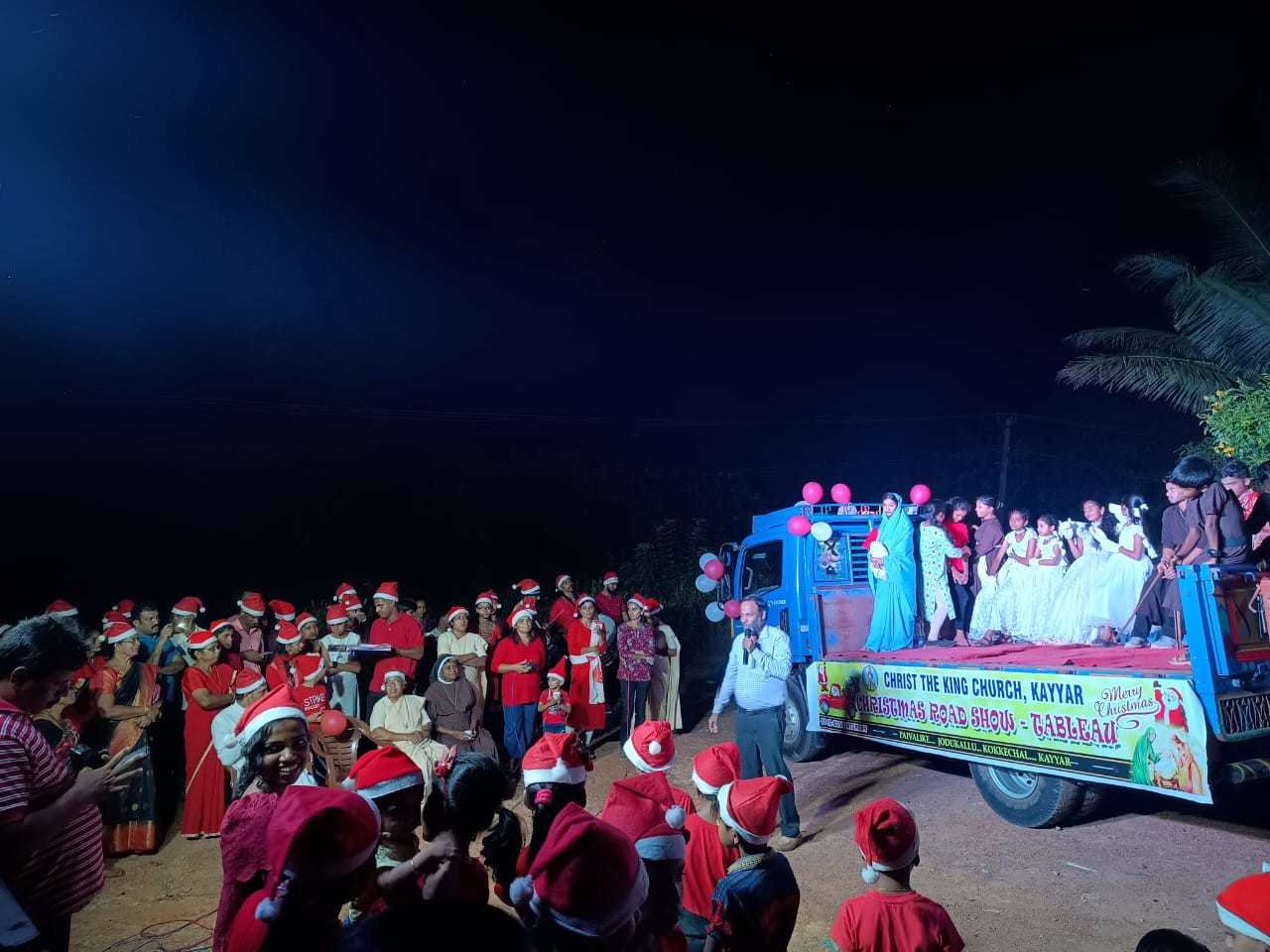
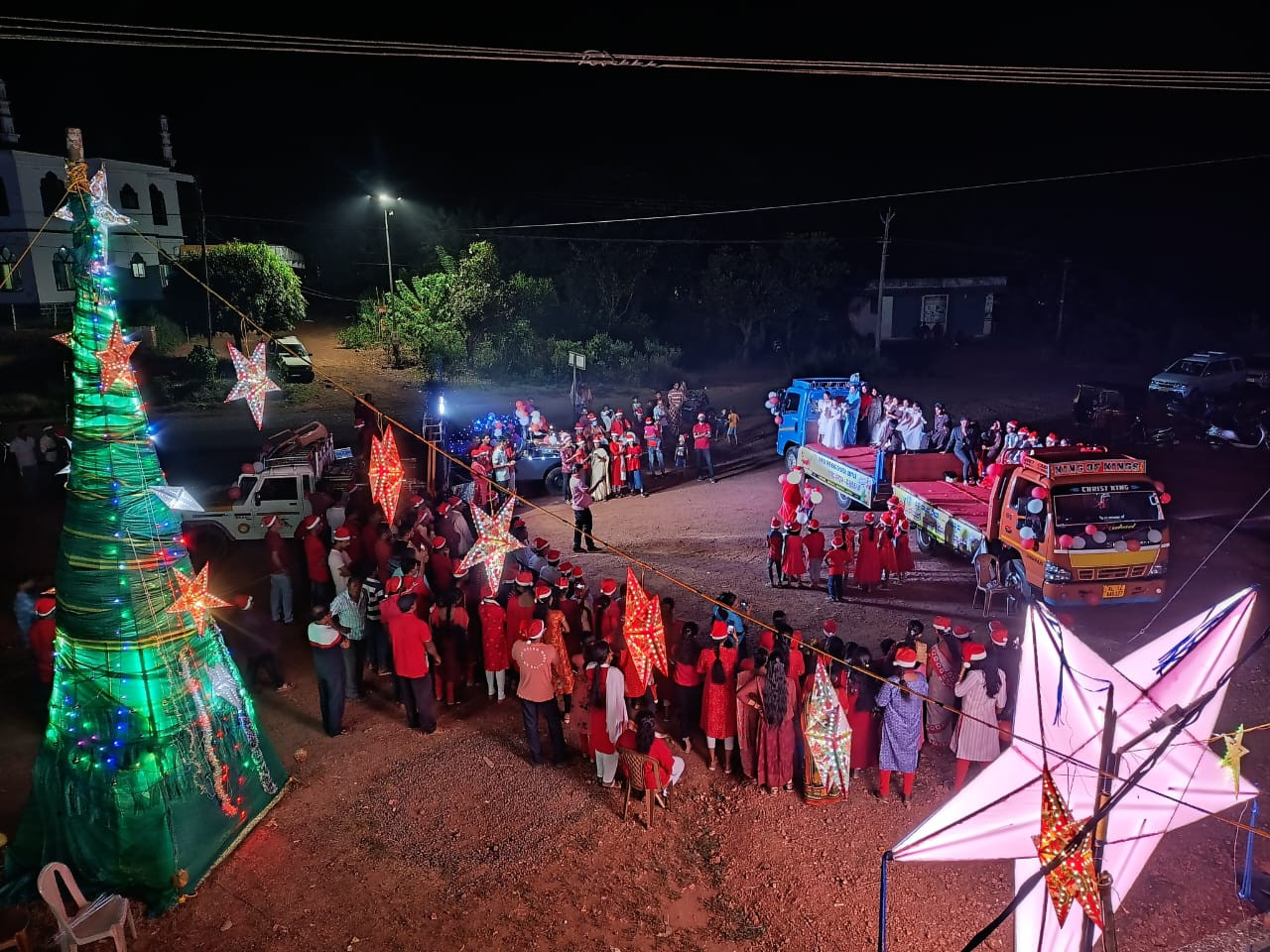
Manjeshwara(Paivalike): Amid Christmas merrymaking, Jingle bells resonated in the air as Christ the King Church in Kayyar village, Kasaragod, orchestrated a joyous tableau and roadshow to spread festive cheer and promote a message of unity among the locals. The roadshow, which covered areas including Paivalike, Jodukallu, Kokechal, and Kayyar, under Paivalike Panchayat limits on Saturday(Dec 23) featured guests from both the Muslim and Hindu communities, enhancing the spirit of togetherness. The events at the roadshow included a compelling portrayal of the birth of Jesus Christ and Christmas carols.
Fr. Vishal Monis, Parish Priest Christ the King Church, shared the roadshow's intent, aiming to extend happiness beyond the Christian community. “The speakers at different spots hailed from different communities, breaking the norm of intra-community events. In a mixed society, where all religious people live together it becomes necessary to spread happiness. When we are happy, that is when the Christian community celebrates, we also feel that this happiness should spread amongst other communities.”
At Paivalike, Ashraf Martya, a Kannada language teacher at the government school here, praised the church's initiative to convey a message of oneness among the locals. He commented, "Such events should be conducted to convey the message of harmony across Tulunadu. For the betterment of society, we all should follow the path of Jesus Christ, who propagated messages of spreading love and peace." Similarly, Kashnappa Pujari Derambala, Trustee of Sadashiva Temple Ambaru, stressed the importance of living peacefully irrespective of religion, caste, and creed during the second halt of the roadshow in Jodukallu.
Meanwhile in Kokechal, Mohidduin Kunhi K., Principal of Kamil School, highlighted the similarities between Christianity and Islam, urging coexistence. He stated, "Jesus Christ showed us the way of living in coexistence and spreading love. Jesus was the first to propagate the idea of loving your enemies."
At the roadshow's endpoint in Kayyar, Ashok Bhandary, a CPI(M) leader and Kudal ward Panchayat Member, emphasized, "God is one, there are different religions. Hence, fighting under the tag of religions is not correct. We all, as a society, should consider the message of Jesus Christ and spread love among each other."
Residents and attendees praised the efforts of the church authorities in organizing such events to promote understanding of different festivals. Ravi Kumar, a resident of Muligade, expressed, "India is such a diverse country; we must understand each other's festivals and celebrate together." Civil police officers on duty, Radeesh and Rakesh, commended the enthusiastic celebrations, stating that it helped them better understand the vivid culture and programs in the border district.
Simultaneously, Anil a excavator(JCB) operator in Kayyar village, who is a native of Bagalkote’s Gaddankeri, expressed that he gets homely vibes as people speak in Kannada here in a Kerala village, “Very happy to see people speak in Kannada here, we always work in the day return to our rooms in the evening that routine continues, but today we saw this unique tableau organised here, immersed ourselves into the program. Such events promoting peace should be organised everywhere.”
The program aimed at bridging communities and celebrating diversity in the spirit of Christmas was organized by the Church Parishad, CKYM (Christ King Youth Movement), and ICYM (Indian Catholic Youth Movement) under the guidance of the Parish Priest Fr. Vishal Monis.
Let the Truth be known. If you read VB and like VB, please be a VB Supporter and Help us deliver the Truth to one and all.
Iran offers to reopen Strait of Hormuz if US lifts its blockade and the war ends: officials

Cairo (AP): Iran has offered to end its chokehold on the Strait of Hormuz in exchange for the US lifting its blockade on the country and an end to the war, while proposing that discussions on the larger question of its nuclear programme would come in a later phase, two regional officials said Monday.
US President Donald Trump seems unlikely to accept the offer, which was passed to the Americans by Pakistan and would leave unresolved the disagreements that led the US and Israel to go to war on February 28.
With a fragile ceasefire in place, the US and Iran are locked in a standoff over the strait, through which a fifth of the world's traded oil and gas passes in peacetime. The US blockade is designed to prevent Iran from selling its oil, depriving it of crucial revenue while also potentially creating a situation where Tehran has to shut off production because it has nowhere to store the oil.
The strait's closure, meanwhile, has put pressure on Trump, as oil and gasoline prices have skyrocketed ahead of crucial midterm elections, and it has pressured his Gulf allies, which use the waterway to export their oil and gas.
The closure has also had far-reaching effects throughout the world economy, raising the price of fertilizer, food and other basic goods.
The proposal would push off negotiations on Iran's nuclear programme to a later date. Trump said one of the major reasons he went to war was to deny Iran the ability to develop nuclear weapons.
The two officials, who had knowledge of the proposal, spoke on condition of anonymity to discuss the closed-door negotiations between Iranian and Pakistani officials this weekend. The Axios news outlet first reported Iran's proposal.
It came as Iran's foreign minister visited Russia, which has long been a key backer of Tehran. It's unclear what, if any, assistance Moscow might offer now.
Strait of Hormuz remains blocked
===================
Iran's ability to choke off traffic in the Strait of Hormuz, the narrow mouth of the Persian Gulf, has proved one of its biggest strategic advantages in a war that has often boiled down to which side can take more pain.
Oil prices have risen steadily since the war began and tankers full of crude became stranded in the Persian Gulf, unable to safely transit through the strait and reach global distribution points.
On Monday, the spot price of Brent crude, the international standard, was trading at around $108 per barrel, nearly 50 per cent higher than when the war began.
Iranian foreign minister holds talks as negotiations with US stall
===============================
Trump last week indefinitely extended the ceasefire the US and Iran agreed to on April 7 that has largely halted fighting. But a permanent settlement remains elusive in the war that has killed thousands of people.
Iran's state-run IRNA news agency said Foreign Minister Abbas Araghchi landed in St. Petersburg on Monday morning ahead of a meeting with Russian President Vladimir Putin.
“It is a good opportunity for us to consult with our Russian friends about the developments that have occurred in relation to the war during this period and what is happening now,” Araghchi said in a video interview posted by IRNA.
It comes as Pakistan has been seeking to revive stalled talks between Iran and the US, and negotiations had been expected in Islamabad over the weekend. Instead, Trump called off a trip by his envoys and suggested the talks could take place by phone instead.
Over the weekend, Araghchi made two stops in Pakistan and a visit to Oman, which shares the strait with Iran. He also spoke by phone with counterparts in Qatar and Saudi Arabia on Sunday.
Iran wants to persuade Oman to support a mechanism to collect tolls from vessels passing through the strait, according to a regional official who spoke on condition of anonymity because he was not authorised to discuss the matter.
Oman's response wasn't immediately clear.
The official, who is involved in mediation efforts, also said Iran insisted on ending the US blockade before new talks and that Pakistan-led mediators are trying to bridge significant gaps between the countries.
Trump says Iran has offered a much better proposal
===========================
Trump told journalists Saturday that after he called off a trip by his envoys to Pakistan, Iran sent a “much better” proposal.
He did not elaborate but stressed that one of his conditions is that Iran “will not have a nuclear weapon”.
Iran insists its programme is peaceful, but the US wants to remove Tehran's stockpile of highly enriched uranium, which could be used to build a bomb, should Tehran choose to pursue one.
Since the war began, at least 3,375 people have been killed in Iran and at least 2,509 people in Lebanon, where fighting between Israel and the Iran-backed Hezbollah militant group resumed two days after the Iran war started. Another 23 people have been killed in Israel and more than a dozen in Gulf Arab states. Fifteen Israeli soldiers in Lebanon, 13 US service members in the region and six UN peacekeepers in southern Lebanon have been killed.
The ceasefire between Israel and Hezbollah has been extended by three weeks. Hezbollah has not participated in the Washington-brokered diplomacy.


