
Mangaluru: PFI activists protest against "Police brutality" in Uppinangady

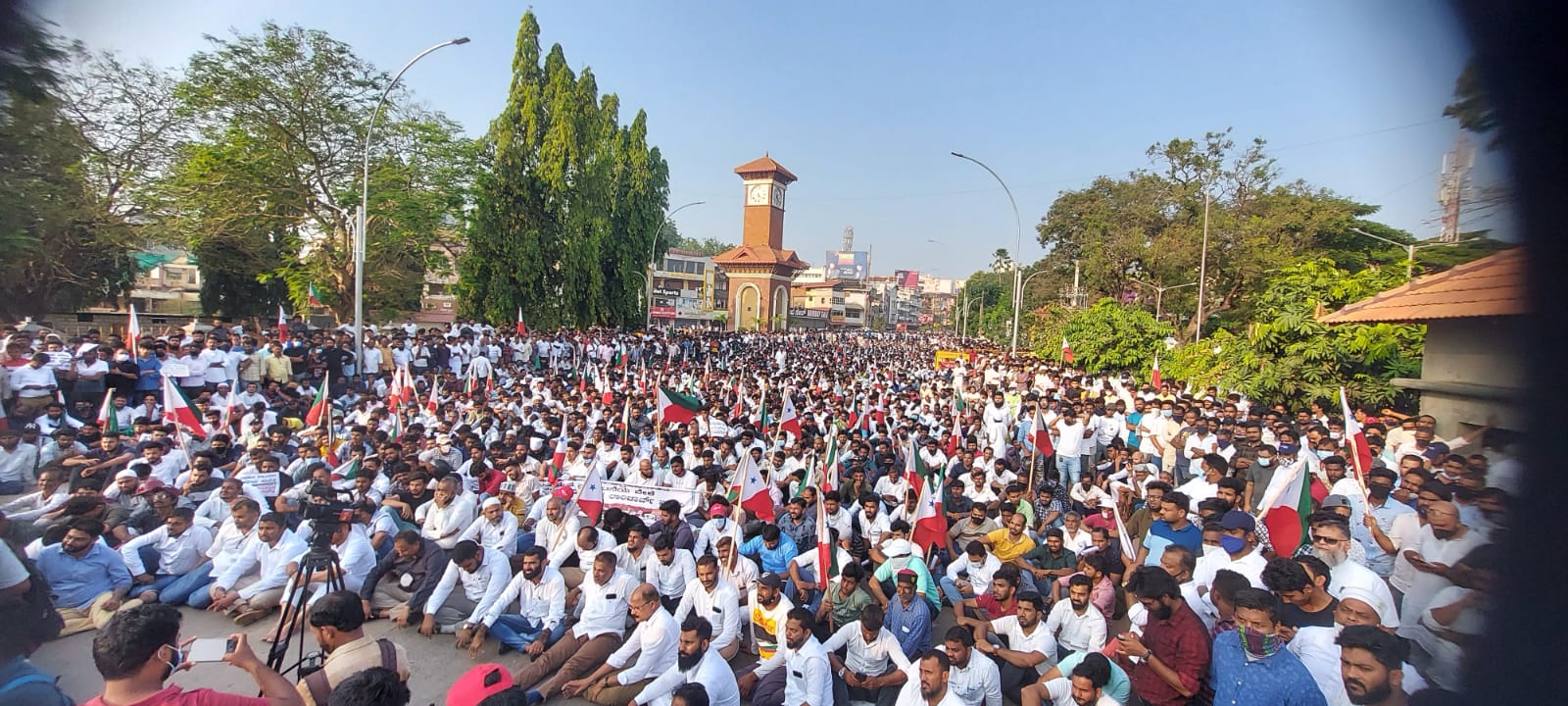
Mangaluru: Protesting the lathi-charge by police at Uppinangady on Tuesday, the District Committee of Popular Front of India (PFI) organized a protest in Mangaluru on Friday.
Although the City Police Commissioner had denied permission for the ‘Walk to SP’s Office’ or the rally, the PFI activists went ahead with their event and walked from Hampankatte to the Clock Tower, it is learned.
Reportedly, the protesters were stopped by the police near the clock Tower. PFI leaders then appealed for them to be allowed to walk to the SP’s office and also stated that the Uppinangady police had indulged in police brutality and protested through sit-in demonstrations demanding justice concerning the issue.
District SP Rishikesh Sonawane arrived at the protest site and received the petition from the protesters. The SP then addressed the gathering assuring that investigations and appropriate action would be undertaken in the case. The Mangaluru Police Commissioner Shashikumar also arrived at the site and took cognizance of their appeal.
SDPI Leader Shafi Bellare addressed the gathering and said, “This is a people’s movement against the Uppinangady police who displayed their cruelty. If innocents are subjected to oppression, such struggles too will continue. Police themselves make claims that the batons/ lathis of police do not have any religion or creed. However, the several incidents that have occurred in the district indicate that the batons/lathis of the district police have a religion, creed, and political affiliation”, he said.
Questioning the police, he asked, “Why haven’t the police taken any action against the Sangh Parivar’s leaders who insulted the SI by threatening to beat him and disregarded the District Commissioner? Why have you been silent when Trishul/Tridents were being distributed openly?” he emphasized.
Shafi Bellare also demanded that a sitting judge must investigate to determine how many police personnel within the district police force possess a Sanghi mindset.
“The police must withdraw the false cases registered by them. The guilty police personnel must be suspended, and the government must compensate the injured in the hospitals by taking over their medical expense”, the PFI listed their demands before the government.
PFI Leaders A. K. Ashraf, Ijaz Ahmed, Ayyub Agnadi, Corporator Muneeb Bengre, SDPI National Leader Alphonso Franko, and SDPI District President Abubakker Kulai led the protest.


Let the Truth be known. If you read VB and like VB, please be a VB Supporter and Help us deliver the Truth to one and all.
Ladakh a living land of dharma for centuries: Amit Shah

Leh/Jammu (PTI): Union Home Minister Amit Shah on Friday described the return of sacred relics of Lord Buddha to Ladakh after 75 years as a "historic reunion" and said that the Union Territory has remained a "living land of dharma", preserving and nurturing Buddhist knowledge for centuries.
Stressing the relevance of Buddha's teachings in modern times, Shah said the message of peace, compassion and the middle path was even more important today than it was 2,500 years ago.
"Ladakh has been a living land of dharma for centuries. When the Dalai Lama comes here, he says this land is not merely a geographical land but a living laboratory of Buddhist culture and compassion," Shah said, speaking after the inauguration of the sacred holy relics exposition of Tathagata Buddha and the 2569th Buddha Purnima celebrations at Jivetsal in Leh during his two-day visit to Ladakh.
Calling Ladakh a land of compassion, he said this land has preserved and nurtured knowledge. "Whenever Buddhism faced crises, this land worked to protect the teachings of Buddha. And when peace returned, it helped to expand and carry forward that preserved wisdom," he added.
"Unless one internalises knowledge and makes it a part of oneself, liberation is not possible. Knowledge is incomplete without spiritual practice, while spiritual practice without knowledge is blind. Therefore, the union of spiritual practice and knowledge is the right path. Even after all this, if there is no moral discipline, one cannot lead a truly wise life. The basis of a life of wisdom is moral discipline," he said.
Shah said it was through Ladakh and adjoining routes that the teachings of Tathagata Buddha, which originated in India, spread to China and several other countries.
"The message that emerged from the land of Ladakh has become a guiding force for many people around the world to take their lives forward. The presence of these sacred relics in Ladakh reminds us that India's civilisation has, for thousands of years, given the message of peace and coexistence," he said.
He said that in a diverse region like Ladakh and Kargil, this message becomes even more relevant. "This heritage still tells us today that amidst conflict and unrest, only the path of peace and compassion can provide solutions."
He said the return of the relics on Buddha Purnima had enhanced the significance of the festival for the people of Ladakh.
"These sacred relics have come to Ladakh after 75 years. It is as if Buddha himself is present here today," Shah said, adding that followers of Buddhism and people of other faiths in Ladakh and Kargil would draw spiritual energy from the relics.
Highlighting Ladakh's role in the spread of Buddhism, Shah said Kashmir was once an ancient centre of Buddhist studies, Mahayana philosophy and Buddhist art, from where Ladakh first came into close contact with Buddhism.
He said Emperor Ashoka's envoys laid the foundation of Buddhist influence in Ladakh through Kashmir and Gandhara, while Mahayana Buddhism expanded in the region during the Kushan period between the first and third centuries CE.
The Silk Route linking Kashmir, Leh, Yarkand, Khotan and Tibet became a channel not only for trade but also for ideas, monks, manuscripts and artistic traditions, Shah said.
He added that later, Tibetan influence between the seventh and tenth centuries further enriched Ladakh through Mahayana and Vajrayana traditions.
Stressing the relevance of Buddha's teachings in modern times, Shah said the message of peace, compassion and the middle path was even more important today than it was 2,500 years ago.
"Amid conflict and unrest, only the path of peace and compassion can provide solutions," he said.
Shah also appealed to the Ladakh administration to ensure complete arrangements so that followers of all faiths, especially Buddhists, could visit and pay obeisance to the relics.
#WATCH लेह, लद्दाख: केंद्रीय गृह मंत्री अमित शाह ने कहा, "जब दलाई लामा यहां आते हैं तो वे कहते हैं कि यह भूमि केवल भौगोलिक भूमि नहीं है। यह भूमि बौद्ध संस्कृति और करुणा की जीवंत प्रयोगशाला है। इस भूमि पर ज्ञान का संरक्षण हुआ है... भारत की सभ्यता हजारों वर्षों से शांति का संदेश… https://t.co/2nwG0w2CE6 pic.twitter.com/W13itRBqeX
— ANI_HindiNews (@AHindinews) May 1, 2026


