
Mangaluru: Supreme Court upholds building license to Land Trades 'Solitaire'

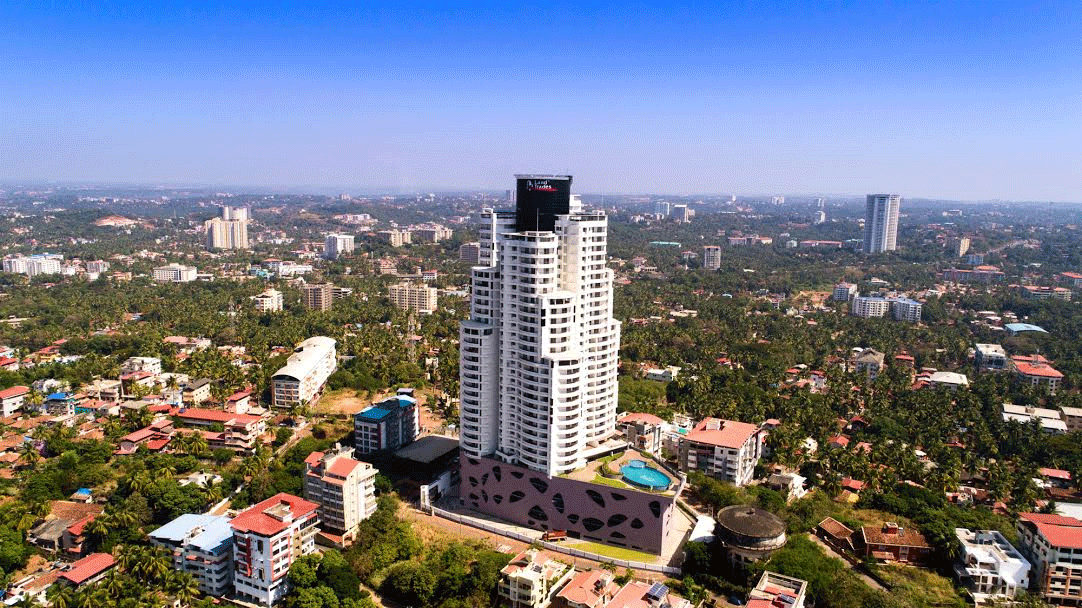
Mangaluru: Supreme Court of India upheld the building license to luxurious residential project of Land Trades Builders and Developers 'Solitaire' issued by Mangaluru City Corporation (MCC).
Aggrieved by the city corporation’s proposal for widening of one of the approach roads to Solitaire, some residents of the locality had approached the High Court with a Public Interest Litigation (PIL) challenging the Building License given by MCC for Solitaire. After listening to the arguments of all parties, the High Court had upheld the Building License given to Solitaire as legitimate and concurred with MCC’s decision to give the license.
After that, the petitioners had appealed the High Court order before the Supreme Court. Now in its order dated 19072019, Hon’ble Supreme Court too dismissed the PIL and upheld the legality of Building License given by MCC for Solitaire.
Supreme Court has also directed the MCC to issue Completion Certificate for ‘Solitaire’ expeditiously in accordance with law.
In the same order, the court has also vacated its status quo on road widening by MCC of the approach road to Solitaire.
Accepting the advice of the Hon’ble Judges to address the grievances of the petitioners, the City Corporation has undertaken before the Hon’ble Court vide written affidavit to construct a retention wall for protecting the structures of the concerned petitioners at the time of road widening in the future.
"With this, all the legal hurdles with regard to road widening have been overcome. Litigation regarding this project was pending before the courts for a long time. Now we are glad that our building license for Solitaire has been legally validated by the highest court” said Mr. K. Shrinath Hebbar, proprietor of Land Trades.
“I am grateful to our customers and associates who have reposed their complete faith in me during this period" he added.
Solitaire is situated at the elite Hat Hill locality of Mangalore, lending a commanding view of the Arabian Sea. With 32 floors it is one of the tallest residential structures of Mangalore.
Solitaire is a green-friendly project with features like solar energy, rain water harvesting, waste segregation facility and in-house sewage treatment and recycle plant.
"We further assure the public and our customers that right from the inception Land Trades have been diligently obeying all laws and statutory regulations. All our buildings including Solitaire are constructed in full compliance of the rules and regulations in force" a press release from the company added.




Let the Truth be known. If you read VB and like VB, please be a VB Supporter and Help us deliver the Truth to one and all.
UP: Blood-soaked body of elderly man found in Hathras

Hathras (UP) (PTI): The blood-soaked body of an elderly man was found inside his house in Paharpur village here on Tuesday morning, police said.
The deceased, Jagdish Prasad Sharma, 75, who lived alone, had gone to sleep in his house on Monday night, officials said.
On Tuesday morning, his blood-soaked body was lying on a cot, with marks on his head and body indicating blows from a sharp-edged weapon, they said, adding that the police suspect murder.
Police and forensic teams reached the spot upon receiving information and sent the body for a post-mortem, they said.
Additional Superintendent of Police Ramanand Kushwaha said that Sharma, a retired Health Department employee, had been living alone since his wife's death during the COVID-19 pandemic.
He owned around 20-25 bighas of land and was also engaged in money lending, the officer said.


