
Mangaluru : Vanamahothsava Day Celebrated in Hikmah International Academy School

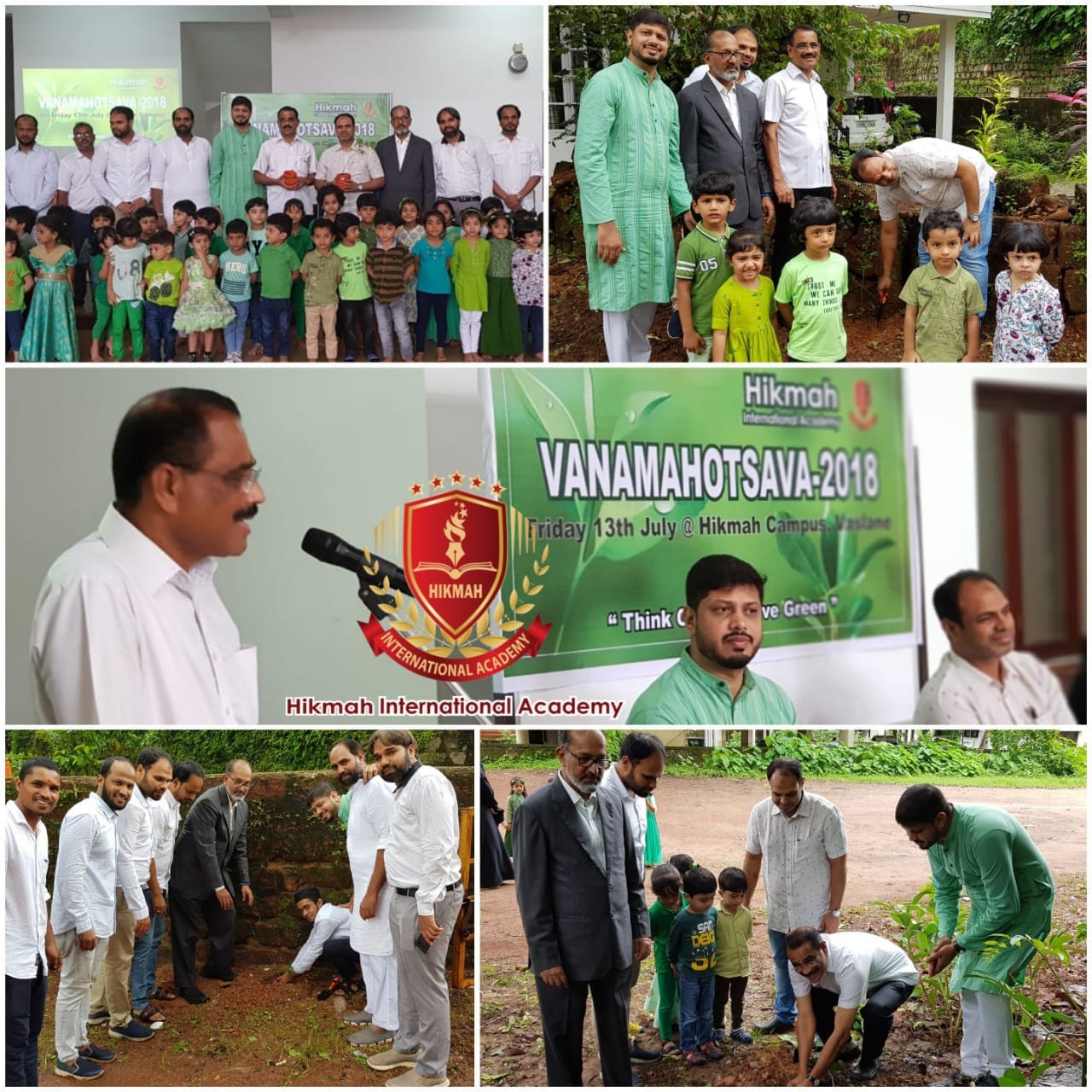
Mangaluru: Hikmah International Academy, the Montessori School in Mangaluru celebrated the annual Vanamahotsava Day recently at their school premises in Vaslane, Mangaluru.
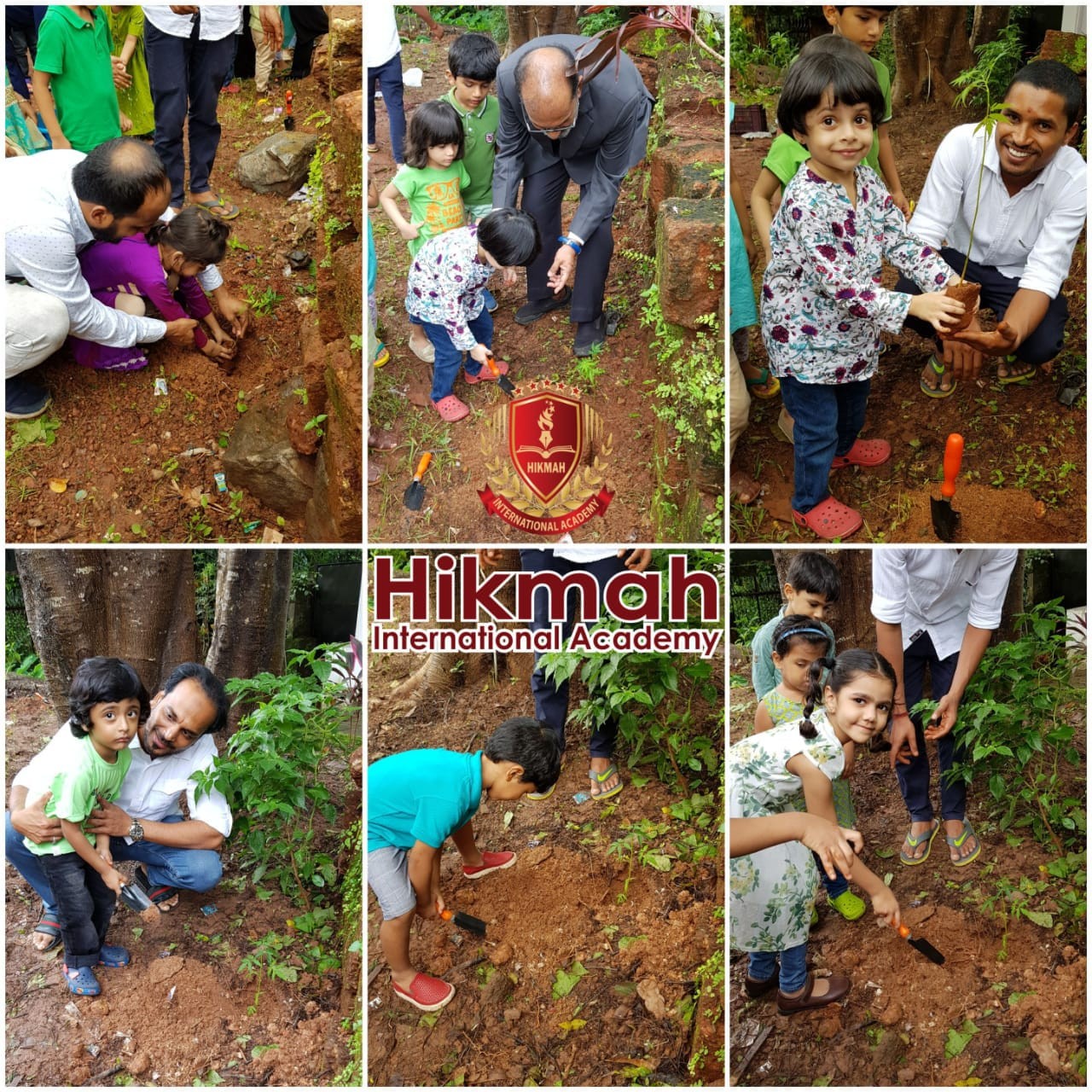
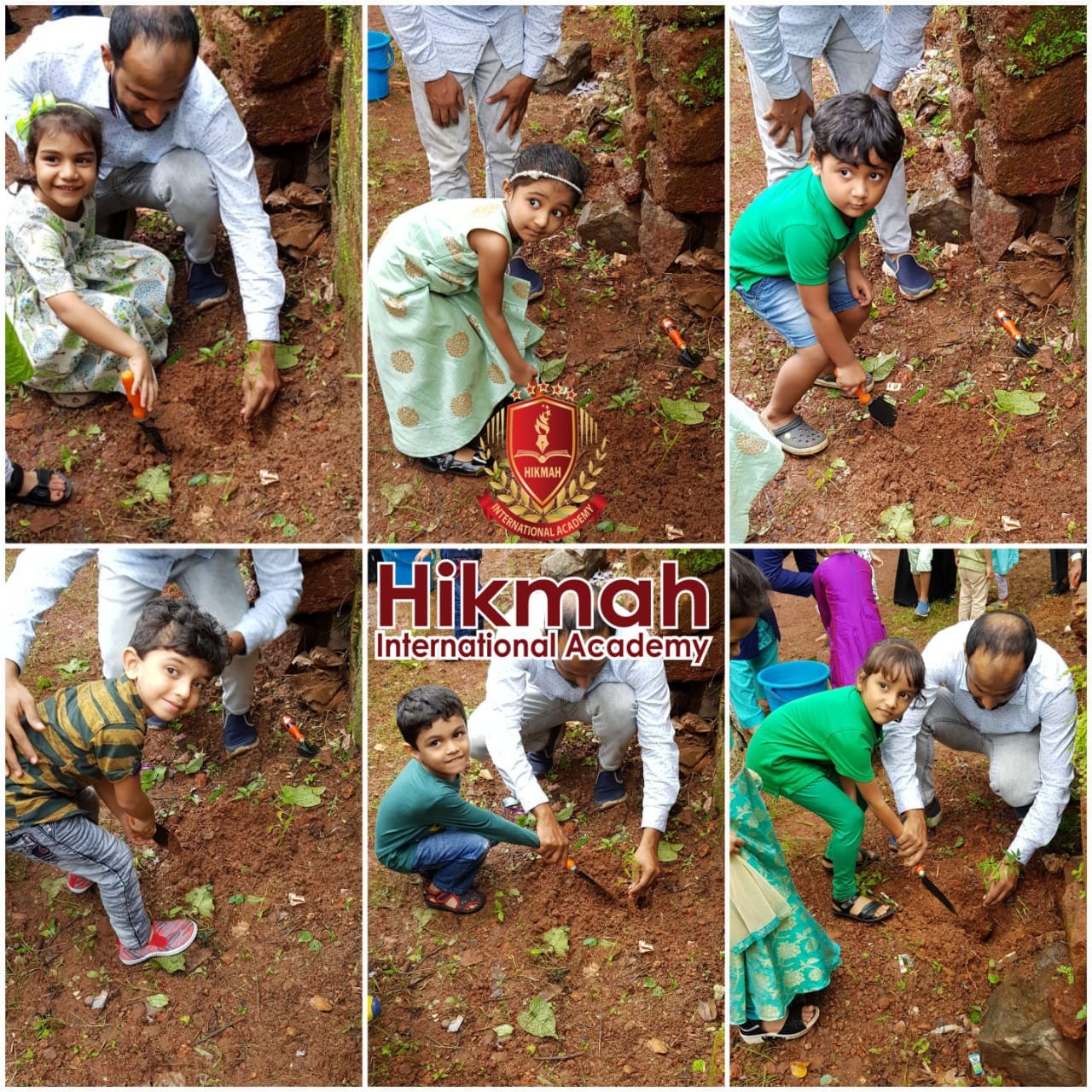
Mayor Bhaskar Moily graced the occasion as Chief Guest and Mr. A.K. Niyaz, Managing Director, A.K. Group of Industries was the Guest of Honor. The Chairman of the Hikmah Educational Trust Mr. Mohammed Nissar, the Trustees, Chief Admin Officer, Principal, teaching & non-teaching staff including over 50 kids from MONT-1, MONT-2 & MONT-3 participated in planting many neem saplings at the adjacent area near to the school premises.
The event slogan was ‘Think Green & Live green’ to motivate the kids to know how important trees and plants are for our survival and well being.
Chief Guest Mr. K. Bhaskar Moily in his inaugural address said that Forests play a vital role for our Nation’s development, loss of forests ruin the ecological balance of the Globe. It also weakens the efforts of pollution control. He stressed that the need for plantation has become even greater these days because of the growing pollution in the environment.
Chairman Mr. Mohammed Nissar, in his welcome address said that all the disadvantages of destruction of trees and forests can be balanced only with plantation of trees which maintains bio diversity, conservation of water and climate control. He said that as we take a lot of care in protecting the plants, it teaches us how we parents and teachers have to nurture our kids in their early stages with knowledge and discipline helping them to groom as respectable citizens of our great nation. He also said that we as a Team Hikmah are happy to announce that we are coming up with an Eco-Friendly Campus in 3.5 acres of land in Mangaluru fully equipped with all the facilities which are required for a Modern School. Stone laying ceremony will take place within months.
Acting Principal Mrs. Asma Syed was in the dias and the Event Coordinator Mrs. Lubaina concluded the program with the vote of thanks.
Let the Truth be known. If you read VB and like VB, please be a VB Supporter and Help us deliver the Truth to one and all.
Mission operations key to space success: ISRO chief Narayanan

Bengaluru, Apr 8 (PTI): ISRO Chairman V Narayanan on Wednesday highlighted the importance of mission operations in ensuring success, calling it key to India’s expanding space programme.
He was addressing a gathering of scientists, industry experts, and students at the three-day international conference on Spacecraft Mission Operations (SMOPS-2026), themed 'Innovative Operations for Smart and Sustainable Space Mission Management–Next Generation'.
"Mission operations are crucial, especially for long-duration ones. This is an important domain," Narayanan said.
Welcoming delegates from leading global space agencies, including Roscosmos, the Japan Aerospace Exploration Agency (JAXA), the European Space Agency (ESA), and the French space agency, Centre National d'Études Spatiales (CNES), the ISRO chief said the conference marked a significant milestone, as it brought together international expertise, startups, and the broader space ecosystem on a common platform.
"This is not just another conference—it is quite a major global gathering with participation from many countries, experts, startups, and ecosystem partners," he said.
Narayanan pointed to the successful Chandrayaan-3 mission, noting that the "historic landing" near the Moon’s south pole was the outcome of sustained teamwork and operational precision.
He credited the leadership and continuous involvement of senior scientists in mission control, saying their contribution remained indispensable during key phases.
The ISRO chief also recalled the challenges faced after the Chandrayaan-2 mission and said the subsequent success demonstrated India’s technological resilience.
"After the partial setback of Chandrayaan-2, Chandrayaan-3 had to be perfect," he said, adding that the achievement had earned global recognition.
Tracing the evolution of India’s space programme since its inception in 1962, Narayanan said the country has accomplished a wide spectrum of missions spanning launch vehicles, scientific exploration, and satellite operations.
He added that while rockets operate for a brief duration, spacecraft require continuous monitoring and control over several years.
"While a rocket functions only for about 15 to 25 minutes, it must generate tremendous energy to place the spacecraft into orbit. However, the spacecraft itself must operate for years—sometimes from two to 15 years," he said.
The ISRO chairman said even minor errors in command execution could jeopardise an entire mission, and commended engineers, software teams, and planners for their role in sustaining mission health.
Narayanan stressed the importance of emerging technologies such as artificial intelligence and cloud-based systems in transforming mission operations.
He also cited key milestones achieved since the previous conference, including space docking experiments, the Chandrayaan-3 mission, and the Aditya-L1 solar mission, noting that each required advanced operational strategies.
On human spaceflight, he described the Gaganyaan programme as a "defining step" for India’s ambitions.
He added that preparations were progressing towards the first uncrewed mission.
Speaking to reporters later, Narayanan reiterated the long-term nature of mission operations and its significance across mission lifecycles.
"A launch vehicle works only for about 20 to 25 minutes, but mission operations must continue for a long time," he added.
Narayanan explained that communication satellites require continuous monitoring for up to 15 years, while interplanetary missions demand sustained operational control over several months.
He said the SMOPS-2026 conference would focus extensively on advancements in this domain.
"Around 400-plus papers will be presented and discussed. This will be useful for the student community, startup companies, and engineers working in this field," the ISRO chief said.
Responding to queries on the Gaganyaan programme timeline, Narayanan said ISRO was proceeding in a phased manner.
"Before proceeding with the crewed mission, three uncrewed missions are planned. At present, we are working on the first uncrewed mission," he said.
Narayanan said further details would be announced at an appropriate time. On the challenges involved, he pointed to the complexities of developing human-rated systems and integrating numerous technologies.
"We have to human-rate the launch vehicle. There are also many new developments involved, such as the crew escape system, environmental control and life-support systems, and the interface between humans, machines, and software," he said.
Narayanan described the programme as a "coordinated national effort" involving multiple laboratories.
When asked about the procurement of critical systems, he said, "The process is underway."

_vb_29.jpeg)
_vb_72.jpeg)