
Mangaluru’s Shabana Faizal among India’s Top 10 Women Philanthropists on EdelGive Hurun List

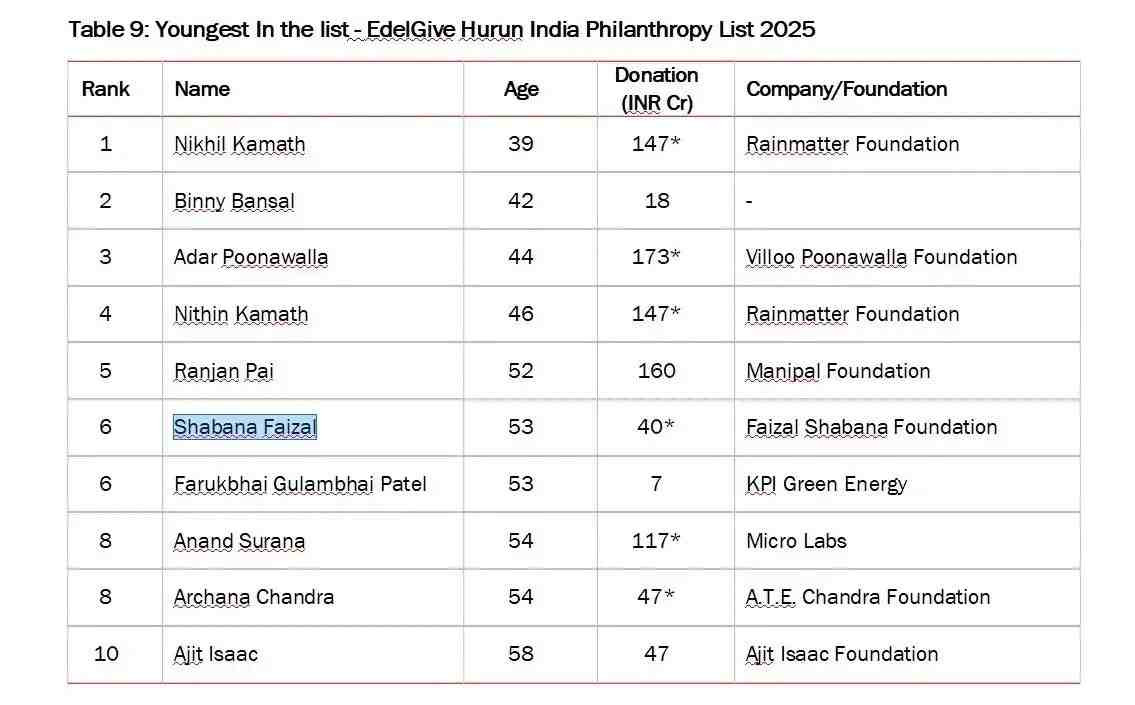
Mangaluru: Shabana Faizal, originally from Mangaluru, has been recognised among India’s top philanthropists, securing a place as the youngest woman in the top 10 of the EdelGive Hurun India Philanthropy List 2025. At 53, she has donated Rs 40 crore through the Faizal & Shabana Foundation, earning a spot among the country’s most impactful changemakers.
Her inclusion places her alongside prominent women philanthropists such as Rohini Nilekani, Kiran Mazumdar-Shaw, and Bina Shah, underscoring her growing influence in India’s social development landscape.
Born and raised in Mangaluru, Shabana is the only daughter of Late B. Ahmed Haji Mohiudeen, a respected businessman and socio-religious leader who founded the BA Group of Businesses in Thumbay, near Mangaluru. She completed her degree in psychology from St. Agnes College and later pursued a diploma in fashion design and merchandising from the National Institute of Fashion Design, Dubai.
Her early professional journey began in industries traditionally dominated by men, including work in steel mills and data entry, experiences that shaped her adaptability and resilience.
According to the Meitra Hospital website, where Shabana serves as a Director, her entrepreneurial career took off in 1995 when she began retailing specialty and luxury products. She later joined her husband, Faizal E. Kottikollon, in managing Emirates Techno Casting (ETC), a major engineering and manufacturing enterprise in the UAE. In her role, she managed human resources and administrative operations, contributing significantly to the company’s success.
Today, she is the Vice Chairperson of KEF Holdings, a Singapore-based family enterprise with investments across sectors like infrastructure, education, agriculture, metals, and finance. The group is known for leveraging off-site construction technologies and sustainability-driven innovations that have made a global impact.
In 2007, Shabana and her husband co-founded the Faizal & Shabana Foundation with the motto “Giving to Create Impact.” The foundation focuses on education, youth development, healthcare, community outreach, regenerative development, humanitarian aid, and the arts, aiming to create sustainable social change through long-term initiatives.
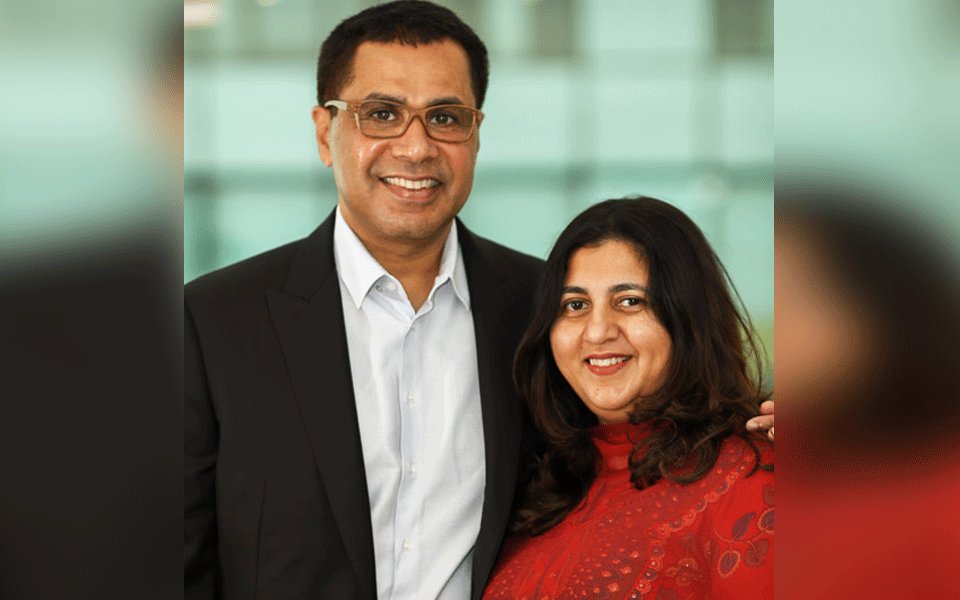
Shabana and her husband Faizal E. Kottikollon
Her philanthropic work reflects a deep commitment to giving back to society, an extension of the values she imbibed from her upbringing in Mangaluru.
The EdelGive Foundation, in collaboration with the Hurun Research Institute, released the 12th edition of the EdelGive Hurun India Philanthropy List this year. The report highlights India’s most generous individuals and families, noting that 191 philanthropists together contributed Rs 10,380 crore over the past three years — an 85% rise in donations compared to earlier years.
Education continues to receive the highest support, with Rs 4,166 crore donated by 107 contributors. The list also revealed that the top 25 philanthropists donated Rs 50,000 crore in just five years, averaging Rs 46 crore per day. Mumbai accounted for the largest share of donations at 28%, followed by New Delhi and Bengaluru.
A mother of four— Sophiya, Sarah, Zacharia, and Czarina — Shabana continues to balance family life with business leadership and social service. Her journey from a small-town upbringing to global entrepreneurship and impactful philanthropy showcases how determination, empathy, and a sense of purpose can redefine success.
Shabana Faizal’s recognition on the EdelGive Hurun India Philanthropy List 2025 stands as a proud moment for Mangaluru and Karnataka, celebrating a woman whose vision continues to inspire both corporate and social transformation.
Let the Truth be known. If you read VB and like VB, please be a VB Supporter and Help us deliver the Truth to one and all.
NEET-UG re-exam to be held on June 21

New Delhi (PTI): Medical entrance exam NEET-UG, which was cancelled following allegations of irregularities in the examination process, will be re-conducted on June 21, the National Testing Agency (NTA) announced on Friday.
The exam was earlier conducted on May 3.
The NTA had on Tuesday announced the cancellation of NEET-UG and said the Central Bureau of Investigation (CBI) would carry out a comprehensive inquiry into the alleged irregularities linked to the exam.
"The National Testing Agency, with the approval of the Government of India, has scheduled the re-examination of NEET (UG) 2026 on Sunday, 21 June 2026," a senior official said.
The announcement came after a high-level meeting was held late on Thursday evening at the residence of Union Education Minister Dharmendra Pradhan to review preparations for conducting the exam afresh.


